On a Sea of Dreams, Language is the Vessel
By Han Briner
On a Sea of Dreams, Language is the Vessel
By Han Briner
What relationships exist between language and visual art? As a graduate student specializing in poetry, as well as an apprentice at Saint Mary’s College Museum of Art, I have spent the past year considering this question. When I first viewed work by the artist Cianne Fragione (b. 1952), I gained insight into the possibilities. In her recent exhibition, Isole: A Voyage Among My Dreams, language is both a central theme and a driving force. Featuring a combination of paintings, drawings, and assemblages that explore memories of the sea, this exhibition invites language to transform and transcend its visual elements.
Fragione’s Creative Process
When I was first introduced to Fragione’s work, I was excited to learn that she often reads and responds to poetry during her creative process. Many of the pieces featured in Isole were inspired by Eugenio Montale, the Italian poet, prose writer, editor, and translator who received the 1975 Nobel Prize in Literature. Fragione has described marking pages in her copy of his collection Ossi di seppia (“Cuttlefish Bones”), circling some words and crossing out others. Then, using these words as a launching point, she turns to the realm of visual art.
In many instances, Fragione’s titles highlight her connection to Montale. For example, she named Ancient One Fed by the Sea after an untitled poem in Ossi di seppia, which begins: “Ancient one, I am drunk with the voice / that comes out of your mouths / when they open like green bells, / then implode and dissolve.” This implies that the art itself — a mass of roiling abstract shapes — was influenced by the poem’s mysterious language. Ossi di Seppia and Lace, one of my favorites among this exhibition, offers further evidence of Fragione’s connection to Montale. Named for Ossi di seppia directly, this work’s visual elements echo the collection’s nautical themes. In both its net-like appearance and its details, including pearls and plastic gemstones, this assemblage evokes human interactions with the sea.
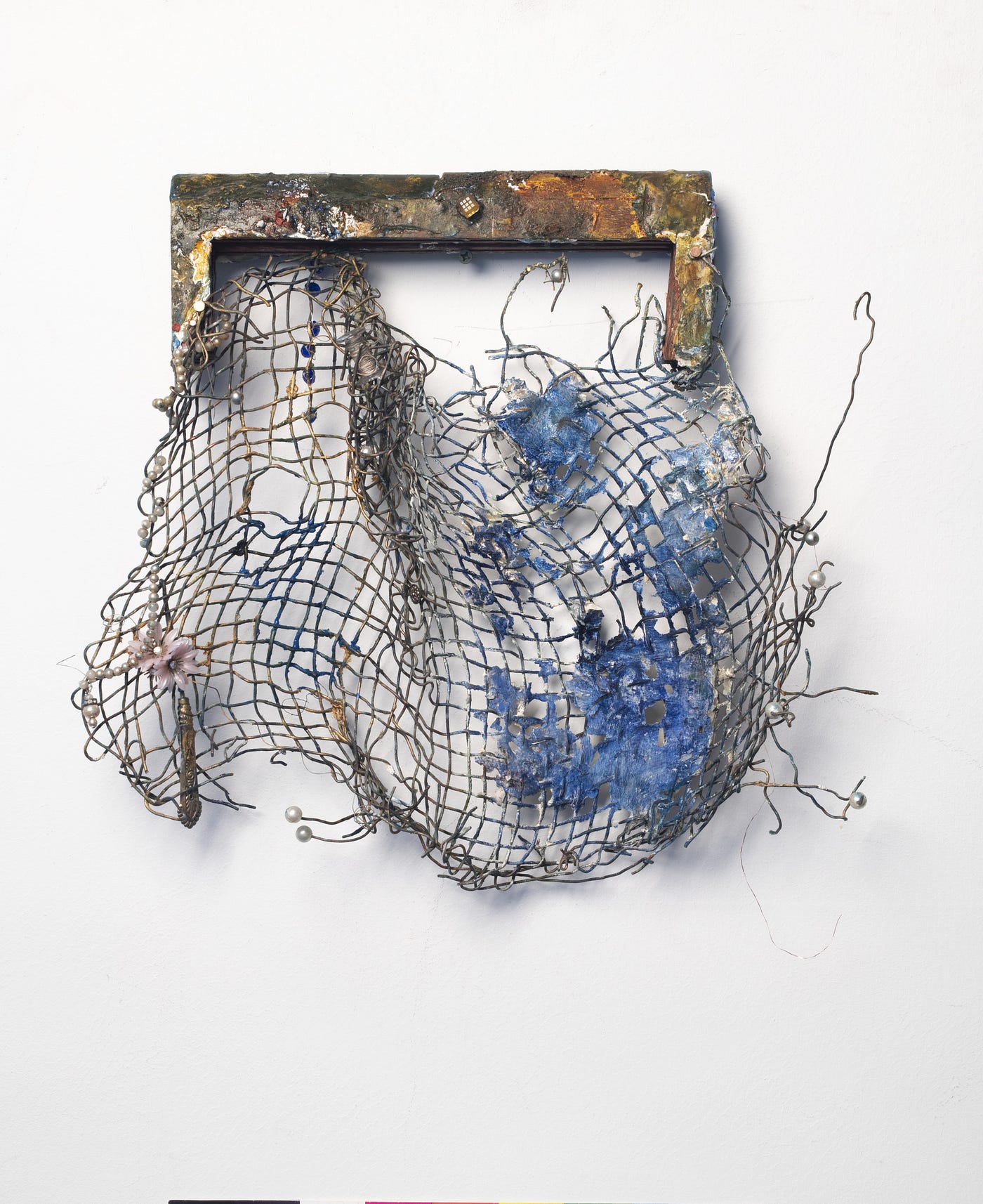
Fragione, Cianne. Ossi di Seppia and Lace. 2015 / 2023, oil-based paint, plastic jewelry gemstones, metal, pearls, textile, thread, and wood, 16 x 18 x 2 inches. courtesy of the artist.
As a whole, Isole seems to welcome face-value reactions. At the same time, Fragione’s process, which is reflected in her titles and themes, speaks to the role of Montale’s poetry in her work. In a statement, Fragione said, “I share some of Montale’s linguistic spirit, as my work draws upon similar motifs that refer to memories, traditions, and histories.” By imbuing her work with this spirit, Fragione adds a textual layer to Isole, inviting the exhibition’s meaning to extend beyond initial interpretations.
Fragione’s Materials
In addition to drawing inspiration from language, Fragione incorporates it as a physical component in her work. Every time I wander through Isole, I enjoy studying the words she has rendered in paint or graphite, the journal pages she has affixed to her assemblages, and the other textual materials that she has repurposed for her art. In one example, Small Works VIII: Sacred Cheese, words intermingle with spots of color on paper. Some of these words, such as “sheep,” “grass,” and “fennel,” are legible. However, many are too faint to read, leaving the viewer to guess what they might say.
In another example, Something I Wrote, I noticed a similar effect. Here, beneath a cloud of color, Fragione wrote a curving sequence of letters. Although this sequence may include full words and phrases, only a few stray letters — an “A” here, a “D” there — are bold enough to comprehend. Beneath this sequence, near the bottom right corner, Fragione attached a torn piece of paper. On this paper, words and phrases such as “waist high grass,” “field of,” and “fennel” bring idyllic themes to the forefront. However, once again, portions of the text are unreadable, obscured by spots of black, white, and red paint.
In many of Fragione’s assemblages, she continues this pattern — concealing and revealing language. Pane, for instance, features a thick bundle of journal pages. Since these pages are glued together, only the top page is viewable; any text on the remaining pages is permanently hidden from view. In another assemblage, one of the three works that make up the triptych Ritorno: Antico, sono ubriacato dalle voce, a wide range of text-based materials, such as food labels, letters, and stamps, entice the viewer to investigate what they say. However, once again, portions of these texts are obscured — in this case, with paint, beads, fabric, and other found objects.
Through this interplay of concealed and revealed text, Fragione uses language to create meaning in her work. Like other prominent motifs in Isole, such as the sea, time, and memory, language becomes a symbol of duality. Just as language is concealed and revealed, the sea ebbs and flows, time moves from the past to the present, and memories are forgotten and made anew. What can be experienced right now, in the moment? What is unavailable, buried by centuries and debris? Intertwined with other motifs in her work, Fragione’s textual materials seem to ask these questions, evoking deeper meanings that transcend shape, color, and form.

Fragione, Cianne. Something I Wrote. 2022–2023, oil-based paint, walnut ink, textile, collage, graphite, and oil paint sticks on paper, 32 x 40 inches. courtesy of the artist.
Inheritance & Interpretation
Fragione comes from a line of artists, including Jay Defeo, Frank Lobdell, and Manuel Neri, whose work shares an interest in the human condition, the ordinary, and the experience of making and viewing art. Through her text-based process and materials, Fragione highlights this artistic inheritance. For example, Eugenio Montale’s poetry explores the human condition after the first World War, focusing on misery, grief, and desolation. Looking at Fragione’s art, I often see these themes embodied. In Small Works: Mediterraneo, named for a section of Ossi di seppia (i.e., Mediterraneo), torn edges evoke a subtle violence through their rough, jagged appearance. Bundles: Ossa, an assemblage that incorporates bones, evokes death and loss. Meanwhile, works such as Baroque, which include vast swathes of dark color, create an ominous mood. Through her connection to Montale, Fragione’s examination of the human condition sharpens. By coming to know Montale’s life and work, the viewer may see these darker facets of Isole more clearly — through the lens of his “cramped, dark, oppressive” seascapes.
Fragione explores other topics, including ordinary life, through her materials. By repurposing everyday objects, such as the aforementioned food labels, letters, stamps, and journal pages, she brings them new purpose and meaning. On their own, the materials in the triptych Ritorno, for instance, are merely discarded objects. However, when placed together, these objects — both textual and non-textual — create symbols. For example, when I see a shoe buckle near food labels, I think of hard work — the struggle to feed oneself and one’s family; when I see beads and purses near letters and stamps, I think of extravagance, travel, and adventure; and when I see a baby’s ballet slippers near ripped journal pages, I think of the aging process, of a life partly remembered, partly forgotten.
Although these symbols can be created without textual materials and linguistic references, Fragione’s broader body of language within Isole heightens their meaning. Comparing Ritorno to Pane, for instance, which features words such as “Tuesday,” “July,” and “rapidly,” I begin to see Isole as a container for life and death — as a reflection of time and its impacts. When I compare both of these works to the pastoral language in Small Works VIII: Sacred Cheese, these ideas are complicated. I imagine myself among grassy fields and herds of sheep. As my perception of time slows down, and as the present moment feels closer, Isole becomes an embodiment of fluid experience. Time is both lasting and fleeting; life is both tragedy and joy. The human condition — ordinary life — is twisting, turning, and shifting.
Fragione’s interests as an artist, including her process and creations, are suffused with language. By reading and responding to poetry, connecting to literature through her titles and themes, writing words on paper or canvas, and incorporating textual materials, she demonstrates the importance of language to the experience of making and viewing her art. Although Isole centers around memories, traditions, and histories as they relate to Italy and the sea, there are seemingly endless ways that the exhibition might be received by her audience. With words, these possibilities are vast. Language, a vessel that carries our imaginations beyond the physical world, gives Fragione’s work a new dimension. As we navigate Isole, a sea of dreams, we voyage to this otherworldly space.
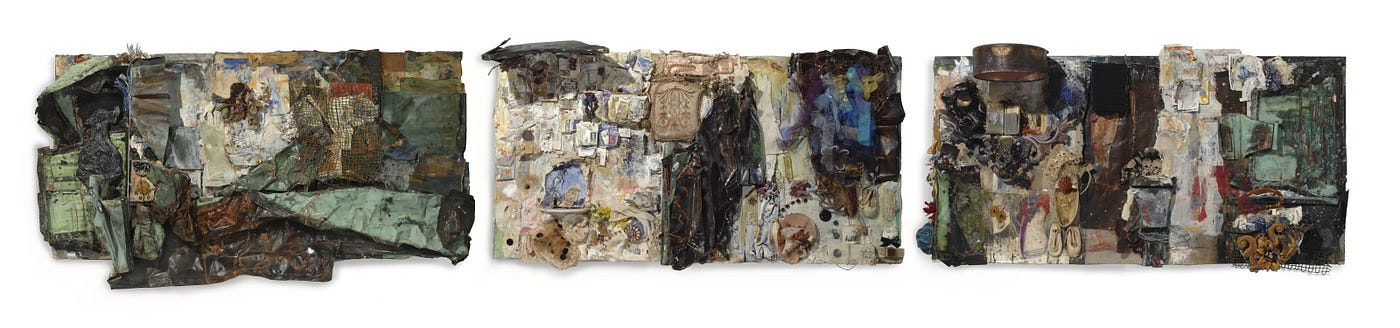
Fragione, Cianne. Ritorno: Antico, sono ubriacato dalle voce. 2007–2022, oil-based paint, wood, collage, mixed media, text, artist drawing, bundles, and assemblage on paper and copper on panel, 32 x 183 inches (triptych). courtesy of the artist.
About the author
Han Briner is a poet in the MFA in Creative Writing program at Saint Mary’s College of California. They hold an apprenticeship position at Saint Mary’s College Museum of Art, where they create content and assist with museum programming. They earned their BA in Creative Writing from the University of Colorado Boulder. Originally from Colorado, they now reside in the San Francisco Bay Area.
메타데이터
- post_id
- da74bd9bd1a2
- slug
- on-a-sea-of-dreams-language-is-the-vessel-da74bd9bd1a2
- url
- https://medium.com/@SMCMoA/on-a-sea-of-dreams-language-is-the-vessel-da74bd9bd1a2
- canonical_url
- https://medium.com/@SMCMoA/on-a-sea-of-dreams-language-is-the-vessel-da74bd9bd1a2
- author_url
- https://medium.com/@SMCMoA
- status
- ok
- fetched_at
- 2026-07-20 01:09:42