The SANS Vulnerability Management Maturity Model
A Practical Guide to Building a Stronger VM Program
The SANS Vulnerability Management Maturity Model
A Practical Guide to Building a Stronger VM Program
Vulnerability management has evolved beyond scanning and patching. A mature VM program blends technology, process, context, and communication to reduce risk in a structured way.
The SANS Vulnerability Management Maturity Model provides a clear roadmap across five maturity levels and five core domains: Prepare, Identify, Analyze, Communicate, and Treat.
This article summarizes the model in a clear, actionable format.
1. PREPARE — Building the Foundation
Policies & Standards
A VM program cannot scale without a solid governance layer. At the lowest maturity level, policies are missing or constantly shifting. As organizations mature, policies become aligned with recognized frameworks, enforced consistently, and eventually automated through technical controls.
Progression:
- Level 1: No formal policies.
- Level 2: Policies created reactively after incidents.
- Level 3: Policies aligned with best practices; training available.
- Level 4: Compliance tracked; deviations highlighted.
- Level 5: Enforcement largely automated; policies continuously reviewed and updated.
Context & Asset Information
Context is the backbone of prioritization. Without accurate asset information (ownership, criticality, exposure), vulnerability findings cannot be translated into risk. Maturity increases as asset data becomes consistent, monitored, and correlated across systems.
Progression:
- Level 1: Fragmented, inconsistent asset data.
- Level 2: Early centralization efforts; partial coverage.
- Level 3: Required contextual fields defined and collected for assets.
- Level 4: Compliance with asset data requirements monitored and reported.
- Level 5: Asset lifecycle management automated; context correlated with other systems.
2. IDENTIFY — Finding Vulnerabilities Effectively
Automated Scanning
Scanning evolves from ad-hoc efforts to standardized, measurable, and integrated practices. At high maturity, scanning becomes continuous and embedded where it delivers the most value (infrastructure and delivery pipelines).
Progression:
- Level 1: Ad-hoc scans with inconsistent coverage.
- Level 2: Defined schedules for some teams or scopes.
- Level 3: Organization-wide scanning standards and baseline coverage.
- Level 4: Coverage and scan quality measured and improved over time.
- Level 5: Scanning integrated into build/release workflows and automated processes.
Manual Testing
Manual testing evolves from occasional checks to a structured capability (based on threat intelligence and historical data) that targets what automation misses. As maturity increases, manual testing becomes more planned, repeatable, and guided by risk signals.
Progression:
- Level 1: Rare or informal manual testing.
- Level 2: Manual testing performed occasionally for critical systems.
- Level 3: Defined approach and scope; repeatable execution.
- Level 4: Testing targeted based on risk and program insights.
- Level 5: Testing continuously refined using intelligence, trends, and feedback loops.
External Vulnerability Intake (VDP/Bug Bounty)
Organizations mature from handling external reports case‑by‑case to running structured, measurable, and strategic external testing programs. At high maturity, external intake becomes a strategic channel integrated into VM operations.
Progression:
- Level 1: External reports handled informally when they occur.
- Level 2: Basic process exists; inconsistent response and tracking.
- Level 3: Structured intake and triage; defined ownership and workflow.
- Level 4: Program performance measured and improved.
- Level 5: External testing aligned to strategy; integrated with internal VM and reporting.
3. ANALYZE — Making Sense of the Data
Prioritization
Prioritization evolves from “severity sorting” to risk-driven decision-making. As maturity increases, organizations incorporate exploitability signals, asset context, and intelligence to focus remediation on what matters most.
Progression:
- Level 1: CVSS only.
- Level 2: Adds exploitability indicators and active threat signals.
- Level 3: Incorporates asset criticality and business context.
- Level 4: Leverages generic threat intelligence to refine focus.
- Level 5: Uses organization-specific intelligence and contextual insights.
Root Cause Analysis
Root cause analysis becomes more sophisticated as organizations mature, moving from basic CVE/CWE categories to deep analysis by department, owner, and systemic patterns. Then use this to reduce future vulnerability creation, not just fix today’s findings.
Progression:
- Level 1: Little to no root cause analysis.
- Level 2: Basic categorization by vulnerability type.
- Level 3: Analysis by owner/team/system; recurring issues identified.
- Level 4: Trend analysis used to guide prevention and governance actions.
- Level 5: Executive-level visibility into systemic drivers and long-term risk reduction.
4. COMMUNICATE — Turning Data Into Action
Metrics & Reporting
Reporting evolves from static outputs to standardized, contextualized, and automated insights. At high maturity, reporting becomes self-service and supports different audiences without manual effort.
Progression:
- Level 1: Basic, unfiltered reports.
- Level 2: Filtered reports by team/department.
- Level 3: Standardized reporting across the organization.
- Level 4: Correlation with other data sources (asset, config, intelligence).
- Level 5: Automated trend detection and customizable dashboards.
Alerting
Alerting evolves from nonexistent or noisy to targeted and automated. Mature programs ensure alerts drive action and are tied to workflows rather than generating unmanaged “security noise.”
Progression:
- Level 1: No formal alerting.
- Level 2: Basic alerts exist but are inconsistent or noisy.
- Level 3: Alerts standardized and routed to defined owners.
- Level 4: Alert effectiveness tracked and tuned.
- Level 5: Automated responses for common cases; continuous optimization.
5. TREAT — Remediating Vulnerabilities Effectively
Change Management
Change management evolves from generic processes to VM-aware workflows with measurable outcomes. As maturity increases, VM changes become better coordinated, tracked, and optimized for speed and reliability.
Progression:
- Level 1: No structured change management for VM work.
- Level 2: Changes handled inconsistently; tracking is weak.
- Level 3: Defined workflow for VM-related changes and ownership.
- Level 4: Performance measured; bottlenecks actively reduced.
- Level 5: Partial automation and continuous improvement based on feedback.
Patch Management
Patch management matures from manual “best effort” to SLA-driven execution aligned with threat intelligence. Mature programs reduce delays, verify fixes, and prioritize patches based on real threat and business context.
Progression:
- Level 1: Manual patching with limited visibility.
- Level 2: Patch process exists but execution is inconsistent.
- Level 3: Patch SLAs defined and tracked.
- Level 4: Prioritization refined using context and intelligence.
- Level 5: Optimized workflows, automation, and verification at scale.
Configuration Management
Configuration management evolves from undefined practices to measured baselines and dynamic adjustments. At high maturity, configuration changes are driven by risk and controlled through consistent standards and monitoring.
Progression:
- Level 1: No defined configuration standards.
- Level 2: Baseline standards exist but adoption varies.
- Level 3: Baselines implemented with clear ownership.
- Level 4: Compliance monitored and deviations managed.
- Level 5: Configuration continuously optimized based on risk and program insights.
Summary: A Clear Path Toward Maturity
The SANS model outlines a predictable progression across five domains.
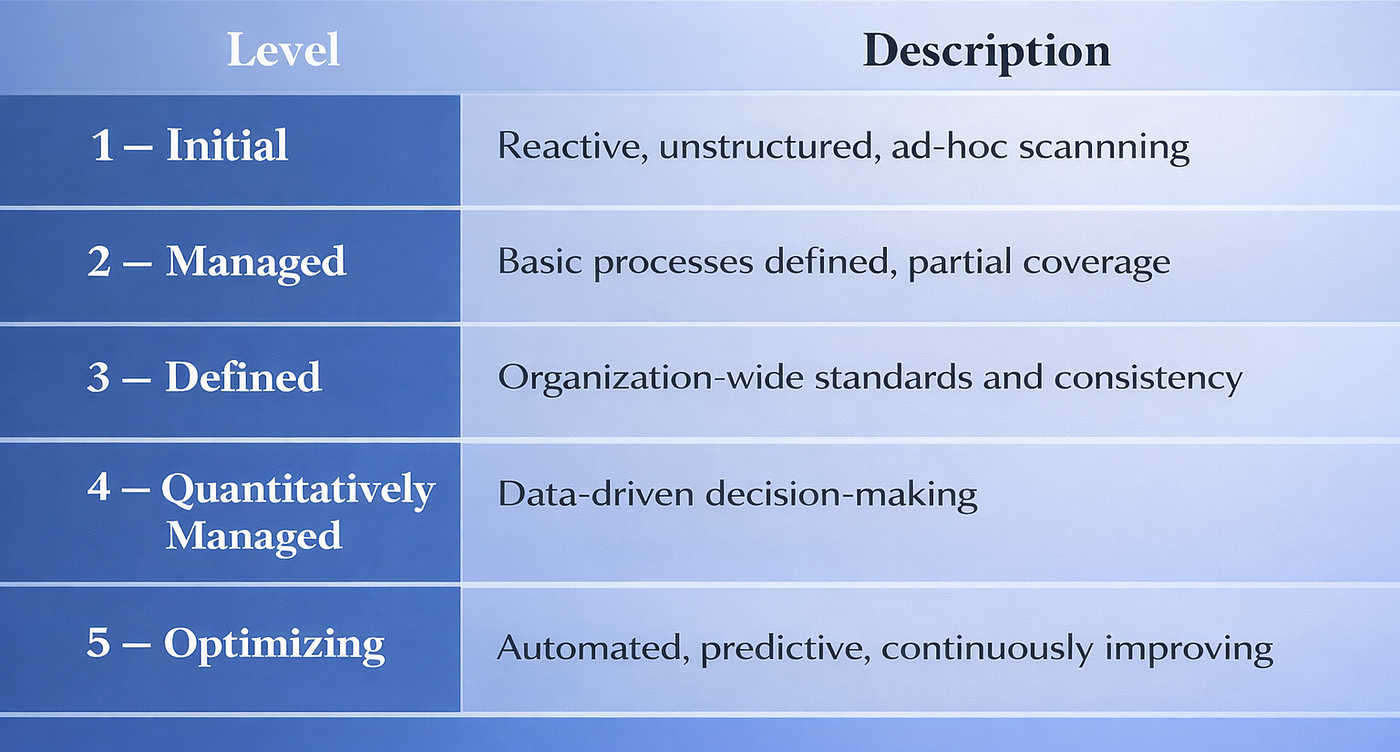
The goal is not only to fix vulnerabilities, but to build a resilient, intelligent, and automated system that reduces risk proactively through governance, context, consistent operations, and automation.
Final Thoughts
The SANS Vulnerability Management Maturity Model is more than a framework. It is a roadmap for transforming vulnerability management from a technical chore into a strategic capability.
By understanding where you stand and what lies ahead, your organization can prioritize investments, streamline operations, and strengthen its overall security posture.
References SANS Institute: Vulnerability Management Maturity Model (original framework)
메타데이터
- post_id
- da7d73df34cd
- slug
- the-sans-vulnerability-management-maturity-model-da7d73df34cd
- url
- https://medium.com/@Khalil.Z/the-sans-vulnerability-management-maturity-model-da7d73df34cd
- canonical_url
- https://medium.com/@Khalil.Z/the-sans-vulnerability-management-maturity-model-da7d73df34cd
- author_url
- https://medium.com/@Khalil.Z
- status
- ok
- fetched_at
- 2026-06-16 19:09:56