Construction Lien Rights: A Contractor’s Guide to Getting Paid
Mechanic’s liens are the most powerful payment protection tool available to construction contractors — and the most consistently underused…
Construction Lien Rights: A Contractor’s Guide to Getting Paid

Mechanic’s liens are the most powerful payment protection tool available to construction contractors — and the most consistently underused. A lien filed on a property encumbers the title, prevents sale or refinancing until resolved, and gives the contractor the right to force a foreclosure sale if the debt isn’t paid. An owner who ignored a payment demand for months will respond to a lien filing within days. The property is their collateral, and a lien makes that collateral unmarketable.
Yet most contractors don’t file liens when they should. The deadlines passed before they realized there was a problem. The preliminary notice wasn’t sent. The required pre-lien documentation wasn’t maintained. By the time the payment dispute is serious enough to consider a lien, the legal window has closed.
Lien rights are use-it-or-lose-it. The deadlines are statutory — missing them doesn’t just weaken the claim, it eliminates it entirely. This guide covers who has lien rights, what deadlines apply, what documentation supports a lien claim, and how construction time tracking records provide the evidentiary foundation for proving labor was performed on specific dates at a specific property.
What a Mechanic’s Lien Is
A mechanic’s lien (also called a construction lien, materialman’s lien, or contractor’s lien depending on state) is a security interest in real property granted to parties who contribute labor, materials, or services to the improvement of that property but aren’t paid.
The core principle: The property itself benefits from the improvement. If the contractor who created that improvement isn’t paid, equity requires they have a claim against the property — not just against the owner personally.
A filed lien:
Lien rights exist in all 50 states. State laws vary significantly on who can lien, deadlines, notice requirements, and enforcement procedures.
Who Has Lien Rights
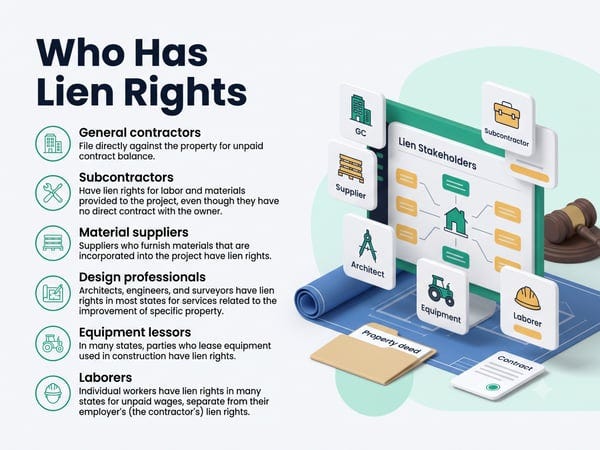
General contractors: File directly against the property for unpaid contract balance.
Subcontractors: Have lien rights for labor and materials provided to the project, even though they have no direct contract with the owner.
Material suppliers: Suppliers who furnish materials that are incorporated into the project have lien rights. Suppliers to suppliers (third-tier) have lien rights in some states, not others.
Design professionals: Architects, engineers, and surveyors have lien rights in most states for services related to the improvement of specific property.
Equipment lessors: In many states, parties who lease equipment used in construction have lien rights.
Laborers: Individual workers have lien rights in many states for unpaid wages, separate from their employer’s (the contractor’s) lien rights.
Who typically does NOT have lien rights:
- Suppliers who deliver to a supplier (not directly to the project)
- Parties who furnish labor or materials for the owner’s personal property (not real property improvement)
- Parties whose contract is for services not related to a specific improvement
The Three Critical Deadlines
Every state’s lien law has multiple deadlines that must be met sequentially. Missing any one of them may eliminate the lien right entirely.
Deadline 1: Preliminary Notice
Most states require that sub-tiers (subcontractors and suppliers who have no direct contract with the owner) serve a preliminary notice on the owner — and sometimes the GC and lender — early in the project. This notice alerts the owner that the party exists, is furnishing labor or materials, and may have lien rights.
Why it matters: Without a timely preliminary notice, the sub or supplier may lose lien rights entirely — even if they performed work and weren’t paid. The preliminary notice is not a lien; it’s a prerequisite to filing one.
GCs typically do not need to serve preliminary notices — they have a direct contract with the owner. Sub-tiers almost always do.
Best practice: Serve preliminary notice on every project as a matter of course — regardless of whether payment problems are anticipated. The cost is minimal; losing lien rights is expensive.
Deadline 2: Filing the Lien
After completion of work (or last furnishing of labor/materials), there is a statutory deadline to file the lien. Missing this deadline means no lien, period.
“Last furnishing” vs. “substantial completion” vs. “project completion”: The trigger date varies by state and claimant type. Some states measure from the claimant’s last day of work; some from project completion; some from recording of notice of completion. Know your state’s specific trigger.
Deadline 3: Enforcing the Lien (Foreclosure)
A filed lien doesn’t last forever. After filing, the claimant has a deadline to file a lawsuit to enforce (foreclose) the lien — typically 1–2 years from filing, depending on state. A lien that isn’t enforced within this window expires and releases automatically.
How to File a Lien
Step 1: Verify Preliminary Notice Was Served (if required)
If your state requires preliminary notice for your tier, confirm it was served timely. No preliminary notice = potentially no lien right.
Step 2: Calculate the Correct Amount
The lien amount is limited to the unpaid balance for labor and materials actually furnished to the project. Include:
- Unpaid contract balance
- Approved change orders unpaid
- Reasonable interest if contract or statute provides
Do not include: disputed amounts you haven’t established entitlement to, overhead not tied to the project, or speculative damages. Overstating the lien amount can expose the claimant to penalties in some states.
Step 3: Prepare the Lien Document
Each state has specific form requirements for the lien document. Required elements typically include:
- Claimant’s name and address
- Owner’s name and address
- Property description (legal description from title records)
- General contractor’s name (if claimant is a sub-tier)
- Description of labor/materials furnished
- First and last date of furnishing
- Amount claimed
- Statement of claim
Use a licensed attorney or a lien service for complex projects. A defective lien form may be unenforceable. The cost of legal review is minimal compared to losing the lien right.
Step 4: Record with the County Recorder
File the lien document with the county recorder’s office in the county where the property is located. Pay the recording fee. Obtain a time-stamped copy — this is your proof of filing and your priority date.
Step 5: Serve the Lien on the Owner (if required)
Many states require that a copy of the filed lien be served on the property owner within a specified number of days of recording. Failure to serve may void the lien.
How Time Tracking Records Support Lien Claims
A lien claim requires proving that labor was actually performed on the subject property during the claimed period. This is where construction employee time tracking becomes legal evidence.
A lien claimant who can produce:
…has documentary evidence that supports every element of the labor claim. An owner who disputes whether labor was performed, when it was performed, or how much labor was performed faces a digital record they can’t easily challenge.
Contrast this with a contractor who kept paper timesheets:
**Construction time tracking for workers with GPS verification creates a lien-ready labor record automatically.** Every project, every day, without additional documentation effort.
For material suppliers: Delivery receipts with GPS-confirmed delivery location serve the same evidentiary function for material lien claims.
The practical scenario: A GC finishes rough framing on a residential project and the developer goes silent on a $85,000 payment. The GC files a lien. The developer disputes, claiming workers were only on site for half the claimed period. The GC produces construction timesheet app records showing 14 workers clocked in on the property from March 3 through April 18, with GPS stamps confirming location at the project address each day, and cost code records showing framing scope. The developer’s dispute collapses.
This is where GPS-verified time records become critical.
Using **GPS Timesheets for Contractors** creates timestamped, location-stamped records showing:
This documentation eliminates disputes about site presence.
For a broader breakdown of how documentation supports cost control and claims protection, see the **Construction Project Management Guide**.
Lien Waivers and Lien Releases
Lien Waiver as Payment Condition
Owners and GCs regularly condition payment on the receipt of lien waivers — contractual exchanges of lien rights for payment. See the subcontractor invoice management process for the conditional/unconditional waiver cycle.
Never sign an unconditional lien waiver before payment clears. An unconditional waiver releases lien rights whether or not payment is actually received. If the check bounces after you’ve signed an unconditional waiver, you’ve lost your lien rights.
Conditional waivers are safe to sign before payment. They only take effect upon actual receipt of the specified payment amount.
Joint Check Agreements
On some projects, the owner or GC pays sub-tiers via joint check — a check made out to both the GC and the sub, or both the sub and their material supplier. The joint check ensures the lower tier actually receives the funds — preventing the GC from receiving payment for the sub’s work and then not passing it down.
When a joint check is required, the receiving party signs the check before their lien waiver is released.
Lien on Bonded Projects
On projects where a payment bond has been furnished — federal projects (Miller Act), state public projects, and some private projects — the bond substitutes for the lien right. Claimants file claims against the payment bond rather than filing liens on the property (public property generally can’t be liened).
Miller Act (federal projects):
- Projects over $150,000 require a payment bond
- Subcontractors and suppliers must give written notice to the GC within 90 days of last furnishing — before claiming on the bond
- Bond claims must be filed within 1 year of last furnishing
State bond requirements vary. Know whether the project has a payment bond before investing in lien preparation — a bond claim has different deadlines and procedures than a property lien.
See Construction Bonds Guide for bond claim procedures in detail.
Owner Defenses to Lien Claims
Owners defending against valid lien claims typically argue:
Work was defective: Owner claims the work was deficient and the lien amount exceeds the value of what was actually delivered. Counter with daily report documentation, inspection approvals, and test results. See Construction Defect Claims.
Payment was already made: Owner claims to have paid. Counter with payment records showing the gap between amounts paid and amounts owed.
No contract with owner: Sub-tiers don’t have direct contracts with owners. Most state lien laws protect sub-tiers anyway — this defense rarely succeeds where preliminary notice was properly served.
Preliminary notice was defective: Owner claims notice wasn’t timely or properly served. This defense succeeds more often than it should — keep proof of preliminary notice service (certified mail receipt, delivery confirmation).
Lien was filed late: Deadline arguments. Know your deadlines and document when work was last performed. Construction time tracking apps with GPS and timestamp records establish the last date of furnishing exactly.
This level of documentation is exactly what modern **construction photo documentation software** is designed to centralize — tying photos, timestamps, and project records together.
Lien Waivers: Don’t Release Rights Too Early
Payment is often conditioned on lien waivers.
Never sign an unconditional waiver before funds clear.
To understand how retainage and waiver cycles interact with lien rights, review **Construction Retainage**.
Poor waiver management directly affects liquidity. Learn more in **Construction Cash Flow Management**.
Common Lien Mistakes
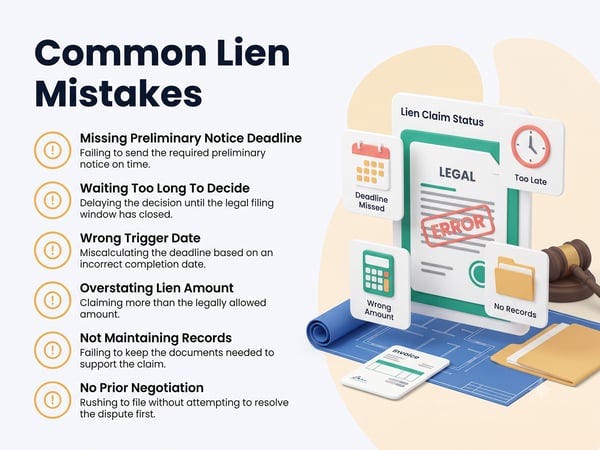
Missing the preliminary notice deadline. The most common lien failure. Serve preliminary notice on every project within the required window — before the deadline, not when trouble starts.
Waiting too long to decide to file. By the time a contractor concludes payment isn’t coming, the lien deadline may have passed. Track lien deadlines from project start, not from payment dispute start.
Using the wrong trigger date to calculate the filing deadline. “Last furnishing” means different things in different states — last day of labor, last material delivery, last date of completion of subcontract scope. Know your state’s specific trigger and use the correct date.
Overstating the lien amount. Including disputed amounts, unrelated costs, or speculative damages. Some states allow the owner to recover attorney fees if the claimant filed a lien for more than actually owed.
Not maintaining records that support the claim. A lien without evidentiary backup is just a piece of paper that can be challenged. GPS-verified construction employee time tracking app records, material delivery receipts, and daily reports are the evidence.
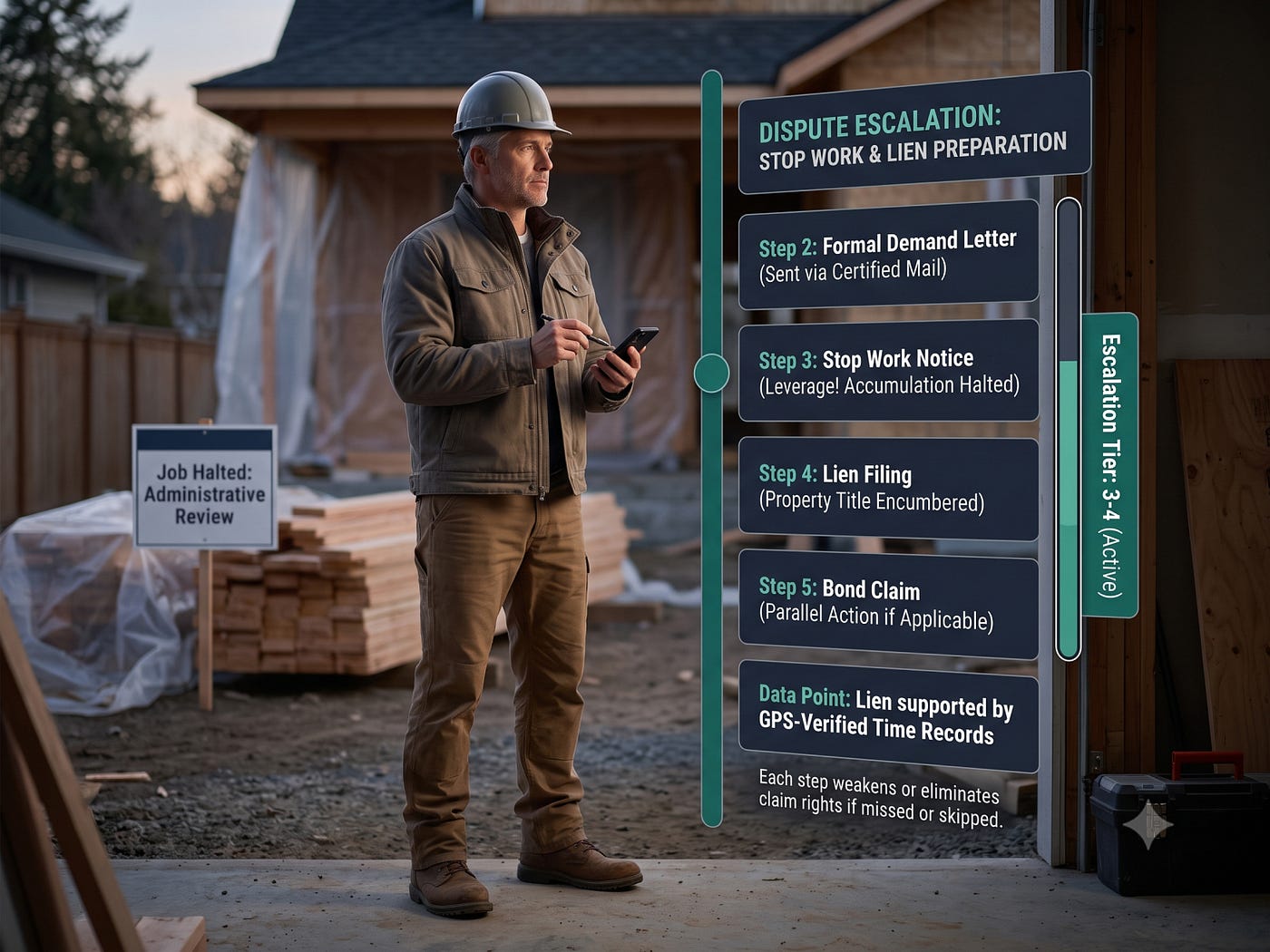
Not negotiating payment before filing. A lien filing is adversarial. Before filing, send a formal demand letter stating the amount owed and the intent to file. Most payment disputes resolve at this stage — faster, cheaper, and without damaging the owner relationship.
Modern contractors reduce risk by using centralized field tools like **Project Management Software for General Contractors** to track documentation across multiple projects.
Roofing contractors managing high sub volume often benefit from structured tracking systems like **Roofing Contractor Project Management Software**.
Lien Rights Checklist
Project start:During project:Payment dispute:
- [ ] Calculate lien filing deadline from actual last furnishing date
- [ ] Send formal payment demand before filing — certified mail
- [ ] If no response: file lien before deadline
- [ ] Serve copy of filed lien on owner per state requirements
- [ ] Calendar lien enforcement deadline (foreclosure action)
Resolution:
- [ ] Upon payment: execute lien release and record with county
- [ ] Obtain unconditional lien waiver if releasing on behalf of lower tiers
Contractors increasingly rely on centralized field platforms built specifically for real jobsite workflows.
You can review **TaskTag Pricing Plans** to compare options.
If you’d prefer to see the system in action first, you can **Book a TaskTag Demo**.
Or start immediately with **Start Your Free TaskTag Account**.
To explore additional contractor resources and tools, visit the **Construction Management Resources** section.
If you’re evaluating documentation platforms against competitors, review the **TaskTag vs CompanyCam Comparison**.
To learn more about the company behind the platform, visit **About TaskTag**.
Related Resources
TaskTag FeaturesRelated Blog Posts
Originally published at https://blog.tasktag.com on August 1, 2026.
메타데이터
- post_id
- da9dc5b7bca2
- slug
- construction-lien-rights-a-contractors-guide-to-getting-paid-da9dc5b7bca2
- url
- https://medium.com/@tasktagapp/construction-lien-rights-a-contractors-guide-to-getting-paid-da9dc5b7bca2
- canonical_url
- https://medium.com/@tasktagapp/construction-lien-rights-a-contractors-guide-to-getting-paid-da9dc5b7bca2
- author_url
- https://medium.com/@tasktagapp
- status
- ok
- fetched_at
- 2026-08-18 23:24:02