IonQ and the New Economics of Quantum Advantage: A Strategic Analysis for 2025
When the early history of quantum computing is written, IonQ may emerge as the first company that successfully combined scientific…
IonQ and the New Economics of Quantum Advantage: A Strategic Analysis for 2025

When the early history of quantum computing is written, IonQ may emerge as the first company that successfully combined scientific credibility, commercial deployment, and public-market discipline into one coherent strategic story. The company was founded on a simple but contrarian thesis: naturally identical trapped ions would outperform artificially fabricated superconducting qubits. That thesis is now the core of IonQ’s competitive advantage, and understanding it is essential for any financial analyst, institutional investor, or CEO evaluating the quantum sector.
IonQ’s trapped-ion architecture delivers some of the industry’s most advanced performance metrics, including a world-record two-qubit fidelity of 99.99 percent (IonQ, 2025d). These qubits, being individual atoms held in an electromagnetic trap, exhibit long coherence times and extremely low error rates. Because they behave predictably and hold their quantum state for longer periods, they enable deeper and more stable circuits than the alternatives. This means IonQ systems can execute computational workloads that other quantum machines cannot run reliably, an insight that carries profound implications for enterprise adoption and long-term valuation.
Unlike many quantum firms still confined to laboratory environments, IonQ already provides commercially available hardware. IonQ Forte and IonQ Forte Enterprise can be accessed via Amazon Braket, Microsoft Azure Quantum, Google Cloud, and IonQ’s own cloud platform (IonQ, 2023). Enterprises such as Airbus, AstraZeneca, Hyundai, NVIDIA and U.S. national-security agencies use IonQ’s systems for complex tasks including aerospace optimization, drug discovery, materials simulation, and image-processing research (IonQ, 2025a). The existence of these real-world use cases — today, not five years from now — is an important indicator that IonQ is transitioning from frontier technology to applied infrastructure.
IonQ’s rise reached a pivotal moment when it became the first pure-play quantum computing company to list on the New York Stock Exchange (NYSE: IONQ), following its merger with the SPAC dMY Technology Group III (SEC, 2021). This listing marked the moment quantum computing became investable at scale and not merely an academic or government-supported discipline. The public-market transition also enabled the company to secure unprecedented capital. In 2025, Heights Capital Management invested US$1 billion in July and an extraordinary US$2 billion in October at a premium to market price, which the Financial Times described as the largest institutional investment in quantum-computing history (Financial Times, 2025a). With a cash position now exceeding US$3.5 billion, IonQ possesses one of the strongest balance sheets in the deep-tech sector — a strategic asset that dramatically reduces execution risk.
This capital position enabled IonQ to acquire Oxford Ionics for roughly US$1.1 billion, providing access to photonic networking IP essential for the company’s long-term vision of modular and interconnected quantum systems capable of scaling to two million qubits by 2030 (Financial Times, 2025b). Modularity is widely considered the only credible path to fault-tolerant quantum computing, making this acquisition a strategically decisive move.
A major strength of IonQ’s approach lies in the internal coherence of its strategy. Because trapped ions possess superior coherence and fidelity, they allow deeper and more accurate calculations. Because accurate calculations reduce the burden of error correction, useful applications emerge earlier. Because the hardware is cloud-native, customers can experiment at low cost. Because enterprises adopt the technology today, IonQ gains early revenue and market visibility. Because capital accumulates, the company accelerates its roadmap and acquires technologies needed for scalability (IonQ, 2025d; Financial Times, 2025b). This chain of reasoning links physics, commercial strategy, and capital markets in a self-reinforcing loop — something few competitors can articulate, let alone execute.
IonQ’s relevance was underscored in November 2025 when the company played a prominent role at the World Strategic Forum in Coral Gables, Florida. CEO Niccolò de Masi delivered a keynote on the economic significance of quantum technologies, while Jamil Abo-Shaeer of Vector Atomic, an IonQ company, contributed to panels on enterprise readiness and the coming quantum transformation (IonQ, 2025c). Their presence highlighted a broader truth: quantum computing is no longer a purely scientific race; it is becoming a core component of national strategy, economic resilience, and technological sovereignty (Politico Europe, 2025).
[embed]
Against this geopolitical backdrop, IonQ’s competitive positioning becomes more distinct. IBM and Google are advancing superconducting qubits, but these systems require extreme cryogenics, intricate fabrication, and grid-style connectivity that amplifies error-correction demands (Bloomberg News, 2025). PsiQuantum seeks fault tolerance through photonic chips, yet its fidelity remains insufficient for meaningful workloads and hardware remains pre-commercial (Economist Intelligence Unit, 2025). D-Wave continues to focus on quantum annealing, which excels at optimization but cannot support general-purpose quantum applications (Politico Europe, 2025). IonQ’s long-coherence trapped-ion qubits, all-to-all connectivity, ambient-temperature operation, and cloud-native deployment collectively position it as the most enterprise-aligned architecture in the commercial marketplace.
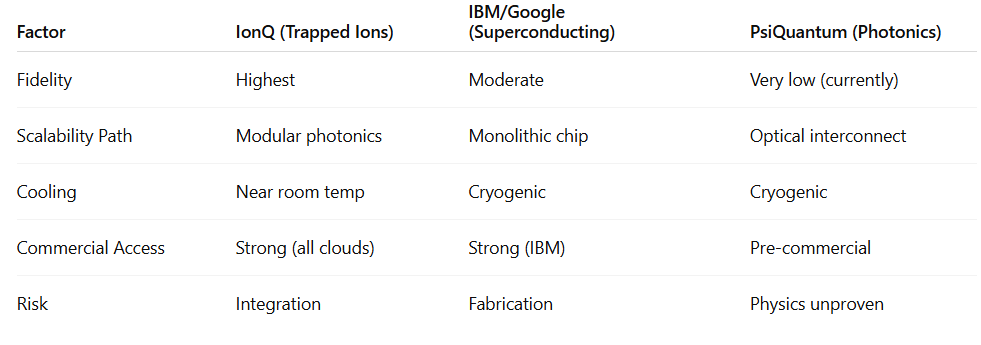
Still, a responsible strategic assessment must consider risks. The greatest technical uncertainty lies in whether IonQ can scale its architecture using photonic interconnects without introducing latency, synchronization noise, or instability (Financial Times, 2025b). Commercial risk remains meaningful because IonQ’s projected 2025 revenue is roughly US$100 million — far below the expectations embedded in its valuation and capital inflows (Financial Times, 2025c). The industry also faces macro-level risks, as classical accelerators such as GPUs, TPUs, and optical compute continue to improve rapidly, potentially delaying the emergence of quantum advantage. Integration of Oxford Ionics and Vector Atomic poses organizational challenges, and global geopolitics — especially U.S.–China technology controls — may restrict the markets IonQ can serve (Politico Europe, 2025).
Yet the company’s global expansion reflects the rising acceptance of its strategy. IonQ now operates across the United States, Europe, Canada, and Asia, and has been recognized by Fortune Future 50, Newsweek’s Excellence Index 1000, and Forbes’ Most Successful Mid-Cap Companies list (IonQ, 2025c). Its advances in quantum networking further position the company as a potential architect of the future quantum internet, an infrastructure expected to transform secure communications, distributed computing, and sensing applications.
If IonQ achieves its target of delivering a multi-million-qubit machine by 2030, it will fundamentally reshape the economics of drug discovery, materials science, logistics, financial modeling, cybersecurity, and defense. If the company falls short, the sector will still benefit from the acceleration driven by IonQ’s breakthroughs in fidelity, cloud accessibility, and commercialization. But if its roadmap holds, IonQ may become not only a leader in quantum computing, but one of the defining infrastructure companies of the twenty-first century.
Reference List
Bloomberg News. (2025). Quantum computing companies face investor pressure as timelines extend. Bloomberg. https://www.bloomberg.com
Economist Intelligence Unit. (2025). The quantum turn: Commercial realities clash with scientific ambition. The Economist. https://www.economist.com
Financial Times. (2025a). IonQ raises $2bn in record quantum funding round. Financial Times. https://www.ft.com/content/998f51a3-aba2-4c81-9157-8860ff20c3ce
Financial Times. (2025b). US quantum computing company IonQ to buy Oxford university start-up. Financial Times. https://www.ft.com/content/dde7bac2-cacb-4deb-9223-5bcfe285db15
Financial Times. (2025c). ‘We’re physicists who are also capitalists,’ says quantum CEO. Financial Times. https://www.ft.com/content/998f51a3-aba2-4c81-9157-8860ff20c3ce
IonQ. (2023). IonQ Forte launched for commercial use. https://ionq.com
IonQ. (2025a). Quarterly results and customer update. https://ionq.com
IonQ. (2025b). IonQ raises $2B from Heights Capital. https://ionq.com
IonQ. (2025c). IonQ leaders to present at World Strategic Forum. https://ionq.com
IonQ. (2025d). Technology performance and roadmap update. https://ionq.com
Politico Europe. (2025). EU governments scramble to secure leadership in quantum after US acceleration. https://www.politico.eu
SEC. (2021). Form S-4: dMY Technology Group III and IonQ merger. https://www.sec.gov/Archives/edgar/data/0001824920
IonQ, #QuantumComputing, #TrappedIon, #QuantumTechnology, #QuantumAdvantage, #QuantumHardware, #QuantumProcessors, #QuantumNetworking, #QuantumInternet, #QuantumSecurity, #QuantumSensing, #QuantumCloud, #AWSBraket, #AzureQuantum, #GoogleCloud, #QuantumScaling, #FaultTolerantQuantum, #HighFidelityQubits, #TwoQubitFidelity, #QuantumCoherence, #ModularQuantumComputing, #PhotonicInterconnects, #OxfordIonics, #VectorAtomic, #NYSE, #IONQStock, #DeepTechInvestment, #QuantumInvesting, #StrategicInnovation, #NationalSecurityTech, #QuantumSovereignty, #QuantumEcosystem, #QuantumCommercialization, #QuantumEnterprise, #DrugDiscoveryAI, #MaterialsScienceAI, #QuantumOptimization, #AerospaceTech, #DefenseTech, #Cybersecurity, #SecureCommunication, #QuantumRoadmap, #QuantumLeadership, #NiccoloDeMasi, #InvestInQuantum, #EmergingTech, #NextGenComputing, #FutureOfComputing, #DigitalInfrastructure, #AdvancedComputing, #TechSovereignty
메타데이터
- post_id
- da9f98ff0b8a
- slug
- ionq-and-the-new-economics-of-quantum-advantage-a-strategic-analysis-for-2025-da9f98ff0b8a
- url
- https://medium.com/@tarifabeach/ionq-and-the-new-economics-of-quantum-advantage-a-strategic-analysis-for-2025-da9f98ff0b8a
- canonical_url
- https://medium.com/@tarifabeach/ionq-and-the-new-economics-of-quantum-advantage-a-strategic-analysis-for-2025-da9f98ff0b8a
- author_url
- https://medium.com/@tarifabeach
- status
- ok
- fetched_at
- 2026-06-17 12:55:42