Understanding the Role of Value Networks in Reinforcement Learning
Introduction
Understanding the Role of Value Networks in Reinforcement Learning
Introduction
Reinforcement learning (RL) has made significant strides in recent years, powering applications in robotics, game playing, and real-world decision-making systems. One of the core challenges in RL is balancing exploration and exploitation while efficiently estimating optimal policies. Among various RL methods, policy gradient methods play a crucial role in directly optimizing policies. However, these methods often suffer from high variance, making training unstable and slow.
To address this issue, value networks are introduced. By leveraging value functions, RL algorithms can stabilize training and improve sample efficiency. Here, we will explore why value networks are essential, their connection to variance reduction, and how they integrate with techniques like Temporal Difference (TD) learning, Actor-Critic methods, and Importance Sampling.
The Variance Problem in Policy Gradient Methods
Policy gradient methods, such as REINFORCE, optimize policies by estimating the expected reward. The fundamental idea behind REINFORCE is to maximize the expected return:
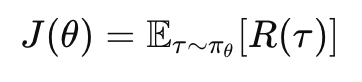
where τ represents a trajectory sampled from the policy πθ and R(τ) is the cumulative reward. The policy is updated using the gradient:

This method is simple and unbiased, but it has high variance due to the direct dependence on the cumulative return R(τ). High variance in gradients results in slow convergence and instability.
Reducing Variance with a Value Function
To mitigate variance, we introduce a value function, which estimates the expected return from a given state. The two common types of value functions are:
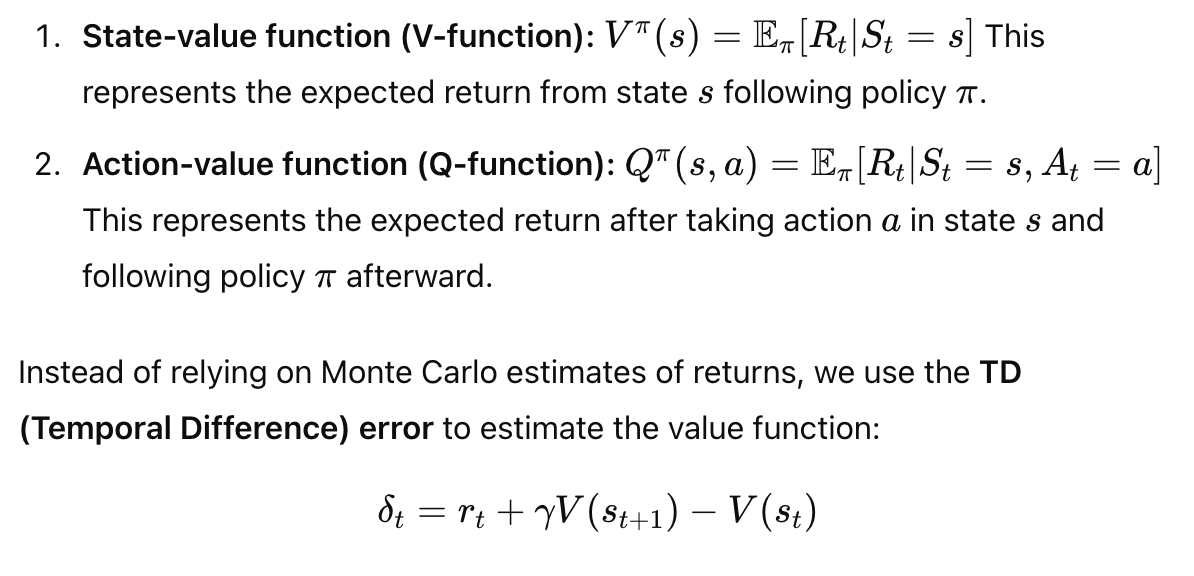
This TD update is more stable than Monte Carlo estimation, which can have high variance due to stochastic returns.
Actor-Critic Methods: Combining Policy and Value Functions
Actor-Critic methods integrate value functions into policy gradient updates. The Actor is responsible for updating the policy, while the Critic estimates the value function to stabilize training.

By using the advantage function instead of the raw return, we reduce variance while still maintaining an unbiased estimate of the gradient.
Advantage Estimation Using Value Networks
Since the advantage function is difficult to compute directly, we approximate it using the TD error:

This allows the critic to provide a low-variance estimate of the advantage function, leading to more stable policy updates.
Importance Sampling in Off-Policy Training
Many RL methods use experience replay, where past trajectories are stored in a buffer and reused for training. However, the trajectories in the buffer may have been collected from an older policy πθ, not the current policy πθ. To correct for this, we use importance sampling:

The ratio

accounts for the discrepancy between the behavior policy (used to generate data) and the target policy (being optimized). This ensures that the policy is updated correctly using off-policy data.
Summary: Why Use a Value Network?
1. Reduces Variance
- Monte Carlo returns are high variance and unstable.
- TD learning provides more stable estimates.
- Advantage function further reduces variance in policy gradients.
2. Stabilizes Training
- Actor-Critic methods leverage value networks to balance bias and variance.
- Value networks provide smoother, more reliable policy updates.
3. Supports Off-Policy Learning
- Importance sampling corrects for using old trajectories from replay buffers.
- Allows sample-efficient training.
4. Improves Sample Efficiency
- Learning a value function helps reuse experience effectively.
- More efficient than purely model-free methods.
Conclusion
Value networks play a critical role in reinforcement learning by reducing variance, stabilizing training, and improving sample efficiency. They enable more effective learning through TD updates and advantage estimation, making Actor-Critic and off-policy RL methods viable for large-scale applications. Understanding and implementing value networks correctly is key to building robust and scalable RL systems.
메타데이터
- post_id
- daa1eb5db688
- slug
- understanding-the-role-of-value-networks-in-reinforcement-learning-daa1eb5db688
- url
- https://medium.com/@VectorWorksAcademy/understanding-the-role-of-value-networks-in-reinforcement-learning-daa1eb5db688
- canonical_url
- https://medium.com/@VectorWorksAcademy/understanding-the-role-of-value-networks-in-reinforcement-learning-daa1eb5db688
- author_url
- https://medium.com/@VectorWorksAcademy
- status
- ok
- fetched_at
- 2026-07-23 04:11:16