CyberArk Integration in Microservice Architecture
Integrating CyberArk into a Microservice Architecture is critical for securely managing secrets, credentials, and privileged access across…
CyberArk Integration in Microservice Architecture
Integrating CyberArk into a Microservice Architecture is critical for securely managing secrets, credentials, and privileged access across distributed services. Here’s a comprehensive approach to integrating CyberArk in such an environment:
🔐 CyberArk Integration in Microservice Architecture
🎯 Objectives
- Centralize secret and credential management
- Avoid hardcoding secrets in code/config
- Ensure auditability and access control
- Secure service-to-service and human-to-service authentication
🧩 Integration Strategies
1. Use CyberArk Conjur or CyberArk Vault (PAS)
Depending on the setup:
- Conjur OSS/Enterprise: Ideal for dynamic secrets, DevOps environments
- CyberArk Privileged Access Security (PAS): For enterprise vaulting of credentials, particularly static secrets
🔧 Implementation Options
✅ Option A: Sidecar Pattern (Recommended for Kubernetes)
Each microservice pod has a sidecar container that:
- Authenticates to CyberArk (e.g., via JWT or certs)
- Fetches secrets at runtime and injects them into the main container’s environment or file system
🔄 Flow:
- Sidecar authenticates to CyberArk using machine identity (e.g., Kubernetes Authenticator, TLS certs)
- Fetches secrets and writes to a mounted volume or injects as env vars
- Main container reads from the shared volume or environment
✅ Option B: Init Container
- An init container pulls secrets at startup and writes them to a shared volume
- Main app reads secrets from there
Use this when secrets don’t need to change during runtime.
✅ Option C: CyberArk SDK or API
Direct integration using CyberArk SDK (e.g., Java SDK) or REST APIs.
Sample (Java with Spring Boot):
CyberArkClient client = new CyberArkClient("https://cyberark-url");
String secret = client.getSecret("db/password");
Good for legacy apps, but introduces tight coupling with CyberArk
✅ Option D: External Secrets Operator (Kubernetes)
Use tools like **External Secrets Operator** integrated with CyberArk to automatically inject secrets into Kubernetes secrets from CyberArk.
🔒 Authentication Mechanisms
- Kubernetes Authenticator: Auth with service accounts
- LDAP / AD Identity: For users and machines
- Mutual TLS
- JWT/OIDC Integration
🧭 Best Practices
- Never store secrets in Git or Docker images
- Use least privilege principle for CyberArk access policies
- Enable auditing of secret access for compliance
- Rotate secrets frequently using CyberArk policies
- Inject secrets at runtime instead of persisting on disk
- Monitor and alert on access anomalies
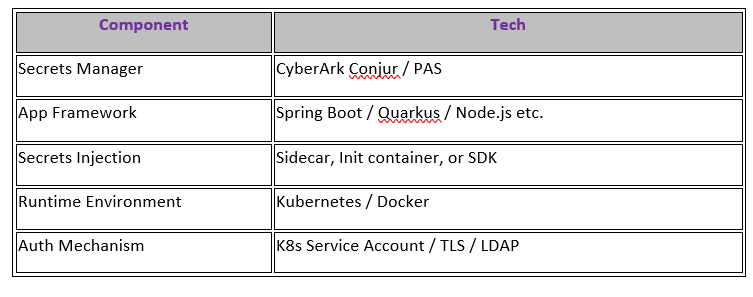
📦 Sample Stack
📘 References
메타데이터
- post_id
- daa39d3d48c2
- slug
- cyberark-integration-in-microservice-architecture-daa39d3d48c2
- url
- https://medium.com/@pattanaikansuman/cyberark-integration-in-microservice-architecture-daa39d3d48c2
- canonical_url
- https://medium.com/@pattanaikansuman/cyberark-integration-in-microservice-architecture-daa39d3d48c2
- author_url
- https://medium.com/@pattanaikansuman
- status
- ok
- fetched_at
- 2026-08-26 15:59:24




