🛡️ Behind the Scenes of Spring Security: Mastering SecurityFilterChain Like a Pro
Spring Security has evolved — the old WebSecurityConfigurerAdapter is gone, and the new SecurityFilterChain is now the backbone of Spring…
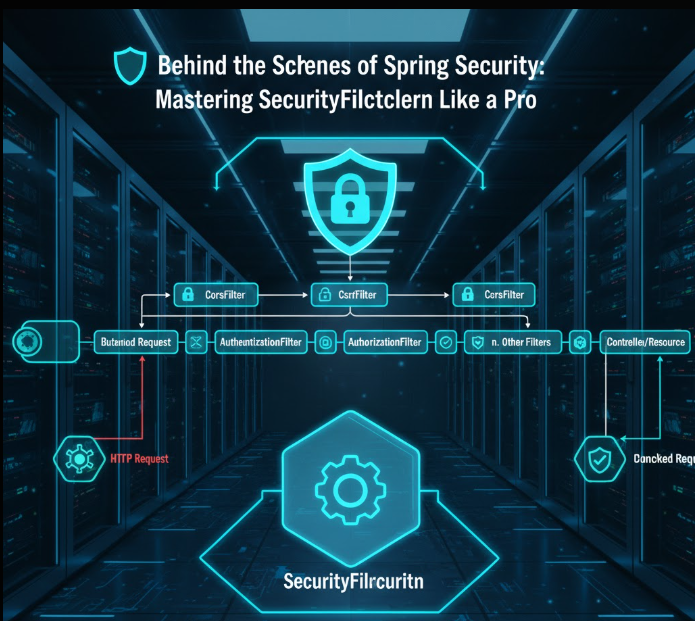
🛡️ “Behind the Scenes of Spring Security: Mastering SecurityFilterChain Like a Pro”
🛡️ Behind the Scenes of Spring Security: Mastering SecurityFilterChain Like a Pro
Spring Security has evolved — the old WebSecurityConfigurerAdapter is gone, and the new SecurityFilterChain is now the backbone of Spring Boot security configuration.
If you’ve ever wondered what happens behind the curtain when a request hits your secure API, or how filters decide whether to allow or deny access — this guide is for you. 🚀
Let’s break down what SecurityFilterChain really is, why it replaced the old approach, and how to configure it the right way.
🔍 What Is a SecurityFilterChain?
Think of it as a sequence of filters that inspect and process every incoming HTTP request before it reaches your controllers.
Each filter has one job:
- Authenticate users 🧑💻
- Check permissions 🔐
- Handle CSRF tokens 🧾
- Redirect or deny unauthorized access 🚫
Together, these filters form a chain — the SecurityFilterChain.
In short:
🔗 Every request goes through the chain, and each filter decides what happens next.
⚙️ Why WebSecurityConfigurerAdapter Was Replaced
Before Spring Security 5.7, we used this pattern 👇
@EnableWebSecurity
public class SecurityConfig extends WebSecurityConfigurerAdapter {
@Override
    protected void configure(HttpSecurity http) throws Exception {
        http
            .authorizeRequests()
            .antMatchers("/public/**").permitAll()
            .anyRequest().authenticated()
            .and()
            .formLogin();
    }
}
That worked fine — but it was:
- Hard to test (tight coupling)
- Not modular
- Verbally heavy
Now, the modern Spring Security style uses beans instead. 💡
🧩 The New Way — Defining SecurityFilterChain as a Bean
Here’s the new (and preferred) approach 👇
@Configuration
@EnableWebSecurity
public class SecurityConfig {
@Bean
    public SecurityFilterChain securityFilterChain(HttpSecurity http) throws Exception {
        http
            .csrf(csrf -> csrf.disable()) // disable CSRF for simplicity
            .authorizeHttpRequests(auth -> auth
                .requestMatchers("/public/**").permitAll() // public APIs
                .requestMatchers("/admin/**").hasRole("ADMIN") // restricted APIs
                .anyRequest().authenticated() // everything else
            )
            .formLogin(Customizer.withDefaults()) // enable form login
            .httpBasic(Customizer.withDefaults()); // enable basic auth
        return http.build();
    }
}
✅ Advantages:
- Uses modern functional style
- Supports multiple filter chains
- Easier to maintain and test
🧠 How It Works Internally
When you start your Spring Boot app:
- Spring Security creates a filter chain proxy (
FilterChainProxy). - Each request is checked against a list of configured
SecurityFilterChains. - The first chain that matches handles the request.
- Filters execute in order (e.g., CORS → CSRF → Authentication → Authorization).
If no chain matches, the request is processed as unsecured (open endpoint).
💡 You can have multiple SecurityFilterChain beans, each handling a different path.
🔐 Example: Multiple SecurityFilterChains
Let’s say you want different rules for /api/** and /admin/**.
@Configuration
@EnableWebSecurity
public class MultiSecurityConfig {@Bean
    @Order(1)
    public SecurityFilterChain adminChain(HttpSecurity http) throws Exception {
        http
            .securityMatcher("/admin/**")
            .authorizeHttpRequests(auth -> auth
                .anyRequest().hasRole("ADMIN")
            )
            .formLogin(Customizer.withDefaults());
        return http.build();
    }
    @Bean
    @Order(2)
    public SecurityFilterChain apiChain(HttpSecurity http) throws Exception {
        http
            .securityMatcher("/api/**")
            .authorizeHttpRequests(auth -> auth
                .anyRequest().authenticated()
            )
            .httpBasic(Customizer.withDefaults());
        return http.build();
    }
}
✅ Each SecurityFilterChain applies only to matching URLs.
🧠 Order matters — Spring picks the first matching chain.
🧾 Adding a Custom Filter
Want to add your own logic (e.g., logging or token validation)? You can easily inject a custom filter into the chain.
@Component
public class RequestLoggingFilter extends OncePerRequestFilter {
@Override
    protected void doFilterInternal(HttpServletRequest request,
                                    HttpServletResponse response,
                                    FilterChain filterChain)
                                    throws ServletException, IOException {
        System.out.println("🔍 Incoming request: " + request.getRequestURI());
        filterChain.doFilter(request, response);
    }
}
Then, plug it into your chain:
@Bean
public SecurityFilterChain securityFilterChain(HttpSecurity http) throws Exception {
    http
        .addFilterBefore(new RequestLoggingFilter(), UsernamePasswordAuthenticationFilter.class)
        .authorizeHttpRequests(auth -> auth.anyRequest().authenticated())
        .httpBasic(Customizer.withDefaults());
    return http.build();
}
✅ Your custom filter executes before authentication. Perfect for request logging, rate limiting, or custom headers.
🧩 Bonus Tip: Testing Your Security Config
You can write quick tests using Spring’s MockMvc to ensure your security behaves correctly.
@SpringBootTest
@AutoConfigureMockMvc
class SecurityTests {
@Autowired
    private MockMvc mockMvc;
    @Test
    void whenAccessPublic_thenOk() throws Exception {
        mockMvc.perform(get("/public/hello"))
                .andExpect(status().isOk());
    }
    @Test
    void whenAccessAdminWithoutAuth_thenUnauthorized() throws Exception {
        mockMvc.perform(get("/admin/panel"))
                .andExpect(status().isUnauthorized());
    }
}
✅ Helps you confirm that your SecurityFilterChain behaves as expected.
🔮 The Future of Spring Security Config
Spring Security’s move to SecurityFilterChain is part of a functional, declarative trend:
- Less boilerplate 🧱
- More composable configurations
- Easier testing & multiple chain support
If you’ve been using WebSecurityConfigurerAdapter, it’s time to embrace the future — cleaner, leaner, and more powerful.
🏁 TL;DR — Key Takeaways

💬 Final Thought
Spring Security isn’t just a firewall — it’s a framework built around filter orchestration.
Once you understand SecurityFilterChain, you understand how every request in your app is secured.
“Security isn’t a plugin — it’s a mindset. 🔐”
A message from our Founder
Hey, Sunil here. I wanted to take a moment to thank you for reading until the end and for being a part of this community.
Did you know that our team run these publications as a volunteer effort to over 3.5m monthly readers? We don’t receive any funding, we do this to support the community. ❤️
If you want to show some love, please take a moment to follow me on LinkedIn, TikTok, **Instagram. You can also subscribe to our [weekly newsletter](https://newsletter.plainenglish.io/)**.
And before you go, don’t forget to clap and follow the writer️!
메타데이터
- post_id
- dab68f96fecc
- slug
- ️-behind-the-scenes-of-spring-security-mastering-securityfilterchain-like-a-pro-dab68f96fecc
- url
- https://blog.stackademic.com/%EF%B8%8F-behind-the-scenes-of-spring-security-mastering-securityfilterchain-like-a-pro-dab68f96fecc
- canonical_url
- https://blog.stackademic.com/%EF%B8%8F-behind-the-scenes-of-spring-security-mastering-securityfilterchain-like-a-pro-dab68f96fecc
- author_url
- https://medium.com/@lakshitagangola123
- status
- ok
- fetched_at
- 2026-07-16 21:00:47