Market Access Is Becoming Tokenized
Key Takeaways
Market Access Is Becoming Tokenized
Key Takeaways
- Tokenization is expanding beyond bonds, funds, treasuries, and private credit into broader areas of financial markets, including equities, IPO access, and private market exposure.
- Recent developments around tokenized stocks and tokenized IPO access suggest that market access itself is becoming an important layer of the RWA narrative.
- The key question is no longer simply whether an asset can be represented on-chain. It is what rights, protections, custody, compliance, and settlement infrastructure exist behind that representation.
- The next phase of RWA will not be defined only by how many assets are tokenized, but by whether tokenized assets can be issued, distributed, accessed, and traded through trusted market infrastructure.
A New Phase of Tokenization
Tokenization has long been discussed as a way to create digital representations of real-world assets.
Can a bond be tokenized? Can a fund be tokenized? Can real estate, private credit, or treasury products be brought on-chain?
These questions have shaped much of the RWA narrative over the past several years. Across the market, we have seen growing experimentation and adoption across tokenized treasuries, money market funds, private credit, real estate, and other financial assets.
But the market is now beginning to move beyond the question of what can be tokenized.
A new question is emerging: how will investors access tokenized markets?
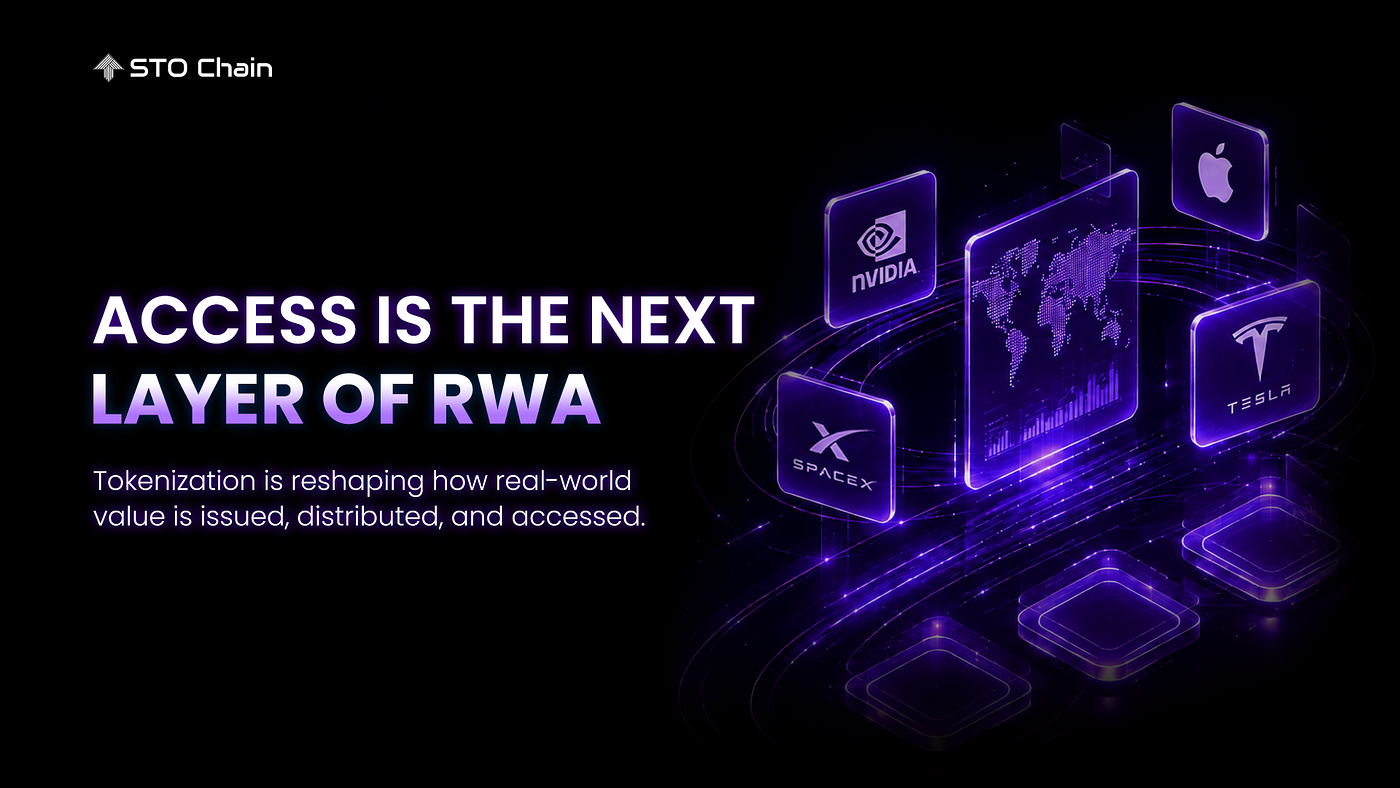
Recent developments around tokenized stocks and tokenized IPO access point to this broader shift. Tokenization is no longer limited to representing financial assets on-chain. It is beginning to reshape how those assets are issued, distributed, accessed, and traded.
In other words, market access itself is becoming tokenized.
From Asset Representation to Market Access
Tokenized IPO access is notable because it touches one of the most restricted areas of traditional finance: access to early-stage or high-demand investment opportunities.
Historically, IPO participation has been shaped by broker networks, allocation structures, institutional relationships, geographic restrictions, and platform availability. For many investors, access to certain opportunities has often depended less on demand and more on distribution.
Tokenized access introduces a different model.
Rather than relying entirely on legacy distribution channels, access to certain financial assets or economic exposure can be structured and delivered through digital market infrastructure.
However, this distinction is important.
Tokenized stocks or tokenized IPO access do not automatically mean direct ownership of the underlying shares. Depending on the structure, a token may provide economic exposure, contractual rights, redemption rights, or another form of asset-linked entitlement. In some cases, it may differ significantly from direct legal ownership.
That distinction is exactly why this trend matters for RWA.
The core question is what the token actually represents. From there, the market must also consider who safeguards the underlying asset, how compliance is enforced, how settlement is handled, where liquidity can form, and whether investors can trust the infrastructure behind the token.
These are no longer theoretical questions. They are becoming central to how tokenized financial markets will be designed, regulated, and scaled.
Why This Matters for RWA
For RWA, the rise of tokenized market access is important because it shows that tokenization is not simply about moving assets on-chain.
The deeper shift is about rebuilding the market rails around those assets.
A tokenized asset is not valuable simply because it exists on-chain. Its value depends on the infrastructure that supports it: clearly defined rights, reliable custody, embedded compliance, efficient settlement and redemption, and liquidity that can develop without weakening investor protection.
Without these elements, tokenization may only create a new digital interface for existing market inefficiencies.
With them, tokenization can become a structural upgrade to capital markets.
This is where the distinction between exposure and ownership becomes critical.
Economic exposure can be created relatively easily. A product can track the price of an asset, reference an underlying instrument, or offer synthetic access to a market.
Ownership is harder.
Institutional-grade RWA requires more than exposure. It requires clear legal rights, regulated custody, compliant transfer mechanisms, reliable settlement, transparent asset servicing, and verifiable market access.
As RWA moves closer to institutional markets, the question becomes less about whether a token exists and more about the market structure in which that token operates.
The Distribution Layer Is Becoming the Next Frontier
The early phase of RWA focused heavily on issuance.
Issuers, protocols, and platforms worked to bring treasuries, funds, credit products, real estate, and other assets on-chain, proving that tokenized formats could represent real-world financial instruments.
But issuance alone is not enough.
For tokenized markets to scale, assets need distribution. They need compliant investor onboarding, trusted access channels, custody frameworks, settlement infrastructure, redemption mechanisms, and liquidity pathways.
Tokenized stocks and tokenized IPO access highlight this next stage.
The value is not only in creating a token. The real value is in making real-world financial opportunities accessible through trusted digital rails.
That is a much larger shift.
It suggests that tokenization is moving from a product narrative to an infrastructure narrative.
In the next phase of RWA, competitive advantage will not come only from what assets are tokenized. It will come from how those assets are issued, distributed, settled, and traded.
The Questions That Matter Next
As more financial assets move toward tokenized formats, the market will become more focused on the infrastructure behind access.
The important questions will center on investor eligibility, rights, compliance, custody, settlement, redemption, liquidity, and connectivity to existing capital markets.
The next phase of RWA will not be defined only by the number of assets brought on-chain. It will be defined by how reliably tokenized assets can operate within trusted market infrastructure.
Tokenized stocks, tokenized IPO access, tokenized funds, tokenized treasuries, and tokenized private market exposure may appear to be different products on the surface. But they point to the same structural trend.
Financial markets are becoming more digital, more global, and more programmable.
The challenge is to make these markets more trustworthy as they become more accessible.
Conclusion
Tokenized market access is one of the clearest signals of where RWA may be heading next.
It shows that the industry is moving beyond asset representation and toward a deeper transformation of capital market infrastructure.
The question is no longer simply what can be tokenized.
The more important question is how tokenized assets will be accessed, what rights they will provide, how they will be protected, how they will settle, and where they will trade.
The future of RWA will not be built around isolated asset tokens.
It will be built on infrastructure that connects real-world value to trusted capital markets.
That is where the next infrastructure shift begins.
메타데이터
- post_id
- dab88e01ddf9
- slug
- market-access-is-becoming-tokenized-dab88e01ddf9
- url
- https://medium.com/@stochain/market-access-is-becoming-tokenized-dab88e01ddf9
- canonical_url
- https://medium.com/@stochain/market-access-is-becoming-tokenized-dab88e01ddf9
- author_url
- https://medium.com/@stochain
- status
- ok
- fetched_at
- 2026-08-03 21:07:43