In Vivo CAR T Cells: The Drug That Builds Itself Inside You
Eight clinical programs, two landmark human datasets, $6B in M&A, and one cautionary tale — a complete field intelligence brief on the most…
In Vivo CAR T Cells:
The Drug That Builds Itself Inside You
Eight clinical programs, two landmark human datasets, $6B in M&A, and one cautionary tale — a complete field intelligence brief on the most important development in cancer immunotherapy since the original CAR-T approval.
Oncology · Cell & Gene Therapy · April 2026
Field Intelligence Report·April 16, 2026·~15 min read·Sources: The Lancet, Blood, Nature, AJMC, OncLive, company press releases. If you are stuck behind a paywall please click this friend link to read the article.
Something extraordinary happened at ASH 2025 in Orlando. An Australian scientist walked to a podium and described an infusion that generates a cancer treatment inside the patient’s own body — no cell extraction, no factory, no weeks of waiting. And the cancer disappeared.
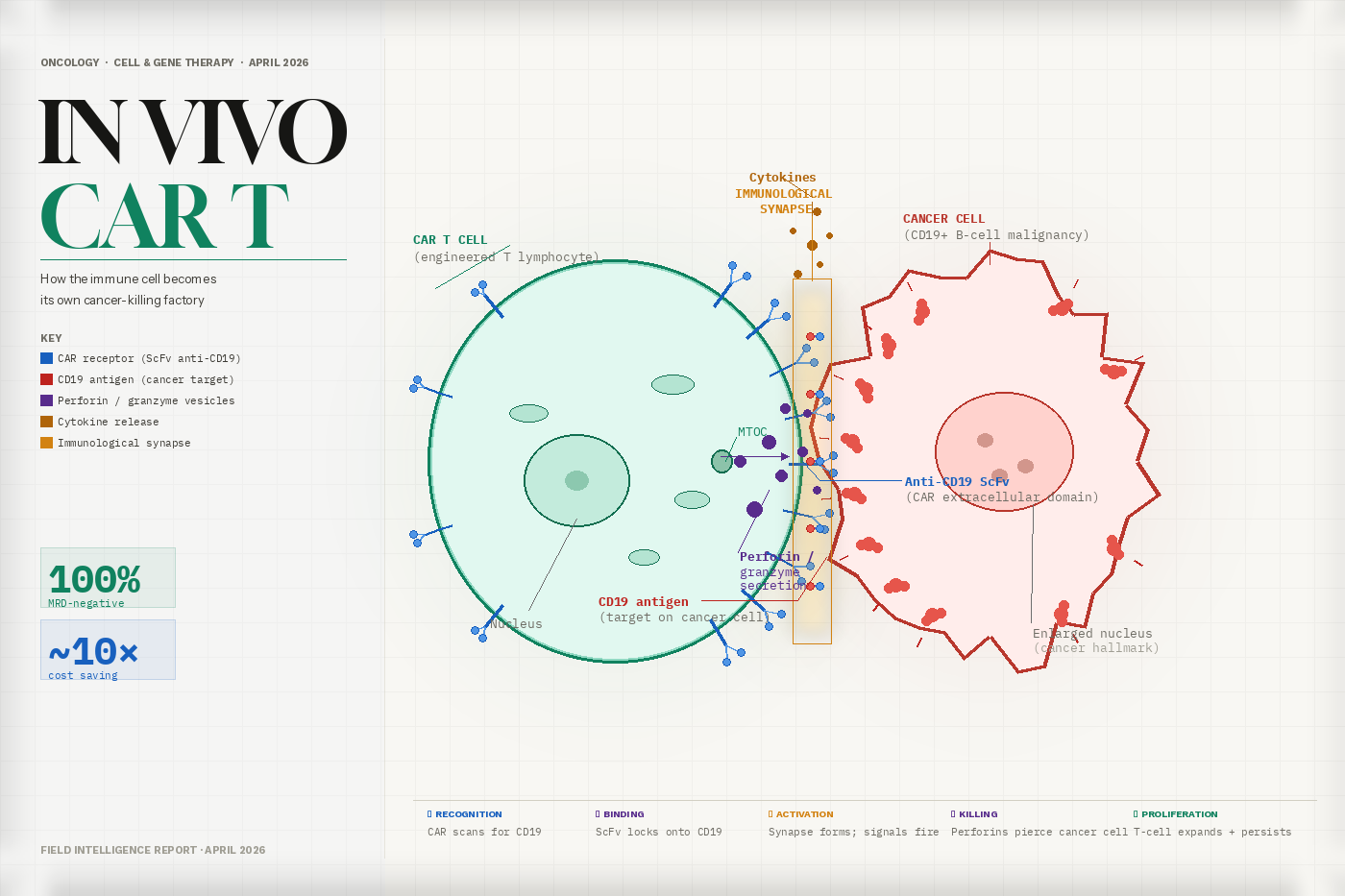
Traditional CAR T cells require apheresis to harvest a patient’s T cells, weeks of GMP manufacturing to engineer and expand them, lymphodepleting chemotherapy to prepare the body, and then infusion — a process costing $400,000–$500,000 per patient, taking 4–6 weeks, and accessible to fewer than 60% of referred patients. In vivo CAR T eliminates that entire chain by delivering the CAR transgene directly into circulating T cells inside the body, using either viral vectors or lipid nanoparticles. The result is a drug-like, off-the-shelf product infused in minutes, without conditioning chemotherapy, at potentially one-tenth the cost.
8+Active clinical programs worldwide
100%MRD-neg rate, Kelonia KLN-1010 (n=4, ASH 2025)
~$6BM&A + financing since 2024
~10×Projected cost reduction vs. ex vivo
Why now? The access crisis that forced innovation
A 2024 McKesson report found that millions of Americans in rural areas live in “CAR T deserts” — more than two-thirds of oncologists lack nearby access to administer the therapy. A Memorial Sloan Kettering study found that Black patients were statistically less likely to receive CAR T, exposing a layer of structural inequity beyond mere geography.
Even for patients who can access major academic centers, the manufacturing bottleneck is ruthless. Disease progresses while the factory runs. Some patients deteriorate past eligibility before their cells return.
“By engineering immune cells directly within the body, the patient becomes their own factory. It dramatically accelerates the process and is significantly more cost-effective.”
— Jean-Pierre Latere, PhD, CEO, EsoBiotec (now AstraZeneca)
In vivo CAR T was proposed as the solution more than a decade ago. The science took time to catch up. Now — with two independent programs showing complete responses in humans, three mega-acquisitions, and eight programs in or entering clinical trials — the field has crossed a threshold.
The delivery platform landscape: four distinct bets
There is no single “in vivo CAR T.” Four distinct technological approaches are competing, with very different risk and reward profiles.
① Lentiviral vectors (LVV)
Stable, durable CAR expression via genomic integration. T-cell selectivity achieved through anti-CD3 or anti-CD8 nanobody-modified envelopes, or fusogen-based targeting. The approach currently generating the most convincing clinical data.
Durable expression | Stable integration | Single dose
Key players: Kelonia, EsoBiotec/AZ, Umoja, Interius, Genocury, Vyriad
② LNP-mRNA (non-viral)
Transient CAR expression lasting hours to days. Targeted LNPs (tLNPs) use anti-CD4/CD8/CD5 antibody conjugation for T-cell selectivity. Tunable, repeatable dosing model; no insertional risk; lower CRS profile expected. Still pre–proof-of-concept in patients.
Reversible expression | Repeat dosing | No integration
Key players: Capstan/AbbVie, Orna/Lilly, Myeloid/CREATE, Sanofi
③ CRISPR / AAV HDR (next-gen)
Site-specific integration at the TRAC locus via CRISPR-Cas9 + AAV-mediated homology-directed repair. Avoids random integration; enables physiological CAR expression. A Nature paper (March 2026) demonstrated in vivo TRAC-targeted CAR generation in mice using a two-vector system.
Site-specific | Preclinical only | Highly precise
④ Circular RNA / oRNA
Orna Therapeutics’ proprietary oRNA platform delivers circular RNA payloads with improved stability and LNP formulation versus linear mRNA. Their panCAR concept targets T cells, NK cells, and myeloid cells simultaneously. Acquired by Eli Lilly for up to $2.4B in February 2026.
Circular RNA | panCAR multi-cell | Preclinical
The clinical programs: a complete map
In vivo CAR T is only now entering the clinic. Here is every active or recently completed human program, in order of clinical maturity.
Kelonia Therapeutics — KLN-1010
Target: BCMA · Multiple myeloma (R/R) · Phase 1: inMMyCAR (NCT07075185) · Australia & US
Best data to date
Technology: Third-generation, replication-incompetent, self-inactivating lentiviral vector with modified vesicular stomatitis virus (VSV-G) fusogen co-expressed with an anti-CD3 antibody on the surface — enabling selective transduction of circulating T cells after IV infusion. KLN-1010 uses the company’s proprietary iGPS® (in vivo gene placement system) platform.
ASH 2025 (December 9, Late-Breaking Oral): 100% MRD-negative response rate in all 4 patients. Complete response (CR) was the best overall response across all patients. All remain in response at up to 5 months follow-up. No CRS grade ≥3 and no ICANS. Minimal cytopenias. CAR-T expansion peaked ~day 15; memory-phenotype T cells persisted in blood and bone marrow through month 3. No lymphodepleting chemotherapy required. Fourth patient dosed at a lower dose level still achieved MRD-negativity, suggesting a wide therapeutic window.
The trial is designed to enroll up to 40 patients (20 dose-escalation + 20 expansion). Patients must have received ≥3 prior lines including a proteasome inhibitor, IMiD, and anti-CD38 antibody. Kelonia has a strategic collaboration with Johnson & Johnson for novel in vivo CAR-T discovery, and a US IND clearance enabling expansion to American sites.
📄 Harrison S, Ho PJ et al. Blood 2025;146(Suppl 2):LBA-1. doi:10.1182/blood-2025-LBA-1 · Kelonia Therapeutics press release, December 9, 2025 · OncLive December 2025
EsoBiotec (AstraZeneca) — ESO-T01
Target: BCMA · Multiple myeloma (R/R) · Phase 1: NCT06691685 · China (Wuhan)
First Lancet data
Technology: Nanobody-targeted, immune-shielded lentiviral vector (ENaBL platform). Key features: T cell–specific synthetic promoter for selective CAR expression, MHC class-I knocked out to mitigate immunogenicity, phagocytosis-resistant shielding. Single IV infusion taking less than 10 minutes, no lymphodepletion required.
The Lancet (July 2, 2025): 4 patients at the lowest dose level — 2 stringent complete responses (sCR), 2 partial responses (PR). All 4 MRD-negative in bone marrow by day 28. CAR-T expansion kinetics comparable to ex vivo products, peaking ~day 14 with transition toward memory phenotypes over time. Updated report (CancerNetwork, April 2026): 4/5 responses in expanded cohort, including 3 sCRs, MRD-negativity at 10⁻⁵ sensitivity in all evaluable responders by day 60.
AstraZeneca acquired EsoBiotec in March 2025 for $425M upfront + up to $575M in milestones (~$1B total). The initial data motivating the deal included a single patient case report presented at JPM 2025. EsoBiotec has stated the cost of goods may be approximately one order of magnitude lower than ex vivo CAR T. The trial aims to enroll 24 patients total; autoimmune expansion is planned.
📄 Xu J et al. Lancet 2025;406:228–231. doi:10.1016/S0140–6736(25)01030-X · EsoBiotec press release January 8, 2025 · AstraZeneca acquisition press release March 17, 2025 · CancerNetwork April 2026
Interius BioTherapeutics — INT2104
Target: CD20 · B-cell malignancies (R/R) · Phase 1: INVISE · Australia & Germany
First-ever in vivo CAR trial
Technology: Lentiviral vector targeted at CD7+ T cells and NK cells, generating both CAR-T cells and CAR-NK cells simultaneously in vivo — a mechanistically unique dual approach. First human trial of any in vivo CAR-T therapy globally (TGA clearance, Australia, July 2024). Expanded to Germany (Paul Ehrlich Institute approval, January 2025) — the first in vivo CAR gene therapy trial cleared in Europe.
No clinical efficacy data has been disclosed as of April 2026. The INVISE trial continues to enroll patients across both sites.
📄 CGTlive January 2025 · Beacon Intelligence October 2025 · OncologyPipeline July 2024
Umoja Biopharma — UB-VV111 / UB-VV400
CD19 & CD22 · B-cell malignancies · Phase 1 (two assets active)
Phase 1 · Two assets
UB-VV111: Anti-CD19 CAR, Phase 1 (IND cleared July 2024; first dosing November 2024). AbbVie holds an option to acquire this asset. UB-VV400: Anti-CD22 CAR, Phase 1 initiated late 2024. Both use Umoja’s VivoVec lentiviral platform, deliverable via intranodal or intravenous routes. No clinical results disclosed as of April 2026.
📄 ApexOnco January 2025 · AJMC July 2025
Capstan Therapeutics (AbbVie) — CPTX2309
CD19 · B-cell autoimmune diseases · Phase 1 · Healthy volunteers · Australia
Phase 1 · mRNA approach
Technology: CD8-targeted lipid nanoparticle (tLNP) encoding anti-CD19 CAR mRNA. Produces transient CAR expression; up to 80% of CD8+ T cells expressed CAR in preclinical models, with minimal CD4+ or B-cell expression. First healthy volunteer dosed June 11, 2025 — the first human to receive a mRNA-LNP in vivo CAR T. Designed to enable reversible B-cell depletion without apheresis, viral vectors, or chemotherapy, targeting a broad spectrum of B-cell–mediated autoimmune diseases.
AbbVie acquired Capstan for $2.1B in June 2024. A second unnamed BCMA-targeting asset is in development for both oncology and autoimmune applications. Earlier investors included Eli Lilly Ventures, BMS, J&J Innovation, and Bayer (as part of $175M Series B, March 2024).
📄 Beacon Intelligence October 2025 · AJMC April 2026 · PMC 12885491
Myeloid Therapeutics / CREATE Medicines — MT-302 & MT-303
TROP2 / GPC3 · Breast cancer, liver cancer · Phase 1
Phase 1 · Solid tumors
Technology: Non-targeted LNPs delivering mRNA encoding CARs with CD89 signaling that drives functional expression exclusively in FcRγ+ myeloid cells — a mechanistically distinct approach targeting macrophages/monocytes rather than T cells. MT-303 (GPC3-targeted, liver cancer): first patient dosed August 2024. CAR+ monocytes persist up to 48 hours post-injection. First-in-human in vivo mRNA CAR data for MT-302 presented at ASCO 2025 (May 30, 2025).
📄 Myeloid Therapeutics press release May 30, 2025 · PMC 12885491
Genocury (Shenzhen) — JY231
CD19 · R/R DLBCL · Chinese academic trial · Single case report
Case report · CR in lymphoma
Technology: CD3-targeted lentiviral vector delivering anti-CD19 CAR. Uniquely, this approach included patient apheresis for T-cell co-infusion plus lymphodepletion conditioning — unusual elements for an in vivo design that were likely included to boost initial efficacy signal. CAR-T expansion peaked in vivo on day 17.
SITC 2024 (Abstract 1482): Single patient with R/R DLBCL achieved complete remission at 1 month, sustained for more than 3 months. Grade 1 CRS only, no neurotoxicity.
📄 SITC 2024, Abstract 1482 · MDPI IJMS 2026;27(4):1737
Failure stories: what went wrong
🔴 Cautionary tale — Sana Biotechnology (SG299)
Sana raised $676M in the biggest biotech IPO of 2021, largely on the promise of its in vivo CAR-T fusogen platform (SG299: CD8-targeted fusogen delivery of CD19 CAR). The program never reached clinical trials, repeatedly slipping from 2022 to 2023. In October 2023, Sana shelved SG299 entirely, laid off 29% of its staff, and pivoted to conventional allogeneic CAR-T approaches. The stock fell approximately 90% from its IPO price. Key failure factors: insufficient in vivo T-cell transduction efficiency at clinically relevant doses, inability to achieve clinical-grade manufacturing with adequate titer and specificity, and severe timeline overconfidence. The rest of Sana’s pipeline (including allogeneic SC291) subsequently pivoted away from oncology as well.
⚠️ Ongoing concern — Off-target transduction
In 2018, during ex vivo CAR-T production, a CAR gene was accidentally introduced into malignant B cells — leading to antigen masking as CAR-positive tumor cells bound to other tumor cells, preventing recognition by therapeutic CAR-T cells and ultimately causing relapse. In vivo delivery amplifies this risk because vectors circulate systemically. EsoBiotec addresses this with a T cell–specific synthetic promoter; however, validated safeguards and long-term genotoxicity surveillance remain active priorities across the field.
⚠️ Critical unknown — Durability
The most important open question: how long will in vivo–generated CAR-T cells persist? Kelonia’s 5-month follow-up and EsoBiotec’s 3-month data are promising but insufficient to establish equivalence with ex vivo products, which can yield multi-year remissions. LNP-mRNA approaches by design produce only transient expression — which may require repeat dosing, and may not achieve durable remissions in oncology. The durability question is the single biggest binary risk factor for the entire field.
The M&A frenzy: $6 billion in 18 months
The in vivo CAR-T space has attracted extraordinary pharma interest. Notably, all three mega-deals are primarily motivated by autoimmune disease, not oncology — reflecting where the easiest regulatory path and largest addressable market may lie.
February 2026
Eli Lilly → Orna Therapeutics — up to $2.4B including milestones. Focus: autoimmune diseases (anti-CD19 oRNA panCAR). No mention of cancer in the deal rationale. CD19×BCMA oncology bispecific fate uncertain.
June 2024 → Closed June 2025
AbbVie → Capstan Therapeutics — $2.1B. Primary focus: autoimmune disease. AbbVie separately holds an option on Umoja’s UB-VV111 for oncology, giving it exposure to both major in vivo modalities.
March 2025
AstraZeneca → EsoBiotec — $425M upfront + up to $575M milestones. AZ’s entry into in vivo CAR-T, motivated by January 2025 JPM data from a single myeloma patient. First Lancet cohort data published July 2025.
Late 2024
Novartis → Vyriad — discovery/development partnership; Novartis leads clinical advancement of in vivo CAR-T programs from Vyriad’s platform.
2024
Astellas → Kelonia Therapeutics — strategic collaboration. Johnson & Johnson → Kelonia — discovery collaboration for novel in vivo CAR-T programs. Roche acquired Capstan’s mRNA-LNP platform (separate from AbbVie deal).
March 2024
Capstan $175M Series B — oversubscribed. Investors included Eli Lilly Ventures, Bristol Myers Squibb, J&J Innovation, and Bayer — four of the world’s largest pharma companies in a single round.
Target indications: where the programs are pointing
Hematologic malignancies (most advanced)
- Multiple myeloma via BCMA: Kelonia, EsoBiotec/AZ, Orna (BCMA panCAR), Capstan unnamed BCMA program
- B-cell NHL / DLBCL via CD19/CD20: Umoja, Interius, Genocury, Legend Biotech
- AML: explored preclinically via myeloid CAR approaches (MT-302 platform)
Autoimmune diseases (the mega-deal target)
- SLE, RA, myasthenia gravis, inflammatory conditions via CD19 B-cell depletion = “immune reset”
- Capstan CPTX2309: Phase 1 healthy volunteers since June 2025
- Orna ORN-252: IND filing planned end-2025; FIH expected 2026
- AbbVie, Lilly, AZ: all three mega-deals cite autoimmune as primary rationale
Solid tumors (hardest; highest risk)
- Liver cancer (GPC3): MT-303, first patient August 2024
- Breast cancer (TROP2): MT-302, Phase 1 data at ASCO 2025
- Post-liver transplant HCC: considered an “ideal” in vivo CAR-T population
- TME, antigen escape, and trafficking barriers remain major unresolved obstacles
Frontier / exploratory
- Infectious diseases: preclinical exploration of CAR-T for HIV, chronic viral infections
- Fibrosis: CAR-T against fibroblast activation protein (FAP)
- CAR-NK and CAR-myeloid as complements to T cell–targeting approaches
What works vs. what doesn’t: an honest scorecard
✓ What is working
Lentiviral vectors with T-cell–specific tropism can generate functional, expanding, memory CAR-T cells in vivo without lymphodepletion. MRD-negative responses have now been demonstrated in multiple myeloma by two independent programs (Kelonia and EsoBiotec/AZ). Off-the-shelf administration eliminates the apheresis wait time. The CRS profile appears milder than ex vivo — no grade ≥3 CRS and no ICANS in Kelonia’s cohort. CAR-T expansion and persistence are comparable to ex vivo products in early follow-up. Cost of goods is projected at approximately 10× lower than ex vivo therapy. Myeloid CAR approaches appear feasible in humans (first liver cancer patient, August 2024).
⚠ What remains unproven
Durability beyond 5 months. Efficacy in earlier-line patients or those with exhausted T-cell repertoires from heavy prior treatment. LNP-mRNA CAR efficacy in any patient (only healthy volunteers so far). Solid tumor responses — TME barriers largely unresolved. Insertional mutagenesis risk with LVV at scale. Development of anti-drug antibodies to targeting moieties with repeat LNP dosing. Immune reconstitution dynamics after in vivo–mediated B-cell depletion in autoimmune disease.
Thought leaders shaping this field
Clinical & Academic
- Prof. Joy Ho (Royal Prince Alfred / Peter MacCallum Cancer Centre) — Lead investigator, inMMyCAR / KLN-1010, ASH 2025 presenter
- Prof. Simon Harrison (Peter MacCallum Cancer Centre) — Co-investigator, inMMyCAR; one of Australia’s leading myeloma clinicians
- Michael Rosenzweig, MD (City of Hope) — Division Chief, Multiple Myeloma; leading commentator on durability questions and access implications
Industry & Scientific
- Kevin Friedman, PhD (Kelonia, CEO/Founder) — iGPS® platform lead; key voice on in vivo gene placement
- Jean-Pierre Latere, PhD (EsoBiotec/AZ, CEO) — ENaBL platform lead; drove the JPM-to-AZ-acquisition trajectory
- Adrian Bot, PhD (Capstan/AbbVie, CSO & EVP R&D) — Leading mRNA-LNP in vivo advocate; coined “two major technologies” framing
- Joseph Bolen, PhD (Orna/Lilly, CEO) — oRNA / panCAR platform; drove Lilly $2.4B deal
- Stephen Russell, MD (Vyriad, CEO) — retargeting strategies, Novartis partnership lead
The breakthrough science (for the technically curious)
A March 2026 Nature paper introduced a genuinely new concept: in vivo site-specific CAR integration using a two-vector system. The first vector delivers CRISPR-Cas9 ribonucleoprotein as an enveloped delivery vehicle; the second delivers an AAV containing a CAR donor template for homology-directed repair at the TRAC locus. This achieves the precision and expression dynamics of ex vivo TRAC-integration (which delays T-cell exhaustion) — but accomplished entirely inside a living organism.
This approach is currently preclinical-only, but it represents the logical endpoint of the in vivo CAR-T trajectory: not just any integration anywhere in the genome, but exactly the right gene, in exactly the right place, in exactly the right cell — achieved by a medicine you inject.
Actionable takeaways for different audiences
For biopharma / BD teams: The LVV-based clinical results validate the core hypothesis. The window to access best-in-class platforms is narrowing — three of the top five LVV players are now partnered or acquired. Autoimmune disease is where the mega-deals are going; BD strategy should factor in the autoimmune pivot. LNP-mRNA CAR is still pre–proof-of-concept in patients — Capstan’s healthy volunteer data (expected 2026) is the critical read-through for Lilly’s and AbbVie’s autoimmune bets.
For clinical / research teams: Design durability readouts into all Phase 1 protocols — 6-month and 12-month MRD and PFS are the critical endpoints. T-cell fitness at the time of infusion matters; patients with exhausted repertoires from heavy prior treatment may underperform, and eligibility criteria should reflect this. Off-target transduction monitoring (PCR for CAR in non-T cells, including tumor cells) should be a standard safety biomarker in all trials.
For investors: The Sana failure (2021–2023) proved that preclinical promise ≠ clinical translatability. The current wave (Kelonia, EsoBiotec) has actual human data. The durability question is the single biggest binary risk. Monitor 6-month and 12-month follow-up data expected in H2 2026 from both programs. Remaining independent pure-plays: Kelonia Therapeutics (J&J collaboration, US IND, Phase 1 expanding) and Umoja Biopharma (two assets in Phase 1, AbbVie option on lead).
The bottom line
In vivo CAR T has crossed from hypothesis to proof-of-concept in humans. Two independent programs have now shown MRD-negative responses in multiple myeloma without lymphodepletion, at a fraction of the cost and complexity of conventional CAR T. The field is not there yet — durability, solid tumors, and the LNP-mRNA modality still have much to prove — but the 2025–2026 data wave has firmly established that reprogramming T cells from the inside is not science fiction. It is clinical medicine in its earliest, most exciting stage.
References & Primary Sources
Lancet 2025Xu J, Li L, Piao P et al. “In-vivo B-cell maturation antigen CAR T-cell therapy for relapsed or refractory multiple myeloma.” The Lancet 2025;406:228–231. doi:10.1016/S0140–6736(25)01030-X
Blood 2025Harrison S, Ho PJ, Lim S-L et al. “MRD-negative outcomes following a novel, in vivo gene therapy generating anti-BCMA CAR-T cells in RRMM: inMMyCAR Phase 1 (KLN-1010).” Blood 2025;146(Suppl 2):LBA-1. doi:10.1182/blood-2025-LBA-1
Nature 2026"In vivo site-specific engineering to reprogram T cells.” Nature 2026. doi:10.1038/s41586–026–10235-x — Two-vector CRISPR/AAV HDR system for in vivo TRAC-targeted CAR integration.
MDPI 2026"In Vivo CAR-T Therapies — A New Era of Programmable Immunity.” Int J Mol Sci 2026;27(4):1737. Comprehensive landscape review.
eBioMedicine 2024Bui T-H et al. “Advancements and challenges in developing in vivo CAR T-cell therapies.” eBioMedicine 2024. doi:PIIS2352–3964(24)00302–5
PMC 2025Review: “In vivo CAR-T cell therapy: New breakthroughs for cell-based tumor immunotherapy.” PMC12427527. Extensive delivery system overview.
PMC 2025"Optimizing In Vivo CAR-T Cell Engineering for Cancer Immunotherapy.” PMC12885491. Clinical program table and regulatory context.
Press releasesKelonia Therapeutics (Dec 9, 2025 ASH; BusinessWire) · EsoBiotec (Jan 8 & Dec 11, 2024; GlobeNewswire) · AstraZeneca acquisition (Mar 17, 2025) · Orna Therapeutics ASH 2025 (Dec 7, 2025) · Capstan $175M Series B (Mar 20, 2024) · Umoja Biopharma (multiple 2024–2025)
AnalysisAJMC: “How In Vivo CAR T-Cell Therapies Could Rewrite the Cancer Care Playbook” (Apr 15, 2026) · AJMC: “In Vivo CAR T Takes Center Stage” (Dec 8, 2025) · OncLive: “Early Data Show Deep MRD-Negative Responses with KLN-1010” (Dec 2025) · CancerNetwork: “What ESO-T01 Tells Us About the Next Frontier” (Apr 2026) · OncologyPipeline / ApexOnco (multiple 2023–2026)
This report synthesizes publicly available data from peer-reviewed journals, conference presentations, and company communications as of April 16, 2026. All clinical results are preliminary, from small patient cohorts, and subject to change. Nothing herein constitutes investment advice or clinical guidance. All drug candidates discussed are investigational and have not been approved by any regulatory authority. For the most current information, refer to ClinicalTrials.gov and the referenced primary sources above.
메타데이터
- post_id
- dabb07cc06ac
- slug
- in-vivo-car-t-cells-the-drug-that-builds-itself-inside-you-dabb07cc06ac
- url
- https://medium.com/clinical-intelligence/in-vivo-car-t-cells-the-drug-that-builds-itself-inside-you-dabb07cc06ac
- canonical_url
- https://medium.com/clinical-intelligence/in-vivo-car-t-cells-the-drug-that-builds-itself-inside-you-dabb07cc06ac
- author_url
- https://medium.com/@shibi76
- status
- ok
- fetched_at
- 2026-06-16 19:09:56