The Necessity of Silliness
How humor and spontaneity keep us engaged in an often mundane, depressing reality.
The Necessity of Silliness
Hi there.
Did you know the world is pretty fucked up? In fact, while you were reading that sentence, it just got a little bit more fucked up. Go ahead and check your news feed if you don’t believe me. I won’t mind, or even know, that you got distracted. In fact, I’m getting a little bit distracted saying this.
Now where was I?
Oh yeah. Here.
Pray, let me name some of the existential catastrophes that engulf us. Ecological devastation. Natural disasters. Foolhardy power struggles. Anti-democratic manipulation. Physical and emotional abuse. Hate crimes. Genocide. Stubbed toes. Hangnails.
It’s no use denying it. Our lives are full of pain, and many times in many places, humanity is literally at war with itself and our environments. But what’s the use in it dwelling on it either?
Don’t get me wrong (you probably will anyway, but moving on…). We all need to be seen, heard or otherwise witnessed by someone, preferably someone we trust, in the midst of our suffering to feel understood, held, and able to move on from it — to make whatever’s plaguing us just a part of rather than the whole of our personal stories. When that need isn’t acknowledged or met, either from inside or outside of ourselves, that’s when positivity and silliness can start to feel toxic.
Meow?
If you’re in my immediate physical environment and you need actual help — like a glass of water, a hug, a bite to eat, a warm place to sleep, or a pair of hands to lift up the wall that just fell on top of your legs in a hurricane — please ask for it. I will do whatever is in my power right then to provide it. Similarly, if you’re a friend, acquaintance, or stranger in a crowd going through a rough time emotionally, and you recognize me as someone who can hold you in whatever way you might need to be held in that moment, I hope you’ll be brave and decisive enough to find your voice and reach out. Sometimes, either for my reasons or yours, I may not be that person, but when I am, I will try to be as sensitive and delicate as the situation calls for.
Then I’ll probably crack a cheesy joke. Because at a certain point, that’s what we need to move on.
A little context for why I’m writing this now (because context is everything): I just returned from the Oregon Country Fair this weekend, which was an amazing and overwhelming time. At first, I mostly felt overwhelmed from all the colorful costumes and boundless opportunities, almost too diverse and numerous to settle in and choose just one. Then I was able to lean into vulnerability and ask a friend to hold space and reflect on something very close to my heart I was processing in being away from home. Not instantaneously, but soon enough after that, I was able to lean in and embrace my silly side, which is where the amazement and inspiration started to come in.

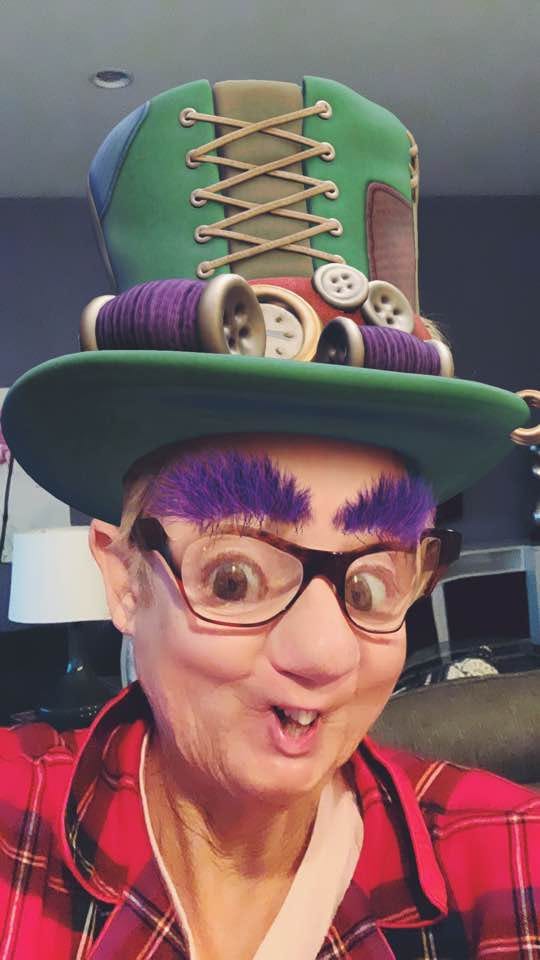
What I was dressed up as for Oregon Country Fair. Somehow I just couldn’t get the pupils right.
Honestly I missed it. I remembered how much it delights me to delight other people. Then the delights just keep amplifying from there, like a silly face bouncing off a mirror back into another mirror, and on and on into infinity.
I used to be all about the silliness, but then I became a teenager and discovered my angsty side that wanted to be seen. Then I became more politically and environmentally conscious as a young adult and felt a powerful urge to speak truth to power and discover ways we could repair our relationships to each other and the rest of our environments.
For a while there, and still at times, I would even resent other people for being silly when I had to (or thought I had to) be serious. Now I recognize I had taken that burden upon myself, maybe because I was trying to prove how grown up and insightful I was. Funnily enough, when I returned to silliness, I could still feel the self-seriousness of that inner critic judging me, silencing me.
To some extent, this was an adaptation with good intentions, recognizing the fraught political and social climates we live in, but I took it too far. While the hype about political correctness can be overblown or used in bad faith, there is a kernel of truth to it in some circles. If we always expect ourselves to be sensitive to every perspective, we’re never going to feel comfortable expressing our own without couching it in platitudes to the point that it becomes meaningless. To me, it’s not only less clear but also less satisfying to say “I’m going through a dark time right now, but know there’ll be a sunrise soon on the horizon,” than “Well, this fucking sucks.” Who am I trying to impress with the former? Someone who can’t allow for the fact that everyone struggles at times and wants to be honest about it without immediately bright-siding it?
This impulse — to take on the weight of human history to guide how I speak and act in this time that, to anyone paying attention, seems like a pretty pivotal point in it — led me to a more holistic understanding of myself and my world. It also put enormous pressure on everything I did, resulting in recurring bouts of depression, anxiety, attentional deficits, physical pain, and a general inability to be fully present and responsive to whatever was right in front of me. One of my therapists called this global thinking. I was so intent on becoming a hero, I wouldn’t let myself merely be human.
Well, no more!
Okay, maybe tomorrow — we’ll see which way the wind blows me.

Maybe back to Serious Jeffree.
To me, humans are fundamentally silly creatures. We can be so profoundly intelligent, creative, and beautiful it stupefies me. It can also get us into profound trouble, but we all (over the age of 10 at least) know that by now, even if we believe in different reasons why.
It’s often useful, but ultimately silly, to have the advanced reasoning capacities we do, when so many of the most important things in life operate beyond reason. It’s silly how we’re all about 99.9% the same but still can’t help but fixate on that 0.1% of differences. It’s silly how we can have existential crises and write philosophical tomes trying to understand what everything means, when the deepest understanding comes from letting go and existing in that wondrous uncertainty.
That’s when we can let ourselves play, and play together, and from that purposefully insignificant play emerges some of our most important work. Are you starting to see what a grand silly paradox life is at its core? Probably you already knew it, and just need to keep remembering it, to experience some fantastical levity to counteract the mundane gravities and responsibilities of life that will always bring you back down.
Humor, play, and silliness are there to help us react to and reconcile these unavoidable contradictions. When you’re wallowing in the depths of despair and I’m riding high on the wings of joy, or vice versa, a good joke can bridge the gap between laughter and tears and teach us to allow room for both. When we hold essentially opposing beliefs — say I think assault rifles are the route of all evil, and you think they’re marvelously fun and necessary tools without which our children could never be safe — but we must still come together to build a fire and cook a meal together, a silly sing-along can get us back on the same wavelength, literally, and remind us we don’t need to solve all of society’s problems before dinner.
If we both consent not to take ourselves so seriously all the time and let it in, laughter is the great reconciler, one of the most powerful weapons evolution has equipped in our emotional arsenal.
Throughout human history, as articulated in David Graeber and David Wengrow’s The Dawn of Everything, festivals like the Oregon Country Fair have served as an occasion to let go of usual customs of behavior and get a little bit crazy. Then afterwards, some of the inspirations and ideas that unfolded within that craziness are gradually integrated back into the everyday life of society. We blast off into space and then arrange the moon rocks we managed to hold on to around our living rooms. I got a lot of lessons from the Oregon Country Fair, but the most important reminder for me is to let my silly side shine and weave it into my everyday life, no matter what else may be going on in the world, because it’s needed.

The view from the last Sasquatch Music Festival, 2018
Now for a hard left turn.
I love being a poet. It’s one of my favorite identities to play with. Sometimes I think I’m the best at it, and sometimes I think I fucking suck. When I’m calm, however, I can recognize these thoughts are more a manifestation of my mood than an indicator of the objective quality of the work itself.
A lot of my self-judgment came from looking out at other poets’ work I saw represented on bookshelves or in literary magazines and feeling like mine didn’t quite fit in. It was neither completely serious nor completely silly, neither strictly personal nor strictly universal. It was sometimes short and sweet, sometimes long-winded and verbose (that means using a lot of fancy words stacked on top of each other).
In short, it was uncategorizable by comparison, and I felt a lot of dread thinking that I needed to categorize it and mimic others in order to be recognized for my gifts of expression. I would even stop myself from sharing my poetry or essays at all because I wanted to make sure they were perfect before I did.
And I would bring this same pressure into other forms of writing or even relaxed conversation, looking for the cues of how others were acting and speaking to calculate precisely how I should act and speak to fit in, impress them, and improve the environment. I still have tons of weighty philosophical essays gathering dust in my journals and Word documents I could try to organize and perfect to diagnose what’s wrong with our self-serious supremacist culture and provide my ideological prescriptions to fix it.

Indeed it is.
Fuck that.
That emphasis on fixing or conforming to expectations to reach as wide an audience as possible completely misses the point of poetry or social interaction, for me at least. The point is not to be taken seriously as an artist or solve anyone else’s problems, but to express and delight myself and anyone else who happens to be around and cares to hear or read what I have to say. If not, no hard feelings, I understand that we’re all humans and have a frankly ridiculous amount of other things going on inside and around us at any given moment.
The point of art is not to fit in, but to stand out, which, paradoxically as usual, is what makes one able to fit in after all. Sometimes it is important to be very controlled and deliberate in how we express ourselves, but we also need to allow the exact opposite, to be chaotic and silly.
We must take some accountability for how we act in the world, but also surrender to the fact that we don’t really get to decide how we show up. We don’t decide the faces, voices, or personalities we’re born with and grow into, but at certain points, we do get to make choices about how and when to channel them appropriately, or inappropriately.
Poetry, like comedy, is a place where what is normally inappropriate can be allowed, which is part of what attracted me about it, after I had become so dreadfully loyal and serious about making a positive impact on the bleak world I found myself in. These moments of ecstatic spontaneity that undermine our expectations are essential in their inessentialness. They keep us going through all the boring, depressing, nerve-wracking and devastating shit life has to throw in us.
Well that’s about all I have to say for now, but I never know how to end things gracefully. Here’s a little ditty to sum up all these words in just a breath, one of my poetic couplets I would’ve been too precious about to throw out off the cuff, once upon a time:
This is a dark timeline I’m playing jumprope with.
Now go forth, fellow humans, and own your silliness. Weigh in unexpectedly on a conversation you hear in passing. Make that cheesy dad joke to your barista. Strike a goofy pose on the dancefloor. Practice your funniest face at a child. Wave your arms when your shoulders are sore like the waving arm inflatable tube mascots at car dealerships.
Whatever you do, no matter how important it seems at times, play with it at others. It’ll keep your love lives fresh. Do it without expectation on other people to react, and you might find the lack of pressure you’re putting on yourself helps them take some of the pressure on themselves too.
Prompt for feedback: How do you build silliness into your everyday life? How could you? How could you?!
메타데이터
- post_id
- dabd0078fbe8
- slug
- the-necessity-of-silliness-dabd0078fbe8
- url
- https://medium.com/@jeffreemorel/the-necessity-of-silliness-dabd0078fbe8
- canonical_url
- https://medium.com/@jeffreemorel/the-necessity-of-silliness-dabd0078fbe8
- author_url
- https://medium.com/@jeffreemorel
- status
- ok
- fetched_at
- 2026-07-08 08:37:11