Why are SI base units considered fundamental, and how are derived units formed using combinations…
Measurement is a fundamental part of science because it allows scientists to accurately observe, compare, and understand natural phenomena…
Why are SI base units considered fundamental, and how are derived units formed using combinations of base quantities like mass, length, and time?
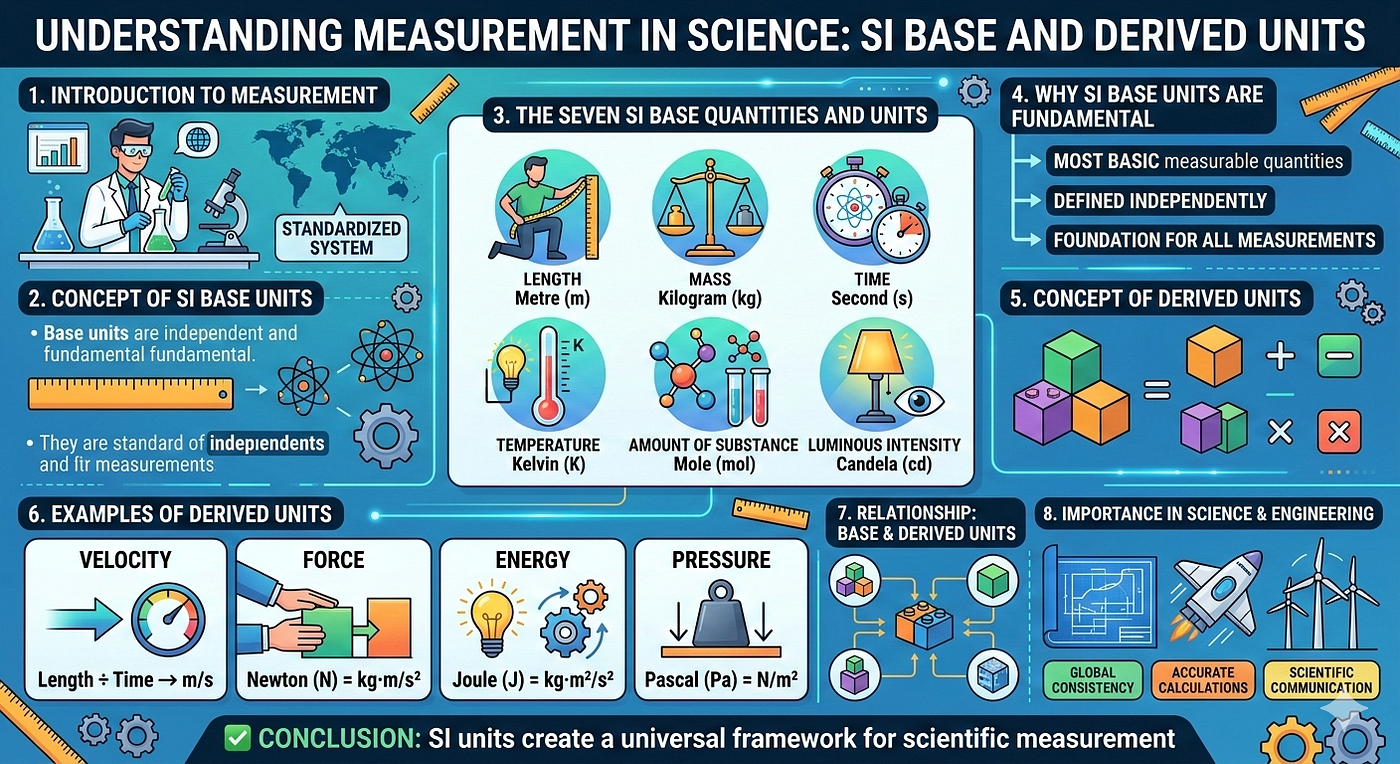
A comprehensive overview of the International System of Units, highlighting the seven fundamental base units and how they create complex derived units for scientific measurement.
Measurement is a fundamental part of science because it allows scientists to accurately observe, compare, and understand natural phenomena. Without measurement, scientific experiments and observations lack accuracy and reliability. To ensure consistency around the world, scientists use a standardized system called the International System of Units. This system provides common units for measuring physical quantities such as length, mass, and time. Standardized measurements help researchers communicate results clearly and reproduce experiments anywhere in the world. By using accepted units such as the meter, kilogram, and second, science maintains accuracy, consistency, and reliability across all areas of study.
Concept of SI Base Units
The concept of SI base units is the foundation of the International System of Units, which is the globally accepted standard for scientific measurement. SI base units represent fundamental physical quantities that are considered independent of each other. These units are not derived from any other units and serve as the basic building blocks for all measurements used in science, engineering, and technology.
There are seven SI base units that correspond to the seven fundamental physical quantities. For example, length is measured in meters, mass in kilograms, and time in seconds. Similarly, electric current is measured in amperes, temperature in kelvins, amount of substance in moles, and luminous intensity in candela. Each of these units represents a specific physical property that can be measured independently.
These base units are essential because they provide a consistent and universal reference for measurements around the world. Scientists and engineers rely on them to ensure that measurements are accurate, comparable, and valid. By establishing these base units, the SI system creates a reliable framework from which many other complex measurements and derived units can be developed.
The Seven SI Base Quantities and Units
The International System of Units is a globally accepted system used for scientific measurement. It is based on seven fundamental physical quantities, called SI base units. Each base unit has a specific base unit, which serves as the basis for measuring many other physical quantities. These units are considered fundamental because they are independent and cannot be expressed in terms of other units. From these base units, many derived units used in science and engineering are formed.
The seven SI base units and their associated units are given below.
- Length
Length measures the distance between two points. The SI base unit for length is the metre (m). It is widely used in physics, engineering, and everyday measurements such as heights, distances, and dimensions of objects.
2. Mass
Mass refers to the amount of matter contained in an object. The SI base unit for mass is the kilogram (kg). It is the only SI base unit that already has a prefix in its name and is commonly used to measure the mass of physical objects.
3. Time
Time measures the duration of events. The SI base unit of time is the second (s). It plays an important role in describing speed, velocity, and many physical processes.
4. Electric Current
Electric current is the flow of electric charge through a conductor. Its SI base unit is the ampere (A), which is widely used in electrical and electronic systems.
5. Thermodynamic Temperature
Temperature measures the degree of heating or cooling of a body. The SI base unit of temperature is the kelvin (K). It is commonly used in scientific calculations related to heat and energy.
6. Amount of Substance
This quantity measures the number of particles, such as atoms or molecules, in a substance. Its SI base unit is the mole (mol).
7. Luminous Intensity
Luminous intensity describes the intensity of light emitted in a specific direction. The SI base unit is the candela (cd).
These seven fundamental units form the basic outline of scientific measurement and support accurate calculations in all fields of science.
Why SI Base Units Are Considered Fundamental
SI base units are considered fundamental because they represent the most basic and independent physical quantities used in scientific measurement. These units form the foundation of the International System of Units, which is the globally accepted standard for measurement. Each base unit is related to a fundamental physical quantity that cannot be expressed in terms of other units. Because of this independence, they serve as the starting point for defining all other measurements in science.
The seven base units describe essential quantities found in nature. For example, length is measured in meters, mass in kilograms, and time in seconds. Other base units include the ampere for electric current, the kelvin for temperature, the mole for the amount of substance, and the candela for luminous intensity. Each of these units is precisely defined using universal physical constants, ensuring accuracy and consistency worldwide.
These base units are fundamental because they serve as the building blocks for all other units. More complex quantities such as velocity, force, and energy are mathematically obtained by combining the base units. This structured system allows scientists and engineers to describe physical phenomena clearly and consistently. As a result, SI base units provide a reliable framework that supports scientific research, technological development, and international communication in measurement.
Concept of Derived Units
In the International System of Units, many physical quantities cannot be described using only base units. To express such quantities, scientists use derived units. Derived units are created by combining two or more SI base units through mathematical operations such as multiplication or division. These units help describe more complex physical relationships that occur in nature and in scientific experiments.
Derived units are based on base quantities such as the meter (length), the kilogram (mass), and the second (time). By combining these base units, scientists can define other important quantities. For example, velocity is measured as distance divided by time, so its unit is meters per second (m/s). Similarly, acceleration is expressed as meters per second squared (m/s²), which shows how velocity changes over time.
Many commonly used scientific units are derived units. For example, the newton is the unit of force and is expressed as kg m/s². The unit of energy, the joule, is written as kg·m²/s². Pressure is measured in pascals, which are equal to newtons per square meter.
Derived units are necessary because they allow scientists and engineers to describe complex physical phenomena using combinations of simple base units. This makes scientific calculations clear, consistent, and universally understandable.
Examples of Derived Units
Derived units in the International System of Units are created by combining base units through mathematical relationships such as multiplication or division. These units help describe more complex physical quantities that cannot be represented by a single base unit.
A common example is velocity, which describes how fast an object is moving in a particular direction. It is measured by dividing its length by time and is expressed in meters per second (m/s). Another related quantity is acceleration, which measures the rate of change of velocity. Acceleration is expressed in m/s², meaning that velocity changes by a specific number of meters per second per second.
Force is another derived quantity that describes how an object’s momentum changes when a push or pull is applied. In SI units, force is measured in newtons (N), which are defined as kg m/s². This means that force depends on mass, length, and time.
Similarly, energy represents the ability to do work and is measured in joules (J), equivalent to kg m²/s². Pressure, which describes the force exerted per unit area, is measured in pascals (Pa) and is defined as N/m². These derived units show how the fundamental SI base quantities combine to describe many physical phenomena in science.
Relationship Between Base and Derived Units
The relationship between base units and derived units is fundamental to the International System of Units, which provides a standardized way to measure physical quantities. Base units represent the most fundamental and independent quantities in physics, such as the meter for length, the kilogram for mass, and the second for time. These units serve as the basis for all other measurements. Because they are independent, they cannot be expressed in terms of other units.
Derived units, on the other hand, are created by mathematically combining base units through multiplication, division, or exponentiation. These combinations allow scientists to describe more complex physical quantities. For example, velocity is expressed in meters per second (m/s), which combines length and time. Similarly, acceleration is measured in meters per second squared (m/s²).
Many important physical quantities are described using derived units. Force is measured in newtons, which are defined as kilogram·m/s² and combine mass, length, and time. Energy is measured in joules, while pressure is measured in pascals.
Thus, base units serve as the building blocks of a measurement system, while derived units extend these foundations to describe a wide range of physical phenomena in science and engineering.
Importance in Science and Engineering
The International System of Units plays an important role in science and engineering because it provides a universal standard for measurement. When scientists and engineers from different countries use the same units, they ensure that experimental results, calculations, and data are easily understood and comparable. This consistency reduces confusion and prevents errors in scientific communication.
- In scientific research
Accurate measurements are essential for testing theories and conducting experiments. Using SI base units such as the meter, kilogram, and second, researchers can accurately describe physical quantities and reproduce experiments anywhere in the world. This standardization strengthens collaboration among scientists and allows discoveries to be validated by others.
- In engineering
SI units are important for designing machines, buildings, electronic devices, and transportation systems. Engineers rely on derived units such as the newton for force and the joule for energy to measure loads, energy transfer, and structural strength. Accurate measurements help ensure safety, efficiency, and reliability in technological systems.
The SI system supports innovation, global cooperation, and technological progress. By providing a consistent framework for measurement, it enables scientists and engineers to develop new technologies, improve existing systems, and solve complex problems that benefit society.
Conclusion
The International System of Units provides a universal framework for scientific measurement. Its base units represent the most fundamental physical quantities and are defined independently, forming the foundation of the entire system. Units such as the meter, kilogram, and second serve as building blocks for describing physical phenomena. From these base quantities, many other units are created through mathematical combinations to create derived units such as the newton and joule. This structured system ensures consistency, accuracy, and clarity in measurements in scientific research, engineering, and everyday applications, enabling scientists around the world to communicate results effectively and reliably.
See more articles
- What is the principle of homogeneity of dimensions, and how does it ensure that both sides of a physical equation remain dimensionally consistent?
- How do absolute error, relative error, and percentage error differ from each other, and how are they used to express the accuracy of a measured quantity?
- How is the least count of a vernier caliper and a screw gauge calculated, and how does zero error affect the final corrected measurement value?
- How are significant figures determined in multiplication and division operations, and why is maintaining proper significant figures important in scientific calculations?
메타데이터
- post_id
- dae4eb6a487b
- slug
- why-are-si-base-units-considered-fundamental-and-how-are-derived-units-formed-using-combinations-dae4eb6a487b
- url
- https://medium.com/@sciencespectrum/why-are-si-base-units-considered-fundamental-and-how-are-derived-units-formed-using-combinations-dae4eb6a487b
- canonical_url
- https://medium.com/@sciencespectrum/why-are-si-base-units-considered-fundamental-and-how-are-derived-units-formed-using-combinations-dae4eb6a487b
- author_url
- https://medium.com/@sciencespectrum
- status
- ok
- fetched_at
- 2026-08-11 15:29:11