Telco AI: The 6G Nervous System or Another Costly Telco Mirage?
Jimmy CHOW
Telco AI: The 6G Nervous System or Another Costly Telco Mirage?
Jimmy CHOW
Abstract
Is “Telco AI” the 6G savior or just another billion-dollar gimmick? At MWC 2026, T-Mobile’s President &CTO, John SAW’s vision of “Kinetic Tokens” and 6G’s ISAC (Sensing) have been hailed as the “nervous system” of the future of telco network, especially 6G. But behind the “AI-native” slogans lies a familiar reality: high “compute taxes,” resource contention in AI-RAN, and a history of unfulfilled 5G promises. This article deconstructs the T-Mobile CTO’s vision through “Jimmy’s Acid Test” — exploring whether operators are truly building a trillion-dollar intelligence layer or simply repeating the ROI mistakes of the past two decades.
(Note: I will use these two concepts, Physical AI & Telco AI, interchangeably without distinction. Outside the teleco industry, Physical AI carries a more specific connotation. )

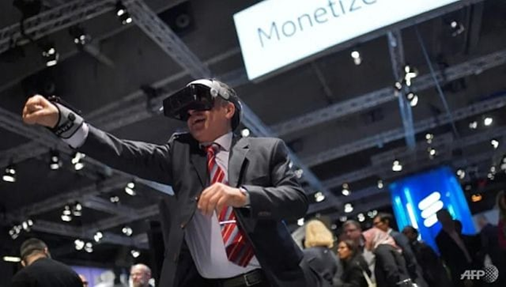
photo credit: internet
Physical AI and AI were hot topics at this year’s MWC. As a flagship professional exhibition for the communications industry, executives from both equipment manufacturers and operators would be embarrassed if they didn’t talk about AI, mention it in interviews, or present AI-driven future strategies for their companies.
“Why Physical AI Begins with Intelligent Networks” — T-Mobile’s CTO John Saw published this blog post on February 17, 2026, just ahead of MWC Barcelona 2026 (March 2–5). At the event, the concept of “AI-native” became the focal point of every conversation. This timing coincided with major showcases from the AI-RAN Alliance, the release of new white papers on AI/ML improvements to RAN, and the establishment of the GSMA-led Open Telco AI Initiative on March 2, 2026. This new alliance, supported by founding partners like AT&T and AMD (and joined by over two dozen global entities), focuses on tailoring AI models for telco-specific tasks through open collaboration on models, data, compute benchmarks, and tools — echoing the “AI-native everything” slogan that permeated MWC 2026 sessions, keynotes, and exhibits.
Saw’s blog positions T-Mobile as a pioneer in the convergence of artificial intelligence and wireless networks, emphasizing that “Physical AI” is the next frontier.
What follows is a structured, in-depth analysis of his views, goals, current status, challenges, and commercial viability. My primary purpose is to share these industry perspectives, insights, and controversies with my peers.
My views stem from his blog posts and some MWC 2026 interviews which you can find from MWC 2026 news reports. I also referenced the AI-RAN TG#1 white paper (which I analyzed in detail in another article, particularly regarding consistency on emerging topics such as AI-native air interfaces, CSI enhancement, RRM, sustainability, and semantic communication/digital twins), as well as the broader MWC 2026 context (e.g., GSMA’s push for carrier-grade models and NVIDIA’s AI-RAN demonstrations in collaboration with global operators).
I will incorporate some profound personal reflections here, because in this industry, aside from hard-won experience and lessons learned, mere “technological leadership” claims are often hollow. While Saw’s vision is optimistic, or over optimistic, in my experience, he MAY overstate the central role of telecommunications in the AI ecosystem and the true place of AI within telco networks. He risks repeating the 5G era’s mistakes: low ROI regarding computing “taxes” and ecosystem fragmentation — errors the industry has been repeating for the past two decades, with increasing enthusiasm each time.
1. The Chief Technology Officer’s Core Viewpoint
John Saw frames wireless evolution as gradual and cumulative, contrasting it with AI’s explosive growth. He argues that AI is transitioning from “digital realm” tools (e.g., generative AI for reasoning/creation) to Physical AI: systems that do not just analyze but actively interact with the physical world through real-time perception, reasoning, decision-making, and action. Examples include autonomous machines, robots, cameras, digital twins, and intelligent infrastructure.
Consequently, this shift fundamentally changes network requirements. This is why John Saw wrote this blog post; he believes he has seen the future.
Key Concept: From Informational to Kinetic Tokens
Saw introduces “Kinetic Tokens” as a paradigm shift. Unlike passive “informational tokens” (data used for description or prediction), these are actionable data constructs that initiate physical outcomes like movement, control, or coordination.
Quote: “Kinetic tokens demand more than bandwidth. They require time-space coherency, deterministic performance, ultra-low latency, synchronization across devices and continuous learning at the edge. Most importantly, they require a network that understands that these tokens are not passive. They are operational. This is where telecom networks become central to the future of Physical AI.”
This aligns with the AI-RAN white paper’s emphasis on AI for real-time RAN functions (e.g., channel estimation, beamforming, and scheduling), where AI embeds adaptability into dynamic environments.* But I have analyzed that not all scenario will find the place for AI in RAN*.
Technically speaking, “Kinetic Tokens” is not a 3GPP term, but a marketing concept co-created by T-Mobile and NVIDIA, I think. Essentially, it refers to executable data commands with “intent, context, and timeliness.” In 5G-Advanced (Rel-18/19), this corresponds to XR (Extended Reality) and Deterministic Networking (DetNet). Rel-19 is currently strengthening low-latency jitter control to ensure commands are sent both quickly and reliably. For 6G (Rel-20 Pre-study), true “power tokens” will require sub-millisecond air interface latency. Current discussions focus on Semantic Communications, where the network doesn’t just transmit bits but understands the “meaning” of instructions (e.g., “fetch” or “turn left”) and optimizes transmission priorities based on the physical environment.
In reality, Kinetic Tokens are simply a highly sophisticated repackaging of URLLC 2.0. At MWC 2026, Ericsson/NVIDIA demonstrated robots processing “visual feedback + action commands” in real-time via a GPU-accelerated core on a 5G SA network. This is considered a prototype of Kinetic Tokens. Similarly, the TSC (Time Sensitive Communication) industrial gateways used in Siemens factories are based on this same concept.
Jimmy’s Challenge: If AI-RAN truly places Layer 1 workloads and AI applications on equal footing within a single GPU, we face a fundamental question: What happens when an AI app — say, a complex factory vision system — suddenly spikes in demand for compute? Does it crowd out communication signaling, causing a network drop, or is the AI’s compute capped, effectively lobotomizing the application? T-Mobile talks about a shared platform, but have they truly solved the puzzle of determinism under such fierce resource competition?
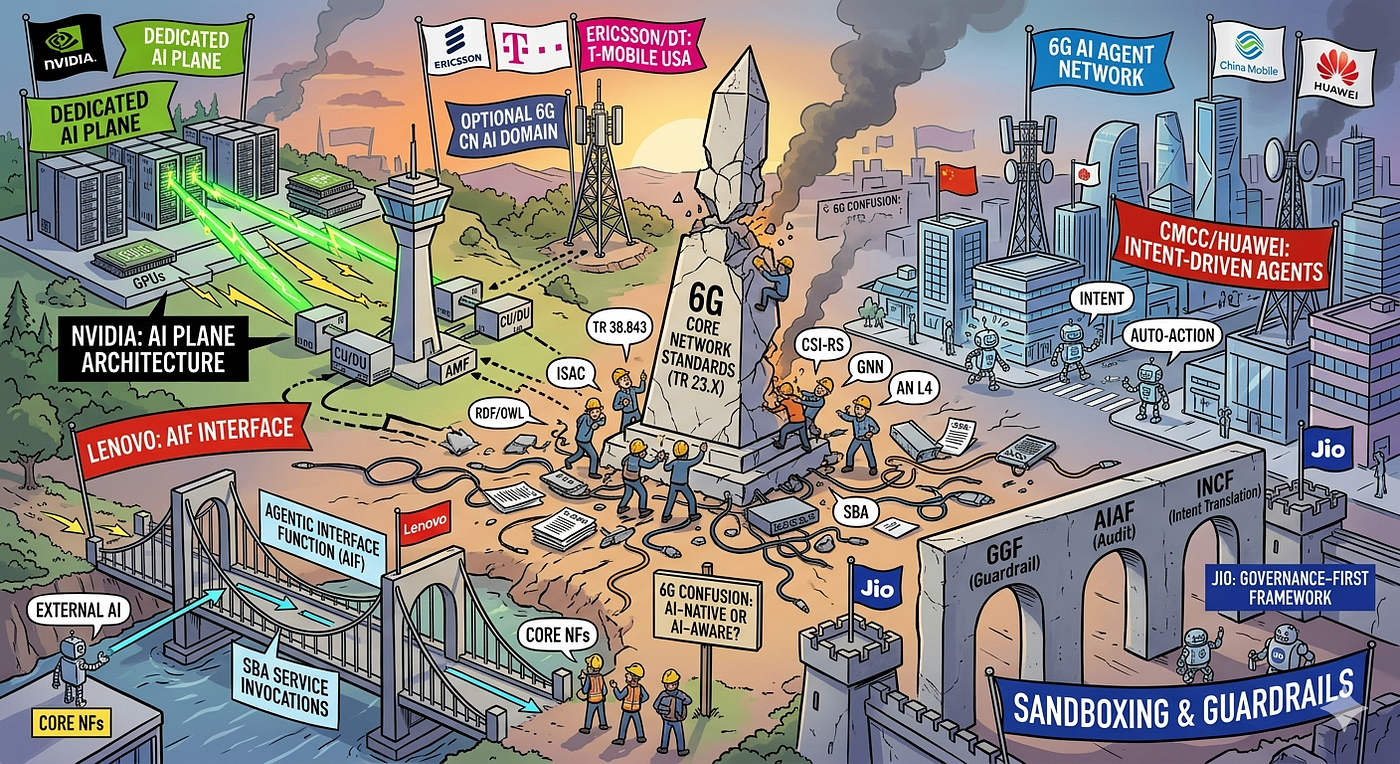
The confusion surrounding AI-RAN stems from a basic misunderstanding of network roles: the RAN is, at its core, an access point providing a communication pipe. Even if certain RAN signal-processing functions (Layer 1) are offloaded to GPUs or hardware accelerators to allow the rest of the stack to run on COTS (Common Off-The-Shelf) platforms as targeted in Open-RAN, this does not imply that every base station should — or even needs to — perform AI-based content recognition and processing. Such an approach defies common sense.
If there is a genuine requirement to offload tasks or use AI to process data content at the edge, that is precisely the definition and objective of MEC (Mobile Edge Computing), which is an interesting point in 5G. Conflating the two in the RAN layer creates an unnecessary conflict between connectivity stability and application compute, a puzzle of determinism that the industry has yet to solve.
Telcos’ Central Role in Physical AI
Saw views telecom networks as the “nervous system” for Physical AI, uniquely positioned due to distributed edge infrastructure, deterministic connectivity, security frameworks, and national-scale operations. Networks evolve from “passive data pipes” to active enablers of edge decisions and peer-to-peer collaboration. This echoes Open Telco AI’s focus on telco-specific AI models (e.g., AT&T’s open models for hardware-agnostic tasks) and AI-RAN’s demos (e.g., GPU-accelerated RAN with concurrent AI workloads).
- Jimmy’s View: The “nervous system” is a poetic metaphor, but in the gritty reality of Physical AI (robots, autonomous vehicles), *local decision-making is the absolute priority*. No industrial robot or self-driving car would dare offload its core control logic entirely to the network. At best, the network serves as a supplementary data source — a useful sensor, perhaps — but NEVER **the “brain” or “central nervous system” where life-and-death logic resides.
6G as an AI-Native Inflection Point
6G isn’t just about speed; it’s the first “AI-native” generation, converging connectivity, sensing (ISAC — Integrated Sensing and Communications), localization, and computing. Quote: “6G brings the convergence of connectivity, sensing, localization and computing into a fabric precise and responsive enough for machines to perceive their environment, coordinate with one another and make decisions in real time.” This mirrors the AI-RAN TG#1 vision (e.g., ISAC in Chapter 8) and MWC 2026 hype, where alliances like O-RAN pushed for “intelligent 6G networks, open from day one.”
- ISAC is arguably the most revolutionary feature of 6G, enabling base stations to transmit electromagnetic waves that both carry data and sense objects like radar.
Rel-19 (Study Item): Preliminary research on channel modeling is underway. We need to understand the reflection characteristics of 5G/6G waveforms (like OFDM) when they encounter people, drones, or vehicles.
Rel-20 (6G Normative): Expected to enter the standards phase. The focus is on designing a “shared waveform”, allowing base stations to use the same energy for both communication and detection.
However, sensing reflected signals and performing complex signal processing requires massive computing power. This brings us back to my logic of the “compute tax” — electricity costs could potentially double just to enable base stations to “see.” Furthermore, privacy laws will impact practical applications; if a network can “see” people inside a house, does that violate privacy? While “Sensing Integration” is key to transforming base stations from “pure cost centers” to “asset leasing” (selling data to traffic depts or security firms), it remains a significant hurdle.
- Jimmy’s View: The claim of being ‘Born Ready for 6G’ carries a heavy scent of PR fluff, reminiscent of the old promise that 4G could jump to 5G with a simple software patch. While 5G Standalone (SA) is a necessary foundation, 6G demands massive hardware shifts: mmWave/Terahertz spectrum, entirely new antenna architectures, and dedicated ISAC silicon. These are physical leaps that today’s 5G base stations simply cannot achieve through a mere software update.
so, are your ready to pay ?
AI-RAN as an Architectural Enabler
AI-RAN is described as an effort to run telecom and AI workloads concurrently on shared infrastructure, essential for Physical AI scalability. Saw highlights T-Mobile’s AI-RAN Innovation Center in Bellevue, with demos alongside Nokia, Ericsson, and NVIDIA (e.g., Layer 1 workloads on NVIDIA Grace Hopper GPUs with real-time AI video captioning). Quote: “These demonstrations matter… because they establish something foundational. The network can evolve into a multi-function, multi-cloud platform capable of supporting connectivity and intelligence simultaneously.”
- Jimmy’s View:
Saw’s views are operator-centric, repositioning telcos from connectivity utilities to AI ecosystem orchestrators. This is strategically savvy — T-Mobile leverages its 5G SA lead to claim it is “born ready for 6G.” However, it subtly downplays the dominance of AI giants (NVIDIA’s Jensen Huang, for instance, underscores AI as “essential infrastructure” like electricity). In reality, telcos risk becoming mere “pipes” if AI models aren’t telco-optimized. Saw’s Kinetic Tokens idea is innovative but abstract — potentially a rebrand of edge computing to reclaim narrative control from hyperscalers.
Commercially, this remains a high-risk gamble. Operators must invest heavily in edge compute and high-frequency sites. If manufacturers ultimately decide that a physical network cable or a dedicated line is more reliable, then ISAC and Kinetic Tokens will become the most expensive gimmicks of the 6G era. Why not invest in truly profitable applications like MEC and 5G NPN (5G Non-Public-Network) on existing heavyly invested 5G networks?
“Telco AI” is a catchy slogan, but most of it cannot be achieved with an affordable ROI. Intelligent MEC is a far more viable AI application. 5G NPN should have been widespread long ago; instead, Wi-Fi still dominates the factory floor. This demonstrates how unrealistic and overly ambitious these operator efforts can be.
2. John SAW’s Goals
Saw’s objectives are twofold: technical and strategic, aiming to accelerate Physical AI while solidifying telco relevance.
- Technical Goals: Build networks supporting kinetic tokens with edge intelligence, determinism, and ISAC for real-time physical-digital fusion. Demonstrate AI-RAN feasibility (e.g., GPU-accelerated RAN without performance loss), enabling concurrent workloads for efficiency. Leverage 5G Advanced as a bridge to AI-native 6G.
- Strategic Goals: Unlock “tens of trillions” in Physical AI economic value, positioning telcos as indispensable for robots/factories. Foster partnerships (e.g., with NVIDIA) to lead standards. Quote: “Leadership… comes from proof points earned through discipline, bold innovation and partnerships.”
Jimmy’s View: These goals are ambitious but pragmatic — focusing on “proof” via demos helps counter the hype fatigue from the 5G era. Yet, they overlook ecosystem silos. Open Telco AI’s launch signals a push for collaboration, but Saw’s T-Mobile-specific center risks further fragmentation. The true goal? Monetize telco assets (spectrum, edge) in the AI era. But this requires overcoming vendor lock-in, a lesson the industry should have learned from Open RAN and others.
3. Realities and Challenges
Realities:
- Progress Demonstrated: Demos prove AI-RAN coexistence (e.g., real-time video captioning alongside RAN workloads). This validates shared infrastructure for Physical AI, aligning with AI-RAN whitepaper OTA tests like DeepRX.
- Economic Scale: The potential for connected robots/factories is grounded in McKinsey/NVIDIA estimates. Telcos’ existing edge strengths are genuine assets.
- Timing Alignment: 5G SA enables immediate testing, while 6G standards allow for AI-native design from the ground up.
Challenges:
- Technical Hurdles: Kinetic tokens require ultra-low latency, but current networks aren’t fully edge-optimized. Challenges like model drift and compute overhead (GPU energy consumption in mMIMO) persist.
- Architectural Shifts: Retrofitting AI is inefficient; edge decisions demand peer-to-peer capabilities beyond centralized clouds. Data privacy for kinetic tokens remains an unresolved minefield.
- Adoption Barriers: Saw acknowledges there is no “finished system,” implying significant scalability issues. While Open Telco AI addresses dataset scarcity, telco-specific models still lag far behind general AI.
*Jimmy’s View:* The realities show momentum, but the challenges are understated. The “nervous system” metaphor is apt, yet telcos face a massive “AI tax”: compute and energy costs could easily offset any gains, echoing the underutilized slices of 5G. Profoundly, this risks “hype cycle fatigue” **— if these demos don’t scale, Physical AI becomes just another unfulfilled promise, you/telcos already have if you have lived in this industry long enough: RCS, NFV, Cloud-native, NFV, Slicing, Open-RAN…
4. Commercial Feasibility from a Business Perspective
From a business lens, Saw’s vision has moderate to low feasibility (4/10) — offering potential but carrying significant risks.
Feasibility Aspects:
- Monetization: Physical AI unlocks B2B growth (factories, autonomous vehicles). Telcos could charge for “premium edge AI slices” or ISAC-based sensing services.
- Ecosystem Momentum: Alliances like AI-RAN (128 members) and Open Telco AI foster standardization. ROI could potentially mirror the projected $250B edge computing market.
- T-Mobile’s Edge: Its nationwide 5G lead enables early adoption and AI-optimized spectrum efficiency.
Jimmy’s Acid Test: Why haven’t these goals been reached in 5G? These are the same MEC and Vertical-related services promised during the 5G hype.
Low Feasibility Aspects:
- Cost Barriers: AI-RAN requires expensive GPUs/NPUs. The white paper warns of an “AI backlash” where energy consumption offsets gains. Nationwide scaling could inflate OPEX/CAPEX, repeating 5G’s $1T+ global spend for modest ROI.
- Competition/Fragmentation: Hyperscalers and AI giants (NVIDIA) already dominate the edge; telcos risk being relegated to “dumb pipes” again.
- Regulatory/Privacy Risks: Kinetic tokens and real-time localization trigger massive compliance friction (GDPR, FCC). No telco centrality is not end of the world for this industry.
Jimmy’s Final View:
Commercially, feasibility hinges on ROI.
Physical AI could transform telcos into $trillion players, but it’s a double-edged sword.
Operators must avoid “Vendor Lock-in 2.0” (e.g., total NVIDIA dependency). If Open Telco AI succeeds in hardware-agnostic models, feasibility rises to 5/10; otherwise, it’s just a “beautiful dream.”
We are looking at vast complexity for marginal revenue, with telcos paying a “dual tax” on both compute and data.
Success requires convergence, but without solving the energy and sustainability puzzle, Physical AI remains aspirational, not inevitable. T-Mobile’s proofs are a start, but the real test lies in post-MWC deployment metrics.
Professional Bio / Collaboration Offer
Strategic Network Transformation & Integration Expert
I am currently open to new professional opportunities and consulting engagements.
If your organisation is navigating the complexities of multi-generation network integration (2G/3G/4G/5G) or managing the intricate network architectures and fragmented service platforms that arise from mergers and acquisitions (M&A), I offer the expertise to streamline your operations.
My focus is on driving operational efficiency and fostering competitive advantage by aligning current infrastructures with future-ready network evolution. Whether working independently or embedded within your existing team, I provide end-to-end support — from situational analysis and strategic roadmap design to hands-on implementation and seamless transition.
Let’s collaborate to transform your legacy complexities into a lean, agile, and future-proof digital foundation.
Mar. 3, 2026
메타데이터
- post_id
- dae5eb85634f
- slug
- physical-ai-the-6g-nervous-system-or-another-costly-telco-mirage-dae5eb85634f
- url
- https://medium.com/@mountdavistechnologies/physical-ai-the-6g-nervous-system-or-another-costly-telco-mirage-dae5eb85634f
- canonical_url
- https://medium.com/@mountdavistechnologies/physical-ai-the-6g-nervous-system-or-another-costly-telco-mirage-dae5eb85634f
- author_url
- https://medium.com/@mountdavistechnologies
- status
- ok
- fetched_at
- 2026-09-11 08:57:08