What If Black Holes Are Not the End of Physics?
A new open-access publication explores whether black holes hide structured physics near the horizon, not empty space or singularities.
What If Black Holes Are Not the End of Physics?
A new open-access publication explores whether black holes hide structured physics near the horizon, not empty space or singularities.
The strange “emptiness” near a black hole
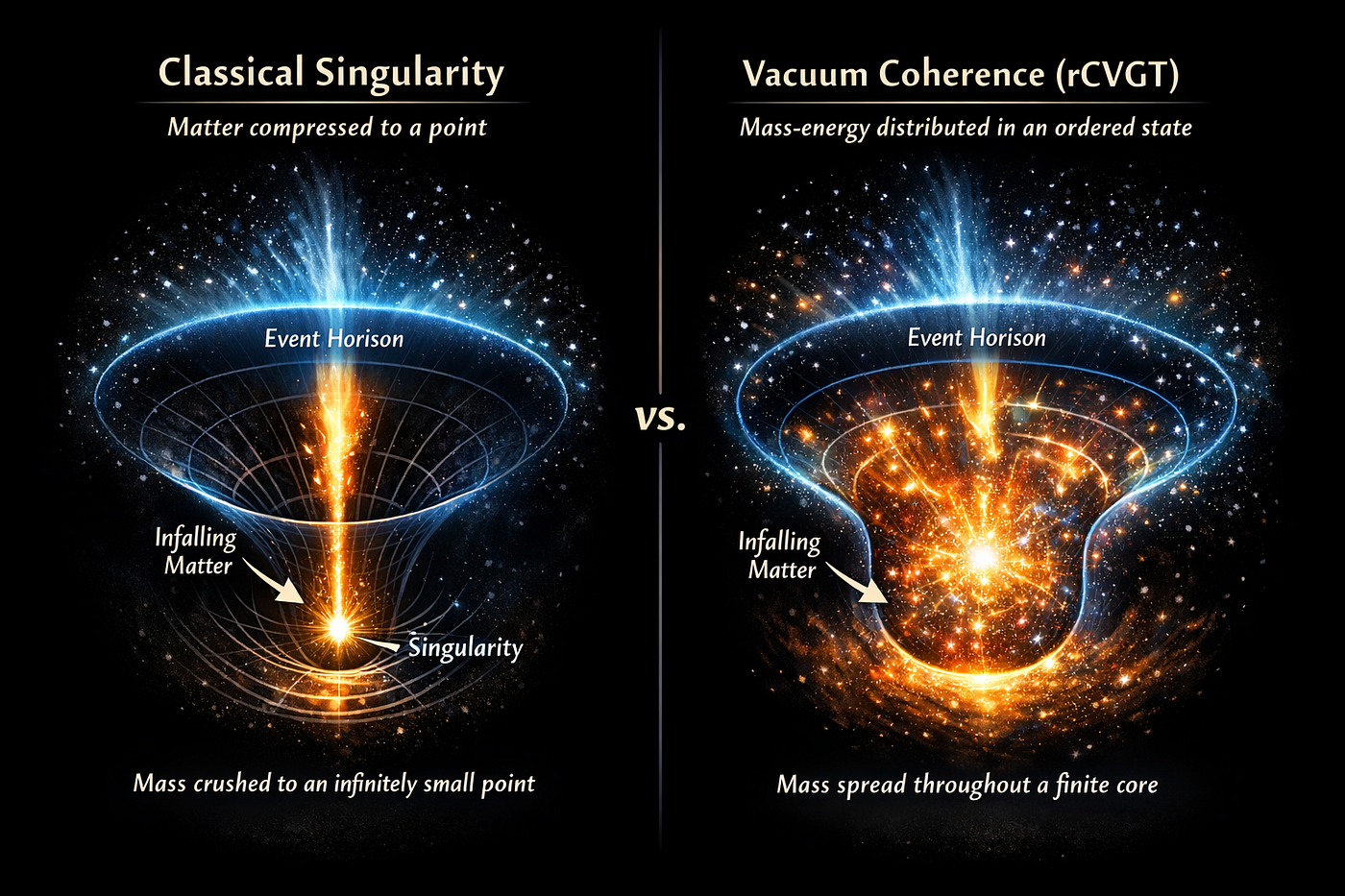
When people hear that black holes are “empty,” it can sound completely wrong. A black hole forms when a massive star collapses, so surely something must be inside. The more careful statement is that, in the classical description of General Relativity, the matter that forms the black hole collapses inward, crosses the horizon, and is no longer described as ordinary structured matter near that horizon. The mass remains visible from outside through the gravitational field, but the region close to the horizon is treated as locally vacuum. In the traditional picture, the collapsing matter is driven toward the central singularity, where the mathematics of the theory breaks down.
This distinction matters. Physicists do not usually love the idea of singularities. A singularity is often described as a point where density or curvature becomes infinite, but infinities in physics are rarely comforting answers. They are usually signs that a theory has been pushed beyond its valid range. General Relativity has been extraordinarily successful, yet black holes expose its limits. When quantum effects are included, black holes are expected to emit Hawking radiation. If that radiation is purely thermal, it appears unable to carry away the detailed information about what originally fell in. This is the black hole information paradox, and it suggests that something important is missing from the semiclassical picture
Why the horizon cannot just be empty
The usual black hole picture relies on a powerful assumption: near the horizon, spacetime looks locally like empty vacuum. For many calculations this works beautifully. But for the information paradox, it becomes a problem. If radiation comes from a region with no structure, then where is the information stored, and how does it escape? If all the details of the original matter are hidden behind the horizon and eventually compressed toward a singularity, then the final radiation seems disconnected from the initial state.
This is why many approaches to quantum gravity try to modify the near-horizon region. The change does not need to be visible far away from the black hole. Far from the horizon, General Relativity can remain an excellent approximation. But close to the horizon, especially where entropy and quantum effects become central, the assumption of emptiness may be too simple. A consistent theory may need something physical there: degrees of freedom, microstructure, or an organized state capable of storing and releasing information.
In this way, the information paradox and the singularity problem may be related. Both problems arise when the classical description treats the black hole as too simple. The horizon is too empty, the interior is too featureless, and the endpoint is too mathematically extreme. The alternative is to ask whether black holes are not empty geometric traps, but structured physical systems.
Samir Mathur and the fuzzball idea
One of the most influential attempts to rethink this picture is the fuzzball proposal, developed especially by Samir D. Mathur and collaborators in string theory. Mathur’s central claim is bold: a black hole should not be understood as an empty region with a horizon surrounding a singularity. Instead, it should be understood as an enormous ensemble of quantum microstates, built from the extended objects of string theory, such as strings and branes.
The word “fuzzball” can sound informal, but the idea is serious. In this picture, the microstates responsible for black hole entropy are not hidden at a tiny central point. They extend outward to roughly the scale of the classical horizon. The black hole is therefore not a hollow container with all the important structure hidden at the center. It is a horizon-sized quantum object. What looks like a smooth classical black hole from far away may be a coarse-grained average over many underlying microstates.
This is important because it changes the origin of radiation. In the standard semiclassical picture, Hawking radiation comes from quantum fields near a horizon treated as vacuum. In the fuzzball picture, radiation can come from the microstate structure itself. That gives information somewhere to live and something physical to escape from. The proposal is not complete in every detail, especially for realistic astrophysical black holes, but it introduced a crucial principle: resolving the information paradox may require order-one structure at the horizon scale, not tiny corrections to an otherwise empty horizon.
A second language, the coherent vacuum fields
The open-access publication discussed here asks whether the fuzzball idea may have a macroscopic counterpart in another framework called Relativistic Coherent Vacuum Gravity Theory, or rCVGT. In this view, strong gravity is not treated as fundamentally caused by spacetime curvature. Instead, what we call gravitational behavior is described as emerging from the dynamical organization of the vacuum itself. Curvature can still appear as an effective geometric description, but it is not the deepest physical driver in the theory.
The vacuum is therefore not treated as simple nothingness. It is described through effective fields that represent coherence, local time-rate, and directed vacuum structure. In the strong-field regime, rCVGT suggests that gravitational collapse does not continue all the way to an infinite singularity. Instead, the system approaches a coherence-saturated state. In plain language, the vacuum becomes highly organized, and physical processes slow dramatically in the collapsed region. Rather than reaching an infinite point, the system may settle into a finite, structured configuration.
The important point is not that rCVGT has already been derived from string theory. It has not. The publication is careful about this. Its proposal is more modest and more specific: perhaps fuzzball microstates and coherent vacuum fields are two descriptions of the same kind of strong-field structure. Fuzzballs would describe the microscopic quantum side. rCVGT would describe the macroscopic effective side. One speaks the language of strings and branes. The other speaks the language of collective vacuum fields.
Coarse graining, the bridge between both pictures
The key idea connecting these two descriptions is coarse graining. This is common throughout physics. A glass of water contains an enormous number of molecules, but we usually describe it with temperature, pressure, density, and flow. These large-scale quantities are not illusions. They are real and useful, but they summarize microscopic behavior rather than listing every microscopic detail.
The same logic may apply to black holes. A microscopic theory might contain a vast number of horizon-scale quantum microstates. A macroscopic theory might describe their collective behavior through effective fields. The coherence field would measure how organized the underlying degrees of freedom have become. The time-rate field would describe how physical processes slow down in the strong gravitational regime. The vacuum-flow field would describe the directional structure of the organized vacuum.
This is why the work is best understood as a correspondence framework or ansatz, not as a final theory. It does not prove that rCVGT follows from fuzzball microstates. It proposes a dictionary between two levels of description. The scientific value lies in making that dictionary explicit enough that future work can test, sharpen, or reject it. A real theory would still need to derive these effective fields from microscopic dynamics, reproduce black hole entropy, recover General Relativity in weak fields, and explain radiation in a calculable way.
Beyond the singularity
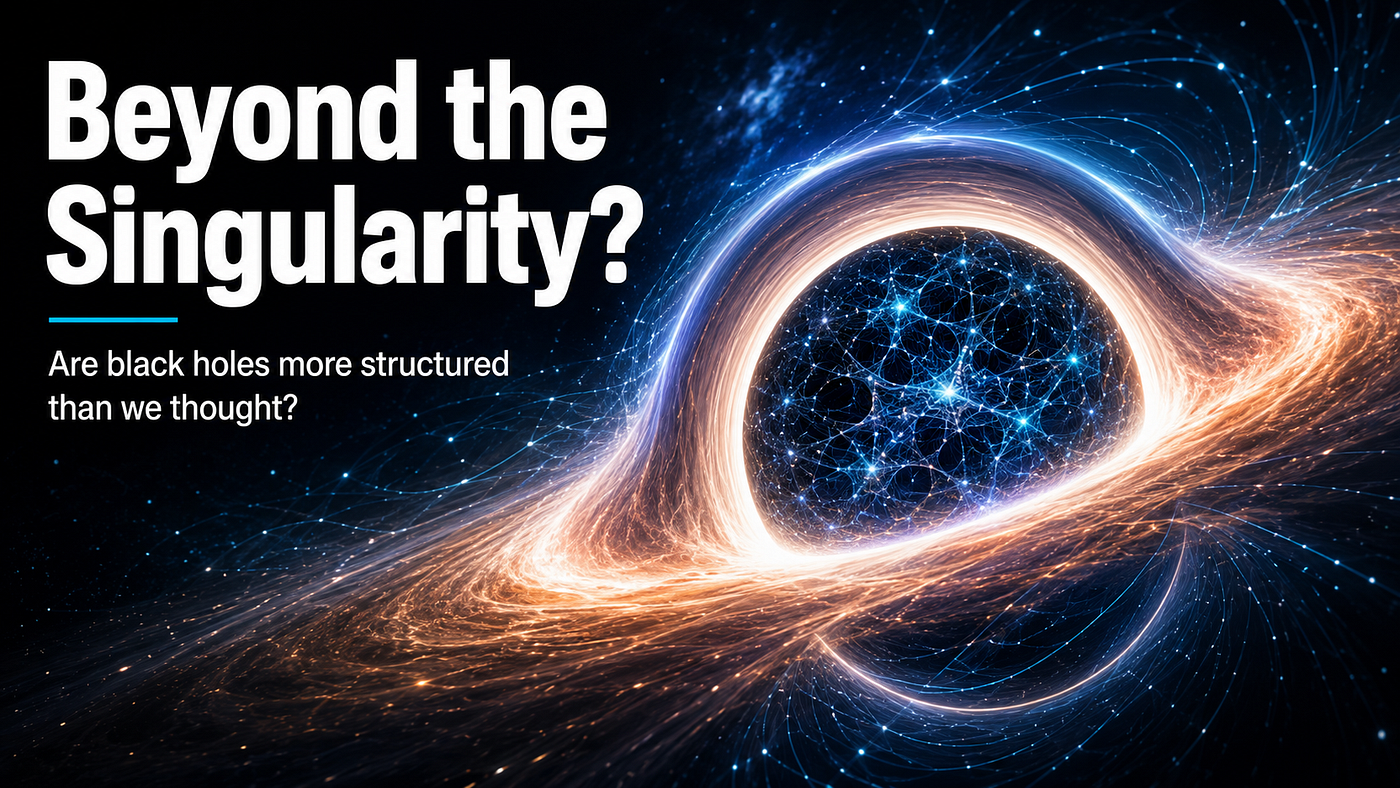
The deeper message is that singularities may not be physical endpoints. They may be signs that our current mathematical language is too coarse. If a theory says that nature becomes infinite, it may be telling us that the theory has stopped seeing the relevant structure. Black holes may be the place where this becomes unavoidable.
The fuzzball proposal suggests that the horizon is not empty, but filled with microscopic quantum structure. The coherent vacuum picture suggests that collapse may end in an organized strong-field state rather than an infinite point. The new correspondence between them explores whether these are two sides of a larger idea: black holes may be structured, information-carrying configurations, not empty geometries hiding impossible infinities.
This does not remove the hard work. It only points to a path. The next step is to turn the correspondence into something more predictive, more mathematical, and eventually testable. But even as a framework, it offers a useful shift in perspective. Perhaps black holes are not where physics ends. Perhaps they are where a deeper layer of physical organization begins to show itself.
메타데이터
- post_id
- dae6173909ec
- slug
- what-if-black-holes-are-not-the-end-of-physics-dae6173909ec
- url
- https://medium.com/the-idea-of-reality/what-if-black-holes-are-not-the-end-of-physics-dae6173909ec
- canonical_url
- https://medium.com/the-idea-of-reality/what-if-black-holes-are-not-the-end-of-physics-dae6173909ec
- author_url
- https://medium.com/@steen_m_n
- status
- ok
- fetched_at
- 2026-06-24 04:09:36