FLUX vs Stable Diffusion: Which Should You Use in 2026?
FLUX vs Stable Diffusion: Which Should You Use in 2026?
FLUX vs Stable Diffusion: Which Should You Use in 2026?
FLUX vs Stable Diffusion: Which Should You Use in 2026?
A practical comparison from someone who runs both in production.
FLUX dropped in August 2024 and changed everything. Suddenly Stable Diffusion felt dated. But is FLUX actually better for your use case? After running both models at scale for Apatero, here’s my honest take.
The Short Answer
Use FLUX for photorealism, text rendering, and prompt adherence. Use Stable Diffusion for anime, stylized art, and when you need massive LoRA ecosystem support.
Now let me explain why.
What is FLUX?
FLUX is a text-to-image model from Black Forest Labs, created by former Stability AI researchers (the same people who made Stable Diffusion). It comes in three variants.
FLUX.1 Pro is the best quality, API-only, not open weights. FLUX.1 Dev is high quality, open weights for non-commercial use. FLUX.1 Schnell is faster, lower quality, fully open source (Apache 2.0).
For most users, FLUX.1 Dev is the sweet spot.
What is Stable Diffusion?
Stable Diffusion has been around since 2022 and has multiple versions. SD 1.5 is the most compatible with LoRAs and extensions. SDXL is higher quality, 1024x1024 native. SD 3 and 3.5 are newer but with less community adoption.
The ecosystem is massive. Thousands of fine-tuned models, LoRAs, and custom workflows.
Quick Comparison
Image quality: FLUX wins for photorealism, SD wins for anime styles.
Text in images: FLUX handles text almost perfectly, SD still struggles.
Speed: SD 1.5 is fastest, FLUX schnell is competitive, FLUX dev is slower.
VRAM usage: FLUX needs 12GB+, SD 1.5 runs on 4GB, SDXL needs 8GB.
LoRA ecosystem: SD has thousands, FLUX has hundreds and growing.
Prompt following: FLUX is significantly better at understanding complex prompts.
Price (cloud): FLUX costs more per image on most platforms.
Photorealism: When to Choose FLUX
FLUX excels at realistic humans. Skin texture, hair, eyes, hands. The improvements in hand generation alone make FLUX worth it for many use cases.
Test prompt: “Professional headshot of a 35-year-old woman with brown curly hair, warm smile, wearing a navy blazer, soft studio lighting, shallow depth of field”
FLUX produces images that look like actual photographs. SD produces images that look like AI generations. The difference is immediately noticeable.
If you’re generating product photos for e-commerce, professional headshots and portraits, architectural visualization, or anything requiring photographic realism, FLUX is the clear winner.
Text Rendering: FLUX’s Killer Feature
Photo by Brett Jordan on Unsplash
Stable Diffusion cannot render text reliably. “Coffee Shop” becomes “Cofee Shoo” or worse. FLUX handles text nearly perfectly.
Test prompt: “Vintage neon sign reading ‘OPEN 24 HOURS’ glowing red against a dark brick wall”
FLUX gets it right. SD gets it wrong almost every time.
This matters for logo mockups, signage visualization, meme generation, book covers and posters, UI mockups, and social media graphics.
If text is part of your workflow, use FLUX.
When to Choose Stable Diffusion
The SD ecosystem has years of specialized models. Anything based on anime, manga, comic art, or highly stylized looks has better support in SD land.
Models like MeinaMix, CounterfeitXL, and hundreds of anime checkpoints produce better results than FLUX for these styles. FLUX can do stylized art, but it defaults toward photorealism.
If you’re generating anime characters, manga-style illustrations, comic book art, or heavily stylized visuals, stick with Stable Diffusion and its specialized checkpoints.
The Ecosystem Advantage
LoRAs let you add specific concepts, characters, or styles without training a full model. The SD ecosystem has thousands of publicly available LoRAs on Civitai.
FLUX LoRAs exist and are growing, but the selection is smaller. Want to generate a specific celebrity, fictional character, or niche art style? SD probably has a LoRA for it. FLUX might not yet.
This gap is closing. New FLUX LoRAs are released daily. But if you need obscure concepts today, SD is more likely to have them.
Speed and Resource Requirements
FLUX.1 Dev at 1024x1024 takes about 20–30 seconds on an RTX 4090. Stable Diffusion XL takes about 5–10 seconds. SD 1.5 takes about 2–4 seconds.
FLUX.1 Schnell is faster (4–8 seconds) but lower quality.
VRAM requirements:
FLUX.1 Dev needs 12GB minimum, 16GB+ recommended.
SDXL needs 8GB minimum.
SD 1.5 runs on 4GB.
If you’re running locally on consumer hardware, SD is more accessible. FLUX really wants a 4090 or M-series Mac with 24GB+ unified memory.
FLUX Understands You Better
Complex prompts with multiple subjects, spatial relationships, and specific attributes work better in FLUX.
Test prompt: “A red chair to the left of a blue table, on top of the table is a green vase with yellow flowers, background is a white wall with one framed painting”
FLUX gets the spatial relationships right most of the time. SD often scrambles objects, puts the chair on the wrong side, or merges elements together.
For simple prompts like “a cat sitting on a windowsill,” both perform well. For complex scenes with multiple elements, FLUX is significantly better.
Cost Comparison
Running your own hardware, SD is cheaper because it requires less powerful GPUs and runs faster.
Using cloud APIs:
FLUX.1 Pro via Replicate: ~$0.055 per image.
FLUX.1 Schnell via fal.ai: ~$0.003 per image.
SDXL via Replicate: ~$0.02 per image.
SD 1.5 via various: ~$0.005 per image.
For high-volume production, SD is more economical. For quality-critical work, FLUX Pro is worth the premium.
At Apatero, we offer both so users can choose based on their needs.
Inpainting and Editing
SD has mature inpainting workflows. Draw a mask, fill it with new content. Works reliably.
FLUX inpainting is newer and still being refined. The FLUX Kontext model handles editing workflows, but the tools and nodes are less mature than SD equivalents.
For production inpainting workflows today, SD is more reliable. This will likely change as FLUX tooling matures.
ControlNet and Conditioning
ControlNet transforms image generation by giving precise control over pose, depth, edges, and more.
SD has excellent ControlNet support. Multiple preprocessors, well-documented workflows, community presets.
FLUX ControlNet support exists but is newer. The results are good, sometimes better than SD, but the workflow is less polished and documentation is sparse.
If ControlNet is central to your workflow, SD has the edge for now.
My Recommendations by Use Case
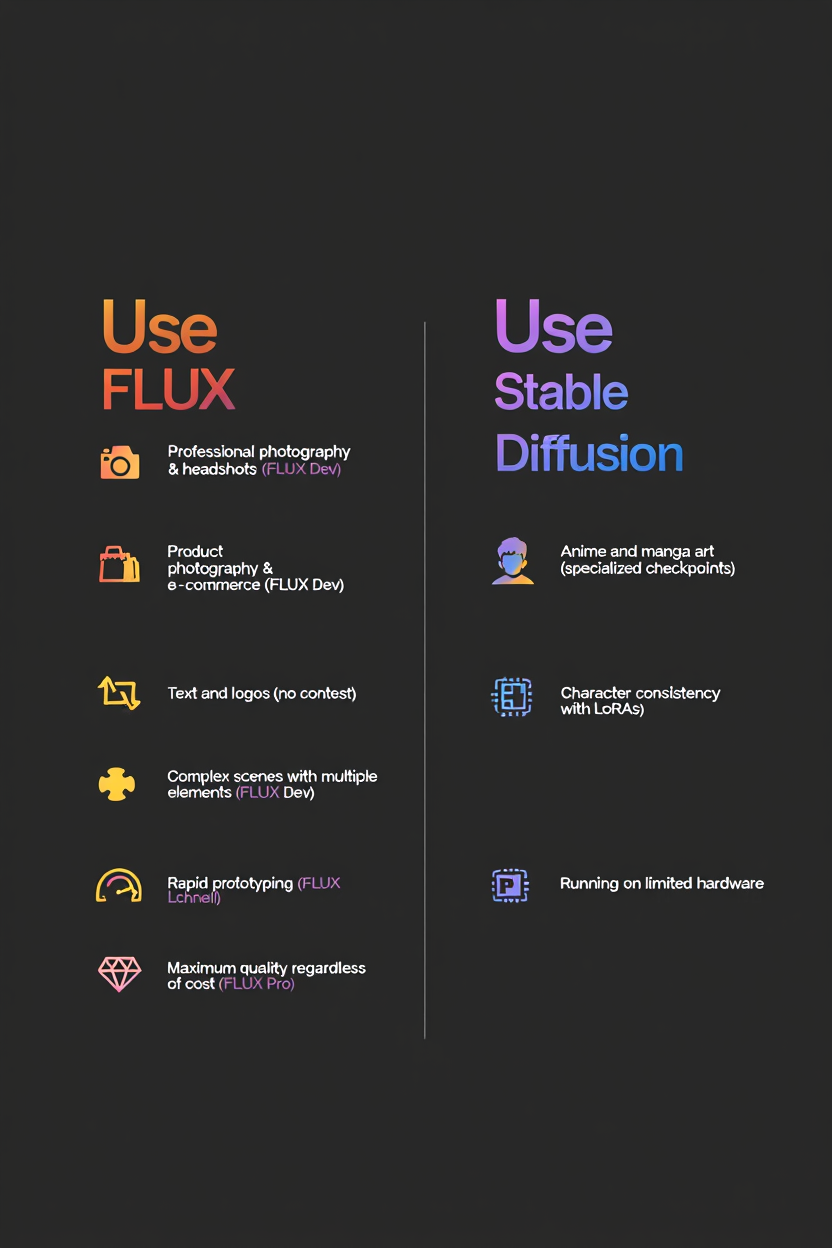
For professional photography and headshots, use FLUX Dev.
For product photography and e-commerce, use FLUX Dev.
For text and logos, use FLUX (no contest).
For anime and manga art, use SD with specialized checkpoints.
For rapid prototyping and iterations, use SD 1.5 or FLUX Schnell.
For complex scenes with multiple elements, use FLUX Dev.
For character consistency with LoRAs, use SD (for now).
For running on limited hardware, use SD.
For maximum quality regardless of cost, use FLUX Pro.
The Convergence is Coming
FLUX LoRAs are being released daily. ControlNet support is improving. The ecosystem gap is closing.
In a year, the choice might be simpler: FLUX for everything except specific SD-only workflows. But today, both have their place.
You don’t have to choose one. Many production workflows use both.
Generate base images with FLUX for photorealism. Use SD for anime-style variations. Apply SD LoRAs for specific characters or styles. Use FLUX for any text rendering.
The tools (ComfyUI especially) support switching between models in the same workflow.
Wrapping Up
FLUX is better at photorealism, text rendering, and prompt understanding. Stable Diffusion has a larger ecosystem, runs on cheaper hardware, and excels at stylized art.
Pick based on your use case, not hype.
For a comparison tool that lets you run both models side by side, check out ToolIndex (https://toolindex.net) where we catalog AI tools with honest comparisons.
For more AI image generation guides, I write at AstroSEOBlog.
What’s your experience with FLUX vs SD? Let me know in the comments.
메타데이터
- post_id
- daf2147cd454
- slug
- flux-vs-stable-diffusion-which-should-you-use-in-2026-daf2147cd454
- url
- https://medium.com/@kgabeci/flux-vs-stable-diffusion-which-should-you-use-in-2026-daf2147cd454
- canonical_url
- https://medium.com/@kgabeci/flux-vs-stable-diffusion-which-should-you-use-in-2026-daf2147cd454
- author_url
- https://medium.com/@kgabeci
- status
- ok
- fetched_at
- 2026-06-21 12:17:11