Where To Buy TB-500 UK
For researchers in the UK sourcing TB-500 for legitimate laboratory work, finding a supplier that meets the documentation and purity…
Where To Buy TB-500 UK
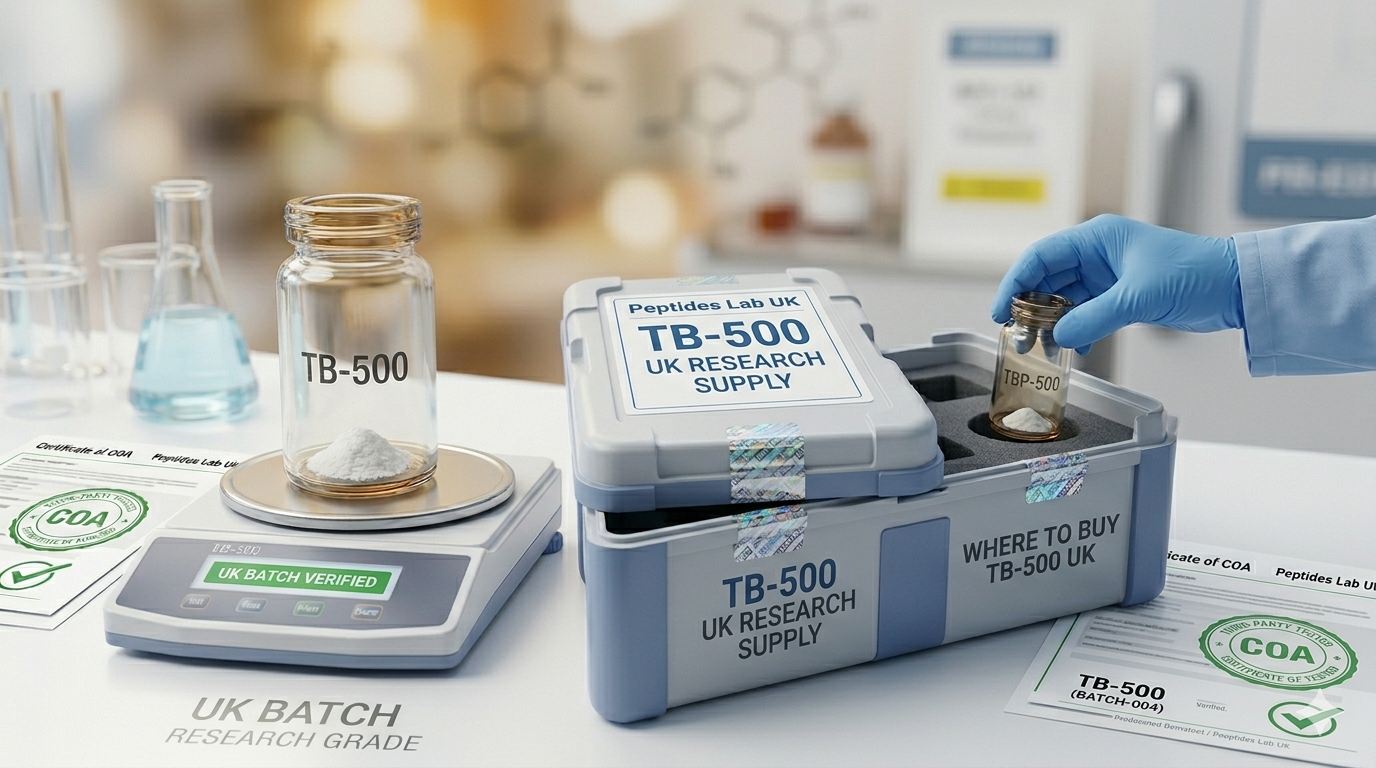
For researchers in the UK sourcing TB-500 for legitimate laboratory work, finding a supplier that meets the documentation and purity standards required for credible preclinical research is the critical first step. TB-500 is available from a range of online sources, but quality varies considerably. Suppliers who cannot provide independently verified Certificates of Analysis, batch-specific purity data, or clear storage guidance are not appropriate sources for research-grade peptide material.
This article is designed to help researchers understand what TB-500 is, how it is studied in laboratory settings, and what to look for when sourcing it in the UK. All content is presented for research and educational purposes only. TB-500 is not intended for human consumption, has no approved clinical application, and nothing here constitutes medical advice or a health claim.
What Is TB-500?
TB-500 is a synthetic analogue of Thymosin Beta-4, a naturally occurring 43-amino acid protein found in high concentrations in blood platelets, wound fluid, and various tissues throughout the body. The TB-500 used in laboratory research is a synthesised peptide fragment produced to replicate aspects of Thymosin Beta-4’s biological activity under controlled research conditions.
It is water soluble and commonly supplied as a lyophilised (freeze-dried) powder, reconstituted in sterile or bacteriostatic water for use in in vitro or in vivo preclinical studies. TB-500 has appeared in peer-reviewed preclinical literature across several research disciplines, primarily in rodent models. It is not an approved medicine and must not be used as a therapeutic agent.
How Does TB-500 Work in Research?
Preclinical research interest in TB-500 is centred primarily on its apparent interaction with actin and the biological processes that interaction may influence in laboratory models. The following proposed mechanisms are based on in vitro and in vivo animal model data only, and have not been confirmed through approved human clinical trials.
-
Actin upregulation — preclinical studies have noted apparent changes in actin dynamics in cell models treated with TB-500 under laboratory conditions. Actin is a structural protein involved in cell shape, internal transport, and division.
-
Cellular migration — laboratory research has pointed to possible involvement in cell movement in tissue biology models using animal subjects, an area of interest in structural tissue research.
-
Angiogenesis — rodent model studies have noted observations related to new blood vessel formation in certain tissue environments, a research area relevant to vascular biology.
-
Inflammatory marker interactions — a subset of animal model studies has noted changes in inflammatory signalling markers when TB-500 was present, though this research remains early and exploratory.
-
Progenitor cell activity — some in vitro research has examined TB-500 alongside progenitor cell behaviour, though findings in this area are limited and preliminary.
All proposed mechanisms are drawn from preclinical research only. Researchers should review the primary literature and interpret findings in the context of animal model limitations before designing experimental protocols.
Why Is TB-500 Studied?
TB-500 attracts laboratory research interest because of the biological pathways it appears to interact with in preclinical models. Its connection to actin, one of the most structurally and functionally significant proteins in cellular biology, makes it a relevant tool compound across several research disciplines.
The main research areas where TB-500 has appeared in the preclinical literature include:
-
Cellular biology — researchers studying actin dynamics and cell motility have used TB-500 as a tool compound in in vitro studies examining how cells organise, move, and divide under controlled conditions.
-
Vascular biology — laboratory research has examined TB-500 in angiogenesis models, looking at its apparent interactions with endothelial cell behaviour.
-
Tissue biology — rodent model studies have examined TB-500 in contexts related to muscle and connective tissue cellular activity, though all findings remain at an early research stage.
-
Inflammatory research — a subset of animal model studies has explored TB-500 alongside inflammatory cytokine markers, making it of interest to researchers studying immune-related biological processes in preclinical models.
TB-500 has not been evaluated in large-scale approved human clinical trials. All published findings are drawn from preclinical research and must be interpreted accordingly.
TB-500 Benefits in Research
The following represent areas of potential research interest based on currently available preclinical data. These are not confirmed benefits or guaranteed outcomes. Researchers should consult the primary scientific literature and form their own conclusions from the available evidence.
-
Actin-related cellular behaviour observed in in vitro laboratory models, noted as an area of active interest in cell biology research.
-
Cell migration activity observed in tissue biology laboratory studies using preclinical animal models.
-
Angiogenesis-related observations in endothelial cell assay conditions and rodent model studies.
-
Inflammatory marker changes noted in some animal model studies at an early and exploratory research stage.
-
Progenitor cell behaviour examined in a small number of in vitro studies, with findings considered preliminary at this stage.
Researchers may be interested in TB-500 as a tool compound for investigating actin-related biology, vascular mechanisms, or cellular migration in controlled preclinical conditions. No claims are made here regarding human health outcomes.
TB-500 Side Effects and Safety Considerations
TB-500 has not been evaluated through large-scale approved clinical trials in humans, meaning its safety profile in human subjects has not been established. Researchers working with this compound should be aware of the following considerations:
-
Purity standards — research peptide quality varies significantly between suppliers. Impure preparations compromise experimental results and create unnecessary laboratory risk. Researchers should only source TB-500 from suppliers providing a Certificate of Analysis from an accredited, independent third-party laboratory.
-
Contamination risk — poorly manufactured batches may contain residual solvents, bacterial endotoxins, or off-target peptide sequences. For in vivo preclinical work involving animal models, endotoxin testing data is a key quality and safety consideration.
-
No approved clinical safety data — TB-500 is not licensed for human therapeutic use in the UK or internationally. It must not be administered to humans and is not intended as a medicine or health supplement under any circumstances.
-
Storage integrity — lyophilised TB-500 should be stored under conditions specified by the supplier, away from light, heat, and moisture. Degraded or improperly stored peptide material can produce unreliable experimental data.
-
Institutional compliance — all laboratory research involving TB-500 should be conducted under appropriate institutional oversight and comply with applicable UK laboratory safety standards, research ethics requirements, and animal welfare legislation where relevant.
TB-500 UK: Supplier Types Compared
Not all sources of TB-500 in the UK offer equivalent quality or documentation. The table below outlines the key differences researchers should consider when evaluating potential suppliers.
Researchers should prioritise suppliers who offer independently verified quality documentation over those offering lower prices without supporting analytical data. For research purposes, a COA from a third-party accredited laboratory is a minimum requirement, not an optional extra.
What Researchers Look for When Sourcing TB-500 in the UK
Sourcing TB-500 for legitimate preclinical research requires careful evaluation of supplier credentials and documentation. The following criteria represent the standard a research-grade supplier should consistently meet:
-
Certificate of Analysis (COA) — every batch supplied should be accompanied by a COA from an independent, accredited analytical laboratory. The COA should confirm peptide identity, HPLC purity percentage, and the absence of common contaminants. Researchers should verify that the COA corresponds to the specific batch being purchased.
-
Third-party testing — a COA issued solely by the manufacturer does not constitute independent verification. Third-party laboratory testing, from a separately accredited facility, is the standard for research-grade peptide documentation.
-
HPLC purity data — high-performance liquid chromatography is the accepted method for confirming peptide composition and purity. Research-grade TB-500 is typically supplied at 98% purity or higher by HPLC.
-
Batch consistency — experimental reproducibility depends on consistent reagent quality across runs. Suppliers who provide batch-specific analytical documentation allow researchers to identify and account for any variation between lots.
-
Endotoxin testing — for in vivo preclinical studies, bacterial endotoxin levels are relevant to both data integrity and animal welfare. Reputable suppliers provide endotoxin test results alongside their standard COA.
-
Storage and handling guidance — TB-500 should be supplied with clear, specific storage instructions for both the lyophilised powder and any reconstituted preparation. Suppliers should be transparent about recommended storage temperatures and post-reconstitution timelines.
-
UK-based or UK-compliant supplier — sourcing from a UK-based specialist reduces import-related risk, supports faster delivery timelines, and simplifies compliance for UK research programmes.
Where To Buy TB-500 in the UK
Researchers based in the UK can access TB-500 research peptide through Peptides Lab UK. Each product listing is accompanied by third-party COA documentation, batch-specific purity data, and storage guidance appropriate for laboratory research use. All products are supplied strictly for preclinical and laboratory research purposes and are clearly marked as not intended for human consumption.
For researchers interested in related compounds, BPC-157 UK is also available through Peptides Lab UK, with the same standard of third-party documentation and batch verification.
Educational content on peptide science, COA interpretation, storage protocols, and responsible research practices is available on the Peptides Lab UK research blog. All resources are produced for research and educational purposes and are aligned with applicable UK laboratory standards.
Frequently Asked Questions
Is TB-500 legal to buy in the UK?
TB-500 is not listed as a controlled substance under UK legislation at the time of writing and may be purchased legally for legitimate laboratory research purposes. It is not a licensed medicine and must not be sold, marketed, or used as a health supplement or therapeutic agent. Researchers should confirm compliance with their institution and any applicable regulatory frameworks before procurement.
Is TB-500 intended for human consumption?
No. TB-500 is a research peptide supplied strictly for laboratory and preclinical research use. It is not intended for human consumption, is not an approved medicine, and must not be administered to humans. Any use outside a legitimately overseen research context is outside the intended and lawful use of the compound.
What purity level should research-grade TB-500 have?
Research-grade TB-500 is typically supplied at 98% purity or higher as measured by HPLC. Researchers should confirm purity data through an independent third-party COA before incorporating any batch into an experimental protocol. Suppliers who cannot provide this documentation are not appropriate sources for research-grade material.
Why does COA verification matter when buying TB-500?
A Certificate of Analysis from an independent, accredited laboratory confirms that the batch of TB-500 being supplied matches its stated identity, purity, and composition. Without this documentation, researchers cannot objectively verify the quality of what they are working with. Impure or misidentified peptides produce unreliable experimental data and introduce unnecessary risk into the laboratory environment. COA verification is a basic requirement of responsible research practice.
Can I buy TB-500 from a general supplement or health retailer?
TB-500 is a research peptide and should not be purchased from general supplement retailers or health stores. Such sources are unlikely to supply research-grade material with the quality documentation required for credible laboratory research. For research purposes, sourcing should be limited to specialist research peptide suppliers who provide transparent, independently verified COA documentation for every batch.
How should TB-500 be stored after purchase?
Lyophilised TB-500 should be stored at appropriate low temperatures, away from light and moisture, in accordance with the supplier’s storage instructions. Once reconstituted, the compound should be used within the timeframe specified by the supplier and stored under the conditions appropriate for the reconstituting solution. Standard laboratory peptide handling protocols should be applied throughout.
What is the difference between TB-500 and Thymosin Beta-4?
Thymosin Beta-4 is a naturally occurring 43-amino acid protein found in various tissues throughout the body. TB-500 is a synthetic analogue, a laboratory-produced peptide designed to replicate aspects of Thymosin Beta-4’s biological activity in research models. The two are related but not identical, and TB-500 should be treated as a distinct research compound with its own documentation and handling requirements.
Disclaimer
This content is for research and educational purposes only. Peptides discussed are not for human consumption and are not intended to diagnose, treat, cure or prevent any disease. Always follow applicable laws, laboratory standards and responsible research practices.
메타데이터
- post_id
- dafcc12780bc
- slug
- where-to-buy-tb-500-uk-dafcc12780bc
- url
- https://medium.com/@peptideslabuk/where-to-buy-tb-500-uk-dafcc12780bc
- canonical_url
- https://medium.com/@peptideslabuk/where-to-buy-tb-500-uk-dafcc12780bc
- author_url
- https://medium.com/@peptideslabuk
- status
- ok
- fetched_at
- 2026-06-09 15:37:30