Not All Interoperability Partners Are Created Equal: How to Score Provider Site Quality
Sources of medical records from sites used for evidence gathering for processes such as risk, HEDIS, and disability evaluation and prior…
Not All Interoperability Partners Are Created Equal: How to Score Provider Site Quality
Sources of medical records from sites used for evidence gathering for processes such as risk, HEDIS, and disability evaluation and prior authorization all vary substantially in quality.
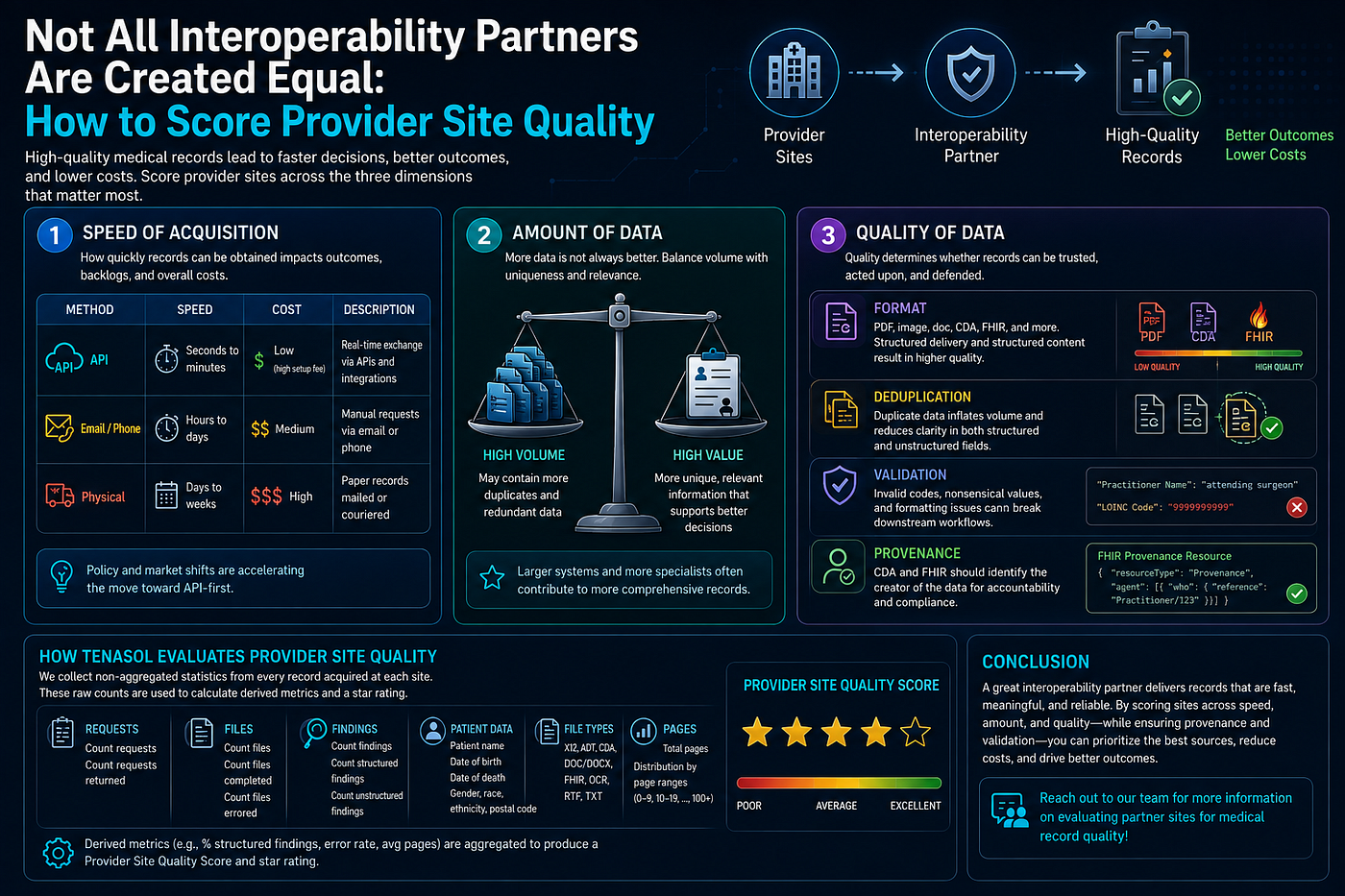
As such an interoperability partner’s value is is associated with how high that quality is. Provider site quality scores may be used to prioritize operations to determine which site should receive requests first to records that are faster and/or higher in quality. This can also save on collections costs.
When a medical record is collected for evidence gathering of an individual, there are broadly 3 ways it can be evaluated:
- Speed of Acquisition
- Amount of Data
- Quality of Data
Speed of Medical Record Acquisition
Method Speed Cost API seconds to minutes low (high setup fee) Email/Phone hours to days medium Physical days to weeks high

Speed of Medical Record Acquisition table
Generally, records may be obtained via API (seconds to minutes, lowest cost), email/phone request (hours to days, moderate cost), or physical gathering (days to weeks, high cost). Today, most medical records are collected via API or email/phone request, however policy requirements are shifting this more towards API.
Part of this is that patient outcomes are of course better when data may be acquired by the practitioner faster. The other part of this is that backlogs build up in processes such as prior authorization when evidence is slow to acquire — this builds inefficiencies requiring more human labor in those collections, which also results in a higher cost healthcare system.
Amount of Medical Data
The amount of data that a site generates is often dependent upon their electronic medical record system, internal practices, and the size of the facility. For example, some EMR systems may duplicate information heavily resulting in high amount of data, but not a high unique amount of data due to duplication that occurs during output rendering.
Larger hospital systems may aggregate more information on a system by having more specialists providing input into a patients history, as well as potentially a larger history.
Quality of Medical Data
Quality of data has multiple facets:
Format: Data may come in PDF, image, doc, CDA, FHIR, or a multitude of other formats. The more structured a format is on delivery. the higher the data quality. Also, just because the data format is structured does not mean that the data inside is structured. For example, a FHIR message may be a structured format, but may simply be encapsulating a PDF or make use of the unstructured fields heavily rather than using structured fields.
Deduplication: As stated in the quality section deduplication of medical data is a massive issue — and it occurs in both structured and unstructured data fields.
Validation: Structured fields, or code that exist in unstructured data may not pass validation. For example, a field seeking “Practitioner Name” may just say “attending surgeon”, or invalid codes may be present (e.g. a LOINC code that is not a real code, or is a series of 9’s or 0's). These data problems may come from the practitioner, issues with the EMR, or processes that occur along the way.
Another form of validation issue is associated with formatting — files may be corrupt or malformed, resulting in processing issues later. For PDF files this may mean they cannot even be opened. For CDA or FHIR, this may mean that they are structured nonsensically.

Example of a CDA
Provenance: Exclusive to CDA and FHIR, provenance is often a required resource whereby the creator of the data is required to be tagged such that liability may be attributed to a specified party. It could be a red flag if this is missing within the file.

Example of FHIR Record Structure
How Tenasol Evaluates Provider Site Quality

Tenasol Site Quality Evaluation
The following are collected from each individual site for all records acquired by that site:

Collection table for site records
These values are non-aggregated statistics. As in they are not percentages or derived statistics like mean or median. Derived values (such as percent structured findings) are then aggregated to form a number of statistics that used to feed Tenasol’s individual star rating for that site.
Conclusion
The value of an interoperability partner lies not only in delivering records but in ensuring they are fast to acquire, meaningful in scope, and reliable in quality. Speed of acquisition reduces backlogs and improves patient outcomes, while the amount of data must be balanced against duplication and relevance. Quality — spanning format, deduplication, validation, and provenance — ultimately determines whether records can be trusted and acted upon. Provenance in particular safeguards accountability and compliance. Together, these factors highlight that effective evidence gathering depends on more than access: it requires integrity, efficiency, and confidence in the data itself.
Reach out to our team for more information on evaluating partner sites for medical record quality!
메타데이터
- post_id
- db0dde9e2cf4
- slug
- not-all-interoperability-partners-are-created-equal-how-to-score-provider-site-quality-db0dde9e2cf4
- url
- https://medium.com/@tenasol/not-all-interoperability-partners-are-created-equal-how-to-score-provider-site-quality-db0dde9e2cf4
- canonical_url
- https://medium.com/@tenasol/not-all-interoperability-partners-are-created-equal-how-to-score-provider-site-quality-db0dde9e2cf4
- author_url
- https://medium.com/@tenasol
- status
- ok
- fetched_at
- 2026-08-06 11:15:05