Copywriting Your Way to Literary Success
Maybe you don’t have to be a struggling artist after all.
Copywriting Your Way to Literary Success
Maybe you don’t have to be a struggling artist after all.
Photo by Marvin Meyer on Unsplash
A couple of weeks ago, I met a young writer—let’s call him Evan—whose work I admire. You can tell immediately that he’s got the gift, the raw talent to become a successful author of literary fiction.
Unfortunately for my young friend, success does not always—actually, not often—mean you can make a living as a full-time writer. He’s been working as a barista, “barely scraping by,” he said. And although his auto-fiction is somewhat exaggerated, it reflects his financial struggles: choosing whether to pay the electric bill or the rent, wondering if and when it will ever be possible to get his car fixed, surviving on day-old scones nicked from the coffee shop. To put it bluntly, he’s living in poverty.
I, on the other hand, have had a solid and mostly lucrative career as a copywriter (and producer and creative director and ad agency owner) for over forty years. I asked Evan if he’d ever considered becoming a copywriter or otherwise using his writing talents to make a living. He told me he preferred being a barista—that he could work his shift, knock off, and never think about work. “My writing is the one part of my life where I’m in complete control, and I want to protect that,” he said.
“Good on you,” I said. I admire his commitment as much as I admire his talent. His writing means so much to him that he’s willing to sacrifice a lot of creature comforts for the sake of the work. He’s living for his art.
And perhaps he’s the sort of artist who has to live that way. Maybe you are, too.
But maybe you’re not. And if you’re not, maybe you should investigate the possibility of a career as a copywriter. Copywriting can be a fun, fascinating, relatively high-paying job that doesn’t require you to give up your literary ambitions. I know it for a fact—because I’ve written and sold essays, short stories, and poetry for years while working as a copywriter, and I think you can, too.
It’s not rocket science, either.
Let’s get this out of the way: Copywriting isn’t easy. There’s a quote in Luke Sullivan’s ridiculously great book about copywriting, *Hey Whipple, Squeeze This*: “Copywriting isn’t brain surgery. You can teach brain surgery.”
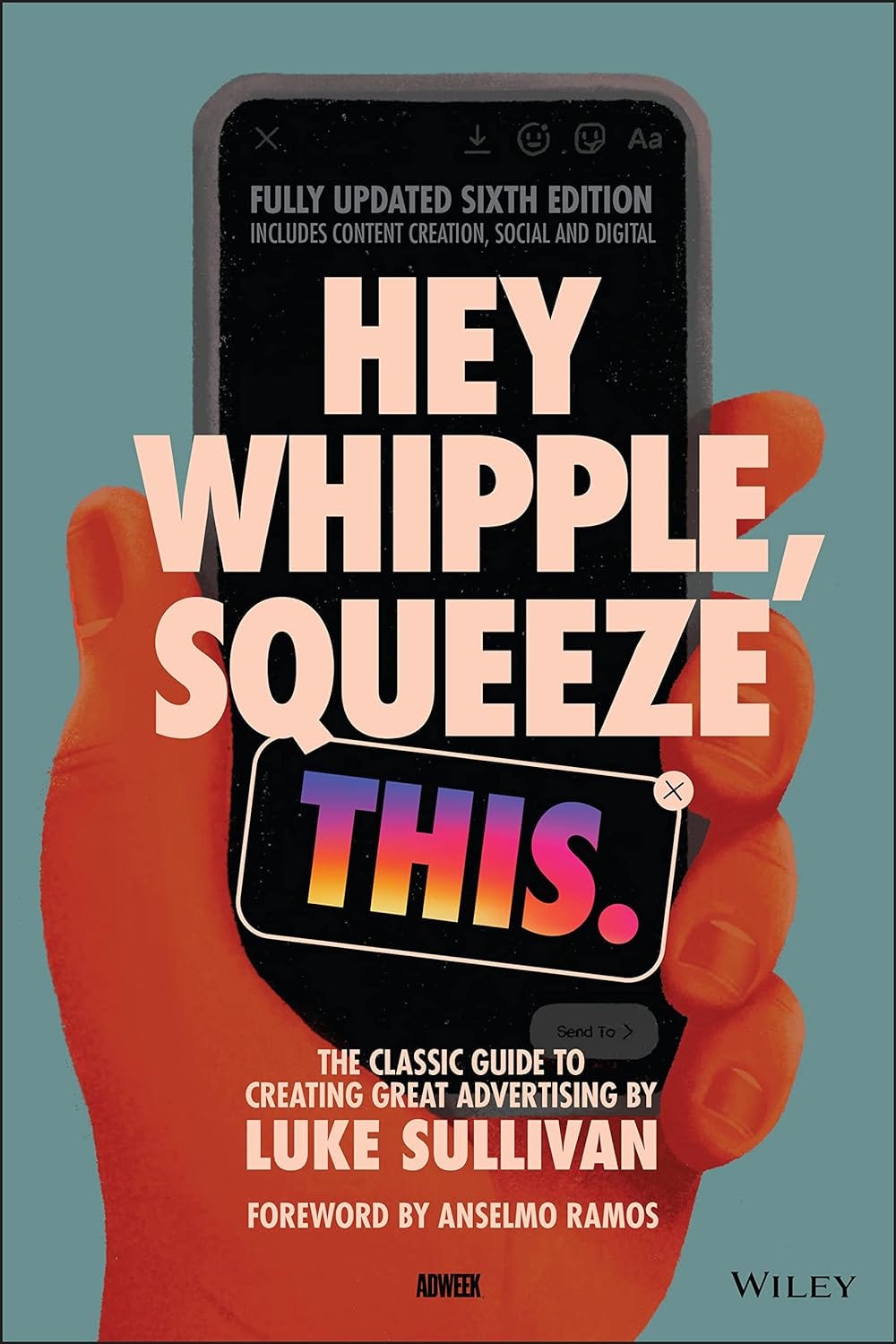
Best book about copywriting ever. Go buy this one.
In many ways, that’s true. Natural copywriters have a knack for coming up with great ideas and a chameleon-like ability to write everything from a compelling tweet to a thirty-second radio spot to a coordinated campaign that seamlessly combines broadcast, print, outdoor, social, public relations, etc.—and to do it all for clients in retail, B2B, B2C, healthcare, tech, and on and on and on. In my career as a copywriter, I’ve written all this and more, including speeches, TV commercials, video scripts, brochures, annual reports, blog posts, and museum exhibits.
And that’s just scratching the surface of what professional copywriters do. And not only do you have to be able to adapt to different media and clients and voices, you often have to turn on a dime and shift from one sort of project to a very different sort—say, from a TV spot for oncology services at a local hospital to a website for a high-tech machine tool manufacturer.
And get it done now. Copywriting is a create-on-demand profession.
Oh, and you’re only as good as your last idea. The pressure to keep performing at a high level, in the face of competing priorities and impossible deadlines, can be withering.
Although some innate ability to come up with winning ideas and turn a clever phrase are essential, most competent writers can learn the craft of copywriting. And if you have the knack—and thick skin—copywriting can be an extremely lucrative way to feed your literary writing habit.
How lucrative?
I once was paid $150 for writing “Free Stickers Inside” for a Fruit of the Loom underwear promotion.
That’s $50 a word. And while that’s probably the highest per-word bill I ever sent, I regularly make well over $100 an hour as a high-level, in-demand freelance copywriter—living and working in an extremely affordable Midwestern city. At the height of my freelance career, in the late ’90s and early ’00s, I made over $200,000 annually.
Not that I’d suggest starting out as a freelance copywriter. I’d suggest looking for a job with an agency or in-house communications department, where the average salary for a copywriter, according to Ziprecruiter, is over $76,000 and top copywriters make over $120,000 a year.
No, that’s not where you’ll start. But a copywriter with even a year or two’s experience can be a hot commodity, and your salary can rise pretty quickly. And if you stick with it and become a creative director, you’re looking at paychecks totaling $150,000 to $200,000 a year and more.
So what’s the downside?
It’s hard work. You don’t get bylines. You’re at the mercy of account executives and clients who think they’re better writers than you. Inevitably, there’s an art director who will treat your copy as just another design element and render it unreadable.
Or maybe like my young friend Evan you think writing commercial copy would steal your mojo. Maybe you think a different sort of life experience—being a barista, for example, or driving for Uber—would give you more psychic energy to pursue the sort of writing you love. Maybe you think writing ad copy all day would exhaust you for writing fiction or poetry or your screenplay.
That’s not the way it worked for me. The discipline of having to write every day—to create on demand—made me a better, sharper, more thoughtful, more versatile writer. And there are far too many examples of very successful writers who ascended from careers in copywriting to literary greatness.
My suggestion? Get your personal writing done first. Get up early and write the stuff you love before you go to your straight job.
Or maybe the end of the day is better for you. Maybe you’re a night owl. The fact is, you can find time to write, and you’re going to have to find it whether you’re a cab driver or a copywriter.
Will your serious writer friends think you’re a sellout? Maybe. Will you get frustrated and wish you had more time to write the things that are meaningful to you? Maybe—and maybe it will inspire you to work even harder on your personal projects.
And sometimes, living well is the best revenge.
메타데이터
- post_id
- db1408c28ae9
- slug
- copywriting-your-way-to-literary-success-db1408c28ae9
- url
- https://writingcooperative.com/copywriting-your-way-to-literary-success-db1408c28ae9
- canonical_url
- https://writingcooperative.com/copywriting-your-way-to-literary-success-db1408c28ae9
- author_url
- https://medium.com/@kenhoney
- status
- ok
- fetched_at
- 2026-07-08 21:20:17