USATF Junior Olympics: A Parent’s Process Guide
How the USATF Junior Olympics move from Association meets to Regionals to Nationals, and what parents should handle before race week.
USATF Junior Olympics: A Parent’s Process Guide
How the USATF Junior Olympics move from Association meets to Regionals to Nationals, and what parents should handle before race week.
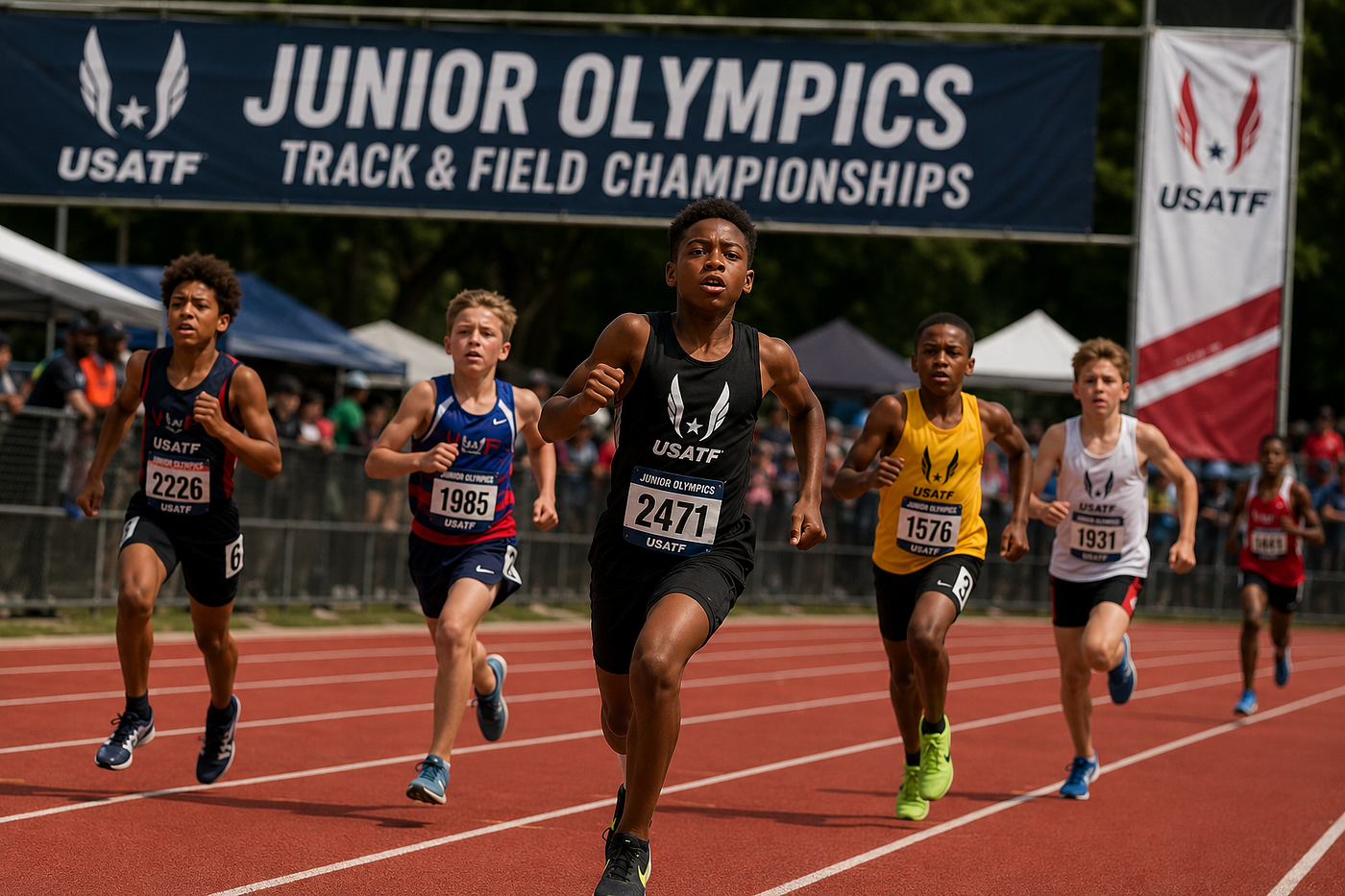
A parent walks into the first Junior Olympic meet thinking, “My child just needs a fast enough time.” Then the clerk calls, the heat sheets change, and another parent mentions “declaring for Regionals.” That is when the process starts to feel bigger than the race. The USATF Junior Olympics are not hard to understand, but they do reward families who know the steps, deadlines, age rules, and recovery demands before the season gets crowded.
What the USATF Junior Olympics Are
USA Track & Field is the national governing body for track and field, long distance running, and race walking in the United States. The USATF Junior Olympics are part of its youth competition pathway, not the same thing as the AAU Junior Olympic Games. Both can be valuable, but they are separate systems with separate registration, advancement, and championship procedures.
For track and field, the usual USATF Junior Olympic path is simple on paper: Association Championship, Regional Championship, then National Junior Olympic Championship. The athlete does not normally enter Nationals by chasing a posted time standard. They advance by placing high enough at the qualifying meet before it. USATF Association pages describe this as advancement from Association to Regional to National competition.
The Three-Step Road: Association, Regional, National
The Association meet is the first real gate. Many parents call it “state,” but USATF Associations do not always match state borders. Some states have more than one Association, and some Associations cover parts of multiple states.
Most Association Junior Olympic track meets are open to youth athletes with no qualifying time or mark. A New England Association meet page, for example, describes the Association Championship as the first leg of the Junior Olympic program and open to youth with no qualifying standards.
The Regional meet is the next gate. Athletes qualify for it by finishing high enough at the Association meet, though the number can vary by Association and Region. Region 1 examples show the top eight finishers advancing from Association to Region, while Florida and Georgia guidance notes that Association-to-Regional numbers may be adjusted for local situations.
Nationals are reached through Regionals. A common USATF rule cited by Association pages is that track and field advances five individuals and five relay teams from each Regional to Nationals, while combined events advance the top two placed athletes plus others who meet the performance standard. Always check the current meet packet, because host-year and local procedures can change the details.
[Parent Power Move] Find your local USATF Association page before the season starts. Save three dates: Association entries close, Regional declaration closes, and Nationals entries close. Missing a declaration deadline can matter as much as missing a race.
Age Divisions Are Based on Birth Year
USATF youth track uses two-year age divisions. The common outdoor Junior Olympic groups are 8 & under, 9–10, 11–12, 13–14, 15–16, and 17–18. Association pages list divisions by birth year, and they state that divisions are based on year of birth, not the athlete’s age on meet day.
This surprises summer-birthday families. A child who turns 13 late in the year competes in the same division as other athletes whose birth year puts them in 13–14. USATF pages also state that athletes compete in their own age division and do not “move up,” including relays.
There is one older-athlete wrinkle. Some USATF pages note that athletes who are still 18 through the final day of the National Junior Olympic Track & Field Championships remain eligible for the 17–18 division through that meet. Families with high school graduates should check the annual packet carefully.
Membership and Age Verification Come First
Before entries work smoothly, the athlete needs a current USATF membership and date-of-birth verification in USATF Connect. Association pages state that date of birth must be verified before an athlete’s entry can be submitted. Accepted documents commonly include a birth certificate, passport, certified baptismal record, driver’s license, or government identification.
Do not leave age verification until the entry deadline. One Association page states that birthdate verification documents must be received no later than five business days before the registration deadline for the sanctioned or sponsored event. Even where the timeline differs, the coaching lesson is the same: handle paperwork before the taper week.
Athletes may compete unattached or with a USATF club. Relays are different. Association pages state that only registered USATF member clubs may enter relay teams, and athletes on those relays must be affiliated with that club as part of their membership.
Entries, Declarations, and Seed Marks
Most Association meets use online entry systems, commonly Athletic.net. Parents should treat online entry like meet-day check-in. Verify the athlete’s name, birth year, club affiliation, events, seed marks, and payment before submitting. A New York Association page states that accuracy of data entered is the responsibility of each club or athlete.
After an athlete qualifies, they often must “declare” for the next round. That usually means confirming the athlete will compete, entering the advanced events, and paying the next entry fee before the deadline. The result does not automatically put the athlete on the starting line at Regionals or Nationals.
Seed marks can also confuse families. A Georgia USATF page explains that Association meet seed marks may depend on how the host configures the meet, but Regional seed marks are locked from Association results, and National seed marks are locked from Regional results. A personal best from a different invitational generally does not replace the mark used to advance.
Event Limits Shape the Whole Season
USATF youth athletes cannot enter every event they like. Current Association pages state that athletes in 8 & under, 9–10, and 11–12 may compete in a maximum of three events, including relays. Athletes in 13–14, 15–16, and 17–18 may compete in a maximum of four events, including relays. Combined events do not count against that maximum.
This is where parents should slow down. A fast 11-year-old who can run the 100, 200, 400, and 4x100 does not get to do all four. A hurdler-jumper-sprinter may need to choose between the event with the best advancement chance and the event with the best long-term development value.
Some events are not contested at every Association meet. New York and New England pages describe examples where events such as combined events or the 4x800 relay may require a waiver or automatic advancement process to Regionals. That is not a loophole. It is a meet-management reality. Families must still follow the stated entry process.
[Biomechanics Insight] More events do not always mean better development. Sprint speed is tied strongly to how much force an athlete applies to the ground, not simply moving the legs faster. Tired young sprinters often lose posture, push behind the body, and practice slower mechanics.
The Hard Part: Qualification Is Relative
Parents often ask, “What time does my child need to qualify?” In most events, the better question is, “What place does my child need at this meet?” Junior Olympic advancement is place-based. A 100-meter time that wins one Association may not advance in another. A high jump mark that looks modest nationally may qualify if the event has fewer athletes locally.
This makes the process fair in one way and stressful in another. Athletes compete against the people who show up in their age group, event, Association, and Region. Weather, wind, heat, field-event flights, lane draws, and relay exchanges all matter.
The best parent mindset is practical: train for performance, compete for place, and read the advancement rules before assuming anything. Region-to-National advancement is often listed clearly on Regional or Association pages, but those pages should be checked every season.
Meet Day Has Its Own Rules
Junior Olympic meets are championship meets, not casual all-comers meets. Athletes may need bibs, event check-in, clerk check-in, implement inspection, spike compliance, and warm-up-area control. New York’s Association page lists separate check-in areas for running and field events, bib requirements, implement inspection timing, spike limits, and a protest deadline after results are posted.
Parents can help without hovering. Pack the uniform, spikes, extra laces, water bottle, simple food, sunscreen, towel, and a printed or saved schedule. Then let the coach handle technical cues. The child already has enough noise in the warm-up area.
For throwers, vaulters, hurdlers, and combined-event athletes, read the meet packet twice. Implement weights, inspection windows, opening heights, hurdle spacing, and event order can change by age group.
[Parent Power Move] On meet morning, ask only three questions: “Do you know check-in?” “Do you have your bib?” “What do you want from me after the race?” That last answer may be food, silence, a hug, or space.
Training Through the Series
The Junior Olympic pathway can stretch a young athlete’s season. Many high school athletes come from a school season. Many younger athletes come from club training. The risk is stacking championship meets on top of hard workouts because everyone is excited.
A good coach treats the Association meet as a qualifier, Regionals as a sharper test, and Nationals as a possible final peak. That usually means the training load narrows, the quality rises, and recovery becomes more deliberate. For sprinters and jumpers, too much volume can flatten speed. For distance runners, too much intensity can make the legs stale. For throwers, technical rhythm matters more than late-season max-effort lifting.
The American Academy of Pediatrics has warned that overuse injury, overtraining, and burnout are real risks in youth sports, especially when training becomes excessive and recovery is poor. Current research supports a balanced approach that keeps long-term participation ahead of short-term chasing.
[Training Load Check] A parent should speak with the coach when a child’s warm-up looks flat for several days, soreness changes their stride, sleep gets worse, appetite drops, or the athlete starts dreading practice. One bad session is normal. A pattern is information.
Heat, Hydration, Sleep, and Food
Junior Olympic season often means summer heat. Youth athletes can compete safely in hot weather, but heat risk rises when hydration, rest, acclimatization, and recovery windows are poor. A youth heat-safety review recommends close monitoring, regular fluid access, schedule modification as heat and humidity rise, and stopping participation when an athlete shows significant deterioration or signs of exertional heat illness.
Hydration does not need to become complicated. Start the day already hydrated. Drink regularly between warm-up, event, cooldown, and awards. For long hot days, salty foods may help older adolescents who sweat heavily. Very young athletes usually do fine with water and normal meals unless the day is long, hot, or repeated across several rounds.
Sleep is the cheapest recovery tool parents control. The American Academy of Sleep Medicine recommends 9 to 12 hours per 24 hours for children ages 6 to 12 and 8 to 10 hours for teenagers ages 13 to 18. Travel meets make that harder, so protect sleep the week before rather than trying to fix it the night before finals.
Food should support growth first, performance second. A recent review on nutrition for children and adolescents in sport emphasizes meeting energy and nutrient needs during growth and activity. The IOC’s RED-S consensus defines Relative Energy Deficiency in Sport as health and performance problems tied to low energy availability in male and female athletes.
[Nutrition Note] Build the meet bag around real food: water, fruit, pretzels, sandwiches, yogurt, rice bowls, or familiar snacks. Save experiments for practice days. A championship meet is a bad place to test a new gel, drink, or supplement.
Supplements are usually a distraction for youth athletes. USADA warns that dietary supplements can carry health and sport-eligibility risks, including contamination or prohibited substances. When a supplement is medically needed, parents should involve a qualified clinician and use third-party risk-reduction tools rather than social media advice.
The Parent’s Role at Regionals and Nationals
At the higher rounds, the emotional temperature rises. The athlete sees better uniforms, bigger teams, faster heats, longer waits, and more public results. Parents feel it too. That is when adults must become steadier, not louder.
Before the meet, help with logistics. During the meet, protect calm. After the meet, respond to the child before the result. “I loved watching you compete” lands better than a technical breakdown in the first minute after a race.
Safe sport also matters. USATF’s Safe Sport program aims to prevent sexual misconduct and abuse, bullying, hazing, harassment, physical abuse, and emotional abuse. Parents should know who is supervising athletes, how travel is handled, and how one-on-one interactions are managed.
Quick Reference: The Parent Map
- Find your USATF Association and its Junior Olympic meet page.
- Buy or renew USATF membership and complete date-of-birth verification early.
- Register for the Association meet in the correct age division and events.
- Compete, then declare for Regionals if the athlete advances.
- At Regionals, verify advancement rules for Nationals before the meet starts.
- Plan recovery, travel, food, and sleep as seriously as spikes and uniforms.
What I’d Tell a New Track Parent
The USATF Junior Olympics are not just a faster meet. They are a process. The families who handle it best do the boring things early: membership, birth verification, event choices, deadlines, travel plans, and honest coach conversations.
The athlete’s job is simpler. Train well. Compete hard. Learn how championship rounds feel.
A young athlete does not need to make Nationals for the season to matter. Sometimes the win is learning to check in alone. Sometimes it is holding form in a Regional final. Sometimes it is choosing one less event and feeling better in the one that matters most.
Key Takeaways

- USATF Junior Olympics usually advance from Association to Regional to National competition.
- Most Association meets do not require qualifying times, but later rounds require placing high enough.
- Age divisions are based on birth year, and athletes do not move up for relays or favorite events.
- Membership, age verification, entries, and declarations are parent-controlled details that can decide eligibility.
- The best Junior Olympic season balances ambition with recovery, food, sleep, safety, and long-term development.
References
Mountjoy, M., et al. (2023). 2023 International Olympic Committee’s consensus statement on Relative Energy Deficiency in Sport. British Journal of Sports Medicine / PubMed.
Capra, M. E., et al. (2024). Nutrition for children and adolescents who practice sport. Nutrients.
Brenner, J. S., et al. (2024). Overuse injuries, overtraining, and burnout in young athletes. Pediatrics / PubMed.
USA Track & Field. Safe Sport.
USA Track & Field New York. Junior Olympic & Para Track & Field Championships meet information.
USA Track & Field New England. Junior Olympic Track & Field Championship meet information.
USA Track & Field Georgia. Junior Olympics advancement and rules summary.
USA Track & Field Florida. Junior Olympics advancement steps.
U.S. Anti-Doping Agency. Supplement Connect and supplement risk guidance.
Bergeron, M. F. Hydration and thermal strain in youth sports. Gatorade Sports Science Institute Sports Science Exchange.
Paruthi, S., et al. (2016). Consensus statement of the American Academy of Sleep Medicine on recommended sleep duration for children and teenagers. Journal of Clinical Sleep Medicine.
Bezodis, N. E., et al. (2019). The biomechanics of the track and field sprint start. Sports Medicine.
Weyand, P. G., et al. (2000). Faster top running speeds are achieved with greater ground forces, not more rapid leg movements. Journal of Applied Physiology / PubMed.
메타데이터
- post_id
- db4a4f648419
- slug
- usatf-junior-olympics-a-parents-process-guide-db4a4f648419
- url
- https://medium.com/@sarahb57/usatf-junior-olympics-a-parents-process-guide-db4a4f648419
- canonical_url
- https://medium.com/@sarahb57/usatf-junior-olympics-a-parents-process-guide-db4a4f648419
- author_url
- https://medium.com/@sarahb57
- status
- ok
- fetched_at
- 2026-07-10 06:10:56