Grand Constance, The Soul of a Legend
Few wines can claim to be more than a drink, to be instead a thread woven into the fabric of culture, literature, and history. Yet…
Grand Constance, The Soul of a Legend
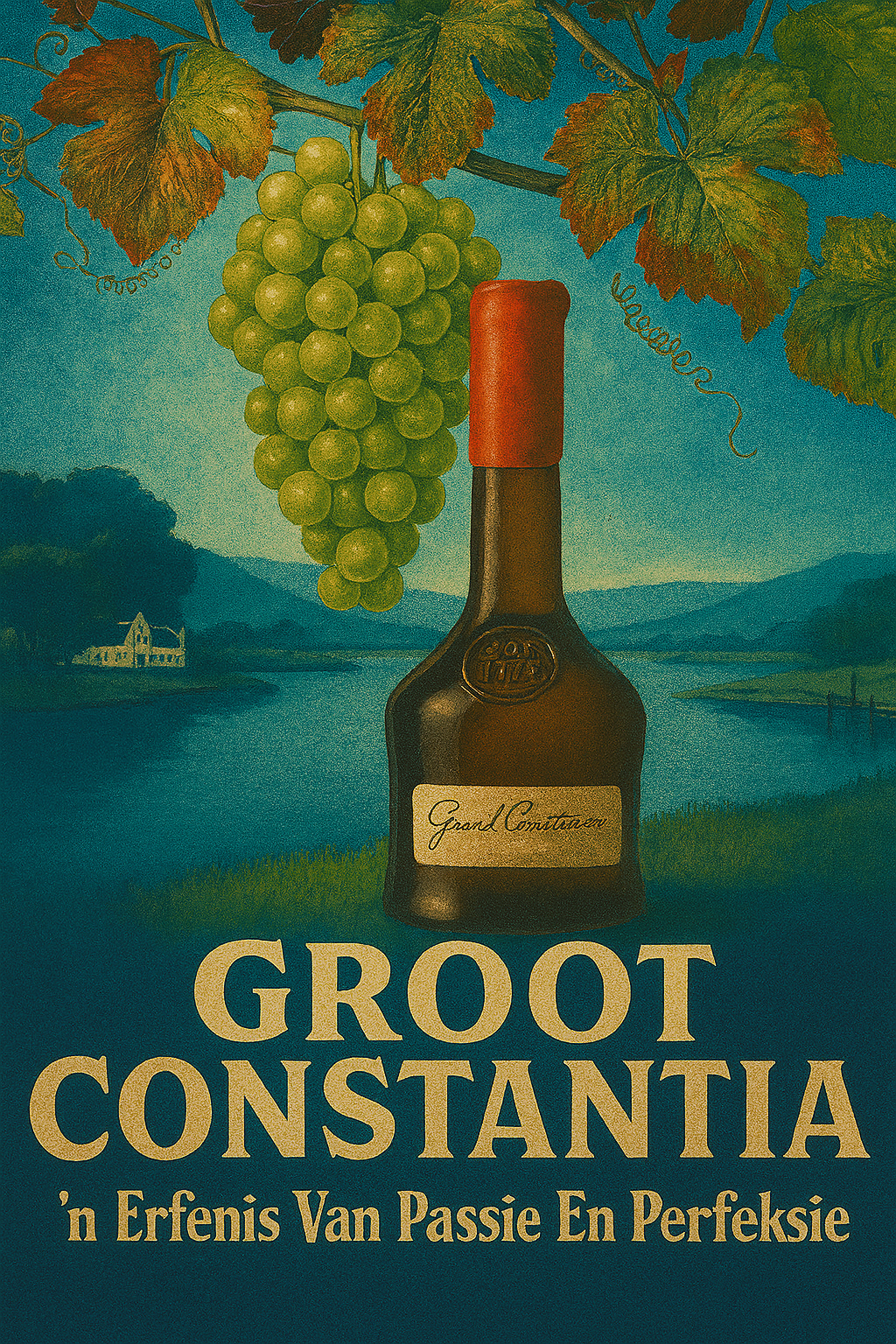
AI-generated poster for Groot Constantia
Few wines can claim to be more than a drink, to be instead a thread woven into the fabric of culture, literature, and history. Yet Constantia, South Africa’s fabled sweet wine, holds precisely that place. It was the darling of European courts, whispered about in the pages of Austen and Dickens, and cherished by Napoleon in exile. Today, two great estates, Klein Constantia and Groot Constantia, have revived this liquid legend. But it is Groot Constantia’s Grand Constance, with its amber glow and haunting complexity, that many argue comes closest to the spirit of the original Constantia Wyn.
A Garden at the Edge of Empire
The Constantia story begins in 1685 when Simon van der Stel, governor of the Cape, planted vines on the gentle slopes of Table Mountain. His estate, Constantia, soon gained renown for its sweet wines made from Muscat grapes. After his death, the property was divided into Groot Constantia, Klein Constantia, and Bergvliet, but the legend had already taken root.
In the late 18th century, the estate passed into the hands of the Cloete family. It was under their stewardship that Constantia achieved its international fame. For more than a century, Europe’s elite clamoured for the unfortified, honeyed wines from this corner of Africa. Frederick the Great toasted victories with it. The British aristocracy stocked it in their cellars. And Napoleon, confined to the lonely island of St Helena, consoled himself with casks of Constantia, reputedly requesting a glass even on his deathbed.
The Original Style, A Symphony in Amber
But what was Constantia really? The historical record reveals not one wine, but several. There were Red Constantia, White Constantia, Pontac Constantia, and variations blended from red and white Muscadel (Muscat de Frontignan), Pontac, and sometimes Chenin Blanc. These wines were picked late, often raisined on the vine, then fermented and aged in barrel. The result was rich, unfortified, and intensely sweet, yet balanced with acidity, a profile utterly distinct from the fortified ports and sherries of the time.
Importantly, many of these wines carried an amber hue, drawn from the inclusion of red Muscat alongside the white. It was this depth of colour and layered flavour that set Constantia apart, and why its fame spread from Paris to Vienna, London to Calcutta.
Decline and Silence
Like many legends, Constantia’s story was not eternal. By the late 19th century, the Cape’s vineyards faced disaster. Powdery mildew and phylloxera devastated plantings, tariffs changed trade flows, and the Cloetes eventually sold Groot Constantia to the government. The once celebrated Constantia Wyn vanished into silence, remembered only in poems, novels, and the dust of old cellars.
For nearly a century, Constantia existed only as myth. The name lived on, but the taste had been lost.
The 20th Century Revival
The revival began in the 1980s when Klein Constantia’s then-owner, Duggie Jooste, set out to recreate the historic sweet wine. With painstaking research and help from historians and winemakers, he brought forth Vin de Constance in 1986. Crafted from 100 percent Muscat de Frontignan, harvested berry by berry as they raisined naturally, the wine reintroduced the world to Constantia’s unfortified, natural sweetness. Critics hailed it as the rightful heir, and for nearly two decades, Vin de Constance stood as the modern face of the legend.
But in 2003, Groot Constantia launched a rival homage, Grand Constance. This wine aimed not only to revive the memory but to echo the very structure of the original blends. Unlike its neighbour, Grand Constance is made from both white and red Muscat de Frontignan, harvested late, partially raisined, and fermented with skin contact before maturing in old oak for up to two years.
The result is a wine with the same amber gold radiance described in 19th century accounts, perfumed with dried apricot, candied orange peel, rose petals, and spice, and drenched in opulent sweetness.
The Question of Authenticity…
Which, then, is truer to history, Vin de Constance or Grand Constance?
On the one hand, Klein Constantia’s Vin de Constance embodies the spirit of the old wines, unfortified, naturally sweet, painstakingly hand picked. It has a 40 year modern track record, critical acclaim, and a consistent golden profile that recalls Constantia’s refinement.
On the other, Grand Constance nods to the details of the past, the blending of red and white Muscat, the skin contact, the amber hue. These features are well attested in records of Red Constantia and White Constantia, which were distinct wines but equally part of the Constantia canon.
The truth is, Constantia was never just one recipe. It was a family of styles. In that sense, both modern revivals are authentic, but each represents a different strand of the tapestry. Vin de Constance is the elegant, golden thread. Grand Constance the deeper, amber one.
Tasting the Past
To raise a glass of Grand Constance today is to drink history. Its sweetness, often near 190 grams of residual sugar per litre, is offset by a backbone of acidity. The flavours unfold slowly, sun dried apricots, ripe peach, turkish delight, honeycomb, caramel, and a whisper of spice. The texture is unctuous yet lifted, the finish lingering like an old memory.
It is a wine that demands contemplation. One sip calls to mind the long rows of Muscat vines, their grapes slowly shrivelling in the Cape sun. Another evokes the dark wood cellars of the Cloete family, casks slumbering until shipped off to Europe. Another still reminds us of Napoleon, gazing across the sea at St Helena, glass in hand, finding solace in the amber glow.
The Enduring Romance
In the end, Constantia remains what it has always been, a wine of story and seduction. Its revival is not merely about flavour, but about capturing an idea, the idea that a place and its people can produce something that transcends centuries, empires, and borders.
Grand Constance, with its shimmering amber body and heady perfume, is perhaps the most romantic of these revivals. It tastes not only of Muscat grapes, but of nostalgia itself. It invites us to sit with the ghosts of history, to drink what Napoleon drank, to feel what Baudelaire described, to savour what Austen’s characters sipped at their tables.
And yet it is alive, here and now, on a hillside in South Africa where the vines still catch the same Atlantic breezes that filled Van der Stel’s sails. To open a bottle is to bridge past and present, myth and memory.
Disclaimer: This article draws on publicly available sources. While accuracy is intended, some details may be incomplete. Please share any corrections or suggestions for improvement.
메타데이터
- post_id
- db512c233824
- slug
- grand-constance-the-soul-of-a-legend-db512c233824
- url
- https://medium.com/@thebarreldiaries/grand-constance-the-soul-of-a-legend-db512c233824
- canonical_url
- https://medium.com/@thebarreldiaries/grand-constance-the-soul-of-a-legend-db512c233824
- author_url
- https://medium.com/@thebarreldiaries
- status
- ok
- fetched_at
- 2026-07-28 18:41:33





