Mesh WiFi or Access Points? A Serviced Apartment Project Shows the Difference
When buyers compare Mesh WiFi and wireless access points, the conversation often starts with speed. That is understandable, but it is…
Mesh WiFi or Access Points? A Serviced Apartment Project Shows the Difference

When buyers compare Mesh WiFi and wireless access points, the conversation often starts with speed. That is understandable, but it is usually not the best starting point.
In real B2B projects, the better question is: what kind of building are we trying to support?
A small apartment, a temporary office, or a rental house may work well with Mesh WiFi. It is simple, flexible, and useful when Ethernet cabling is not available. But a serviced apartment, hotel, school, office, or commercial building usually has a different set of requirements.
A Kuala Lumpur serviced apartment indoor WiFi coverage project gives a practical example.
The Customer needed to improve WiFi across a 10-floor building with 82 guest rooms, corridors, a lobby, front desk, breakfast restaurant, meeting rooms, elevator lobbies, and a management office. The issue was not only weak signal. The building needed a more organized network structure for guest rooms, public areas, roaming paths, staff devices, and future maintenance.
This is where the difference between Mesh WiFi and an AP-based design becomes easier to understand.
Mesh WiFi is often useful when a buyer needs fast deployment and does not have wired backhaul. A home user may place several mesh nodes around the house and get better coverage than a single router can provide. For many residential environments, this is enough.
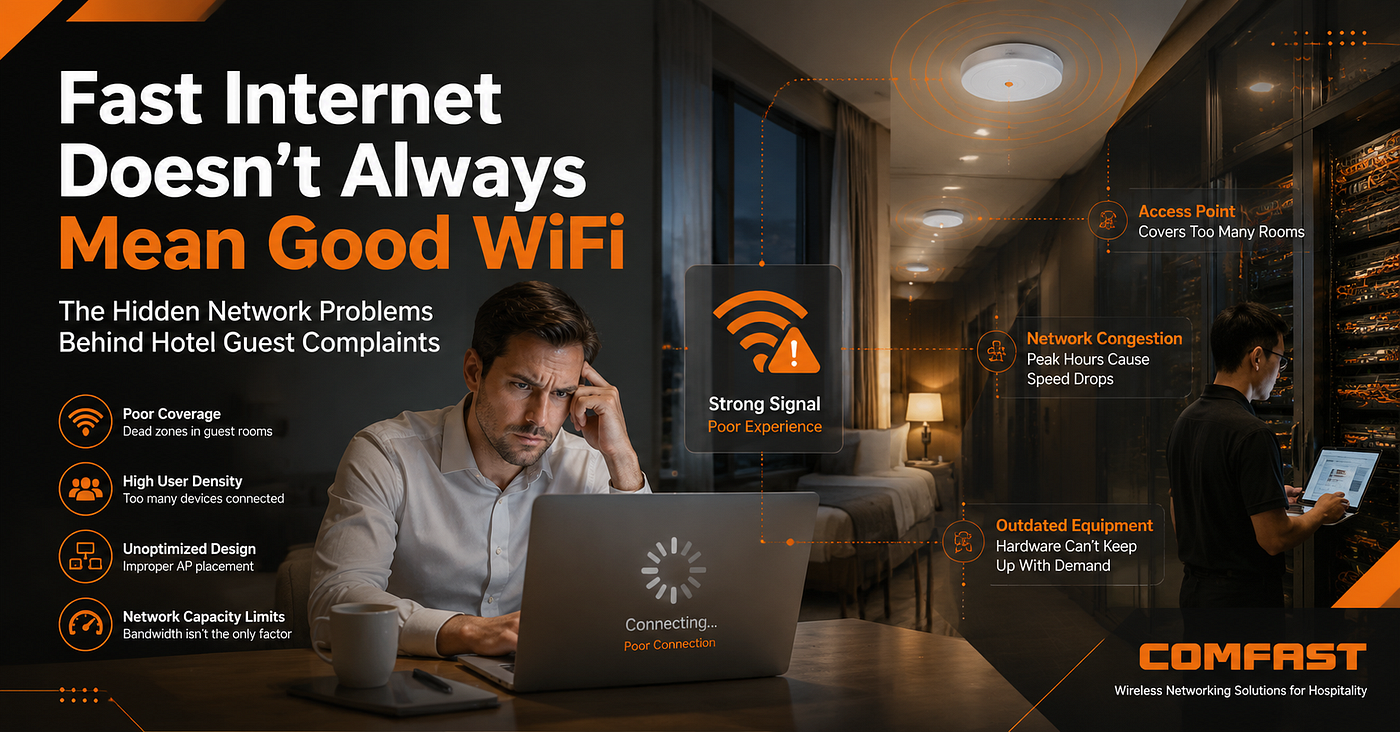
A serviced apartment is different. Rooms repeat across floors. Users move between room, corridor, elevator, lobby, and restaurant. Peak usage changes throughout the day. A guest may use WiFi for video calls from the desk, then move to the lobby, then connect again in the breakfast area. The building also needs a network that staff can inspect and maintain.
For this Kuala Lumpur project, the configuration was built around COMFAST access points, PoE switches, and gateway control.
The guest rooms used COMFAST CF-E593AX wall plate APs. This one-room-one-AP logic helped the project avoid a common mistake in hospitality networks: expecting corridor signal to perform well inside every room. Walls, doors, furniture, room layout, and guest device placement can all affect the experience. A wall plate AP places coverage closer to the actual user.
Public areas used COMFAST CF-E395AX ceiling APs. The lobby and breakfast area have different usage patterns from a guest room. More users may connect at the same time, and devices may stay active for shorter sessions. Ceiling AP placement helped the project focus on shared-space coverage rather than treating every area the same way.
Four COMFAST CF-SG1241P PoE switches supported floor-by-floor access. In commercial WiFi projects, PoE is often important because it simplifies power supply and makes installation cleaner. It also helps the maintenance team trace APs by switch port, floor, and location.
A COMFAST CF-AC200 gateway was used at the core of the network. This supported centralized access control and helped separate different types of network use. For a serviced apartment, guest traffic, office devices, and management needs should be planned carefully instead of being placed into one flat network.
This project also shows why network buyers should not choose hardware based only on wireless rate labels. The buyer should consider:
- Is wired backhaul available?
- How many rooms need dedicated coverage?
- Are public areas used heavily during certain hours?
- Does the property need guest and staff network separation?
- Can APs be named and mapped for maintenance?
- Is PoE switching part of the design?
- Will firmware configuration or OEM/ODM support be needed for repeat projects?
COMFAST’s article on Mesh WiFi and AP selection explains this decision from a product comparison angle. The Kuala Lumpur serviced apartment case shows how the same decision appears in a real project environment.
For importers, system integrators, project contractors, and networking hardware distributors, this is also where supplier capability matters. A device may look suitable on a product page, but project success depends on more details: sample confirmation, firmware settings, signal stability checks, labeling, export packaging, quality inspection, and stable communication before shipment.
COMFAST’s OEM/ODM support is relevant for buyers who need repeatable hardware supply for local markets. Logo printing, custom packaging, product configuration, and long-term supply planning can help a distributor or system integrator build a more consistent product line.
The lesson from this project is not that Mesh WiFi is bad or that access points are always required. The lesson is more practical.
Mesh WiFi is often suitable when ease of installation is the priority. Access points are usually better when the building needs structured coverage, wired backhaul, centralized control, and long-term maintenance.
For a serviced apartment, that difference matters.
메타데이터
- post_id
- db5f4aed5240
- slug
- mesh-wifi-or-access-points-a-serviced-apartment-project-shows-the-difference-db5f4aed5240
- url
- https://medium.com/@szcomfast/mesh-wifi-or-access-points-a-serviced-apartment-project-shows-the-difference-db5f4aed5240
- canonical_url
- https://medium.com/@szcomfast/mesh-wifi-or-access-points-a-serviced-apartment-project-shows-the-difference-db5f4aed5240
- author_url
- https://medium.com/@szcomfast
- status
- ok
- fetched_at
- 2026-08-09 08:45:20