NASA’s Chandrayaan-3 Payload to Work After Vikram and Pragyan’s Dormancy: LRA to Assist Future…
The Chandrayaan-3 mission, a collaborative effort between the Indian Space Research Organisation (ISRO) and NASA, is gearing up to…
NASA’s Chandrayaan-3 Payload to Work After Vikram and Pragyan’s Dormancy: LRA to Assist Future Missions
Chandrayaan-3 Payload to Work After Vikram-Pragyan’s Sleep
The Chandrayaan-3 mission, a collaborative effort between the Indian Space Research Organisation (ISRO) and NASA, is gearing up to revolutionize lunar exploration. One of the mission’s standout features is the Laser Retroreflector Array (LRA), a payload that promises to contribute significantly to the scientific endeavors of future lunar missions.
Chandrayaan-3: A Joint Mission
Chandrayaan-3 represents a remarkable collaboration between ISRO and NASA, combining their expertise and resources to explore the Moon’s mysteries. Following the partial success of Chandrayaan-2, the decision to embark on Chandrayaan-3 was made to further lunar exploration.
The Role of the LRA
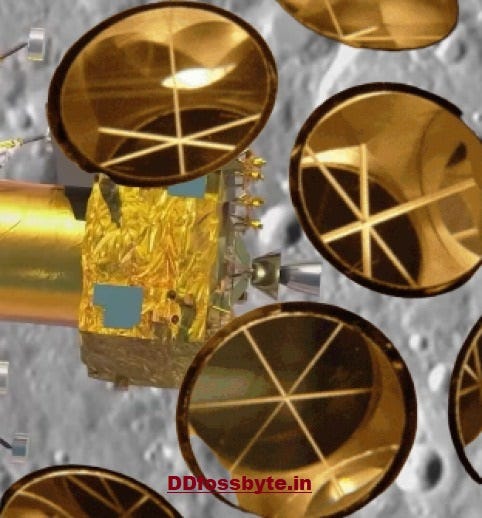
At the heart of Chandrayaan-3’s scientific payload is the Laser Retroreflector Array (LRA). This instrument, developed by NASA, is designed to be a long-term asset on the lunar surface. Its primary function is to reflect laser beams sent from Earth or lunar orbiters back to their source with exceptional precision.
How the LRA Works
The LRA essentially consists of a series of corner-cube prisms, which are exceptionally effective at reflecting light or laser beams. These prisms are strategically arranged to ensure that incoming laser beams are accurately redirected toward their source. By analyzing the time it takes for the laser beams to return, scientists can precisely calculate the distance between Earth or lunar orbiters and the LRA on the Moon’s surface.
Benefits for Future Missions
The LRA on Chandrayaan-3 is expected to serve several critical purposes for future lunar missions:
- Precise Positioning: By accurately measuring the distance between Earth or lunar orbiters and the LRA, future missions can improve their navigation and positioning systems. This will be invaluable for landing missions and scientific observations.
- Seismology Studies: The LRA will help scientists monitor lunar seismic activity. Any disturbances on the Moon’s surface can be detected by analyzing the reflections of laser beams. This data is vital for understanding the Moon’s geology and potential lunar quakes.
- Gravitational Studies: Lunar missions can also utilize the LRA to enhance their studies of the Moon’s gravitational field. Precise measurements of the Moon’s gravitational anomalies can provide valuable insights into its interior composition.
The Laser Retroreflector Array (LRA), housed within Chandrayaan-3’s Vikram lander, has embarked on a unique lunar mission. This fourth payload aboard Vikram, constructed by NASA’s Goddard Space Flight Centre, will initiate its operations once the other onboard instruments and those on Pragyan enter their sleep mode at the close of the lunar day.
Among the payloads activated by the Indian Space Research Organization (ISRO) are the Radio Anatomy of Moon Bound Hypersensitive ionosphere and Atmosphere (RAMBHA), Chandra’s Surface Thermo physical Experiment (ChaSTE), and the Instrument for Lunar Seismic Activity (ILSA). In contrast, the LRA stands out as an international collaborative instrument designed by NASA.
The primary objective of the LRA is to employ laser light reflected from orbiting spacecraft, typically equipped with laser altimeters or light detection and ranging (lidar) systems, to precisely ascertain the lander’s location as a fiducial marker. Furthermore, it aids in determining the distance from the orbiter to that specific lunar surface point.
Retroreflectors, a hallmark of the LRA, exhibit the remarkable property of reflecting incident light directly back to its source. These retroreflectors can be effectively tracked by orbiting laser altimeters or lidar systems, even from distances spanning several hundred kilometers.
NASA elaborates on the composition of the LRA aboard Vikram, detailing its eight circular corner-cube retroreflectors, each with a diameter of 1.27 cm, mounted on a hemispherical platform measuring 5.11 cm in diameter and 1.65 cm in height. These retroreflectors are oriented slightly differently, each with a maximum useful light incidence angle of approximately ±20 degrees. Notably, the LRA boasts a total mass of merely 20 grams and requires no power source.
To prevent interference with the lander’s optical equipment, such as cameras and spectrometers, the LRA’s ranging operations have been postponed until after the conclusion of the Chandrayaan-3 mission. This decision is in line with the recommendations of Xiaoli Sun, the principal investigator of the LRA, and other members of the LRA team.
Looking ahead, the LRA promises an array of scientific benefits. Its role extends to enabling highly accurate positional determinations on the lunar surface from orbiting spacecraft. When integrated with knowledge of the orbiter’s position, it facilitates precise measurements of the distance between the LRA and Earth, contributing to our comprehension of the Moon’s movement relative to our planet.
Moreover, the deployment of multiple LRAs on the lunar surface can establish fiducial markers and form a geodetic network, an invaluable asset for planning precise landings in future lunar missions. Currently, NASA’s Lunar Reconnaissance Orbiter (LRO) is the sole orbiter equipped to perform laser ranging through its laser altimeter, known as LOLA.
While the longevity of LRAs ensures their utility in upcoming missions, there is no predetermined minimum number required for optimal geodetic network formation. Consequently, these retroreflectors are poised to play an integral role in enhancing our understanding of lunar dynamics and guiding future lunar endeavors.
메타데이터
- post_id
- db61edd69acb
- slug
- nasas-chandrayaan-3-payload-to-work-after-vikram-and-pragyan-s-dormancy-lra-to-assist-future-db61edd69acb
- url
- https://medium.com/@dbnkds91/nasas-chandrayaan-3-payload-to-work-after-vikram-and-pragyan-s-dormancy-lra-to-assist-future-db61edd69acb
- canonical_url
- https://medium.com/@dbnkds91/nasas-chandrayaan-3-payload-to-work-after-vikram-and-pragyan-s-dormancy-lra-to-assist-future-db61edd69acb
- author_url
- https://medium.com/@dbnkds91
- status
- ok
- fetched_at
- 2026-08-19 08:19:10