From Emergency to Recovery: The Next Chapter of myResponder
By Zhou Yansheng, former Product Lead of SCDF’s myResponder
From Emergency to Recovery: The Next Chapter of myResponder
By Zhou Yansheng, former Product Lead of SCDF’s myResponder
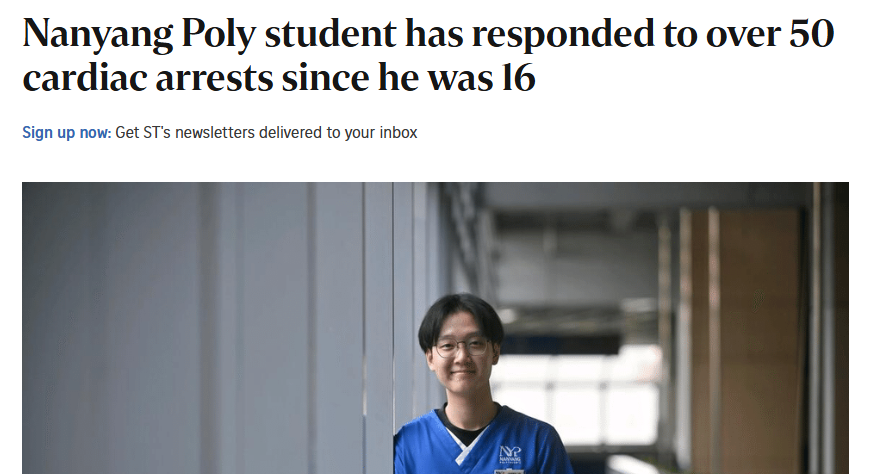
When the Singapore Civil Defence Force (SCDF) launched the myResponder app in 2015, the goal was bold: to mobilise ordinary members of the public to save lives before frontline responders arrived. In its first years, myResponder proved that this was possible. Hundreds of lives were saved because citizens stepped forward to perform CPR or extinguish small fires.
As the platform’s product lead, I had the privilege of witnessing first-hand how technology, trust, and community could come together to strengthen Singapore’s emergency response. But rather than seeing only limitations, I see a much larger opportunity waiting to be unlocked. This idea is a radical one, and my intent in writing this is to spread it further and garner the attention needed to build it.
Today, myResponder is activated about 5,000 times a year — roughly 3,000 cardiac arrests and 2,000 minor fires. That is just 2% of the 250,000 emergencies reported to 995 annually. The opportunity to scale is massive. But it requires a rethink of the model. Mobilising a random stranger works for cardiac arrest (where every second counts) or a small fire in a public space. But society is unlikely to accept a stranger stepping into other emergencies — a family dispute, or a woman in distress in a toilet. For these, the platform needs to evolve, mobilising the right people for the right emergencies.
Recovery is also more than fires. Imagine a breadwinner who fractures his leg. He survives the emergency but now faces weeks of physiotherapy and regular hospital visits. His family may need help with transport or even someone to send the kids to school. These are areas where the community can and should step in.
If Singapore wants to build a deeper culture of resilience, myResponder must take its next leap: scaling adoption, extending into recovery, and evolving into a public–private–people platform sustained for the long run. Unlike other countries, Singapore is not tested by frequent natural disasters. Safety is not top of mind for many of us. But with this next leap, we can nurture the spirit of resilience in everyday emergencies. Already, myResponder has influenced many to learn CPR and lifesaving skills. With the right changes, this impact could be scaled much further.
Step 1: Scale Emergency Response Adoption
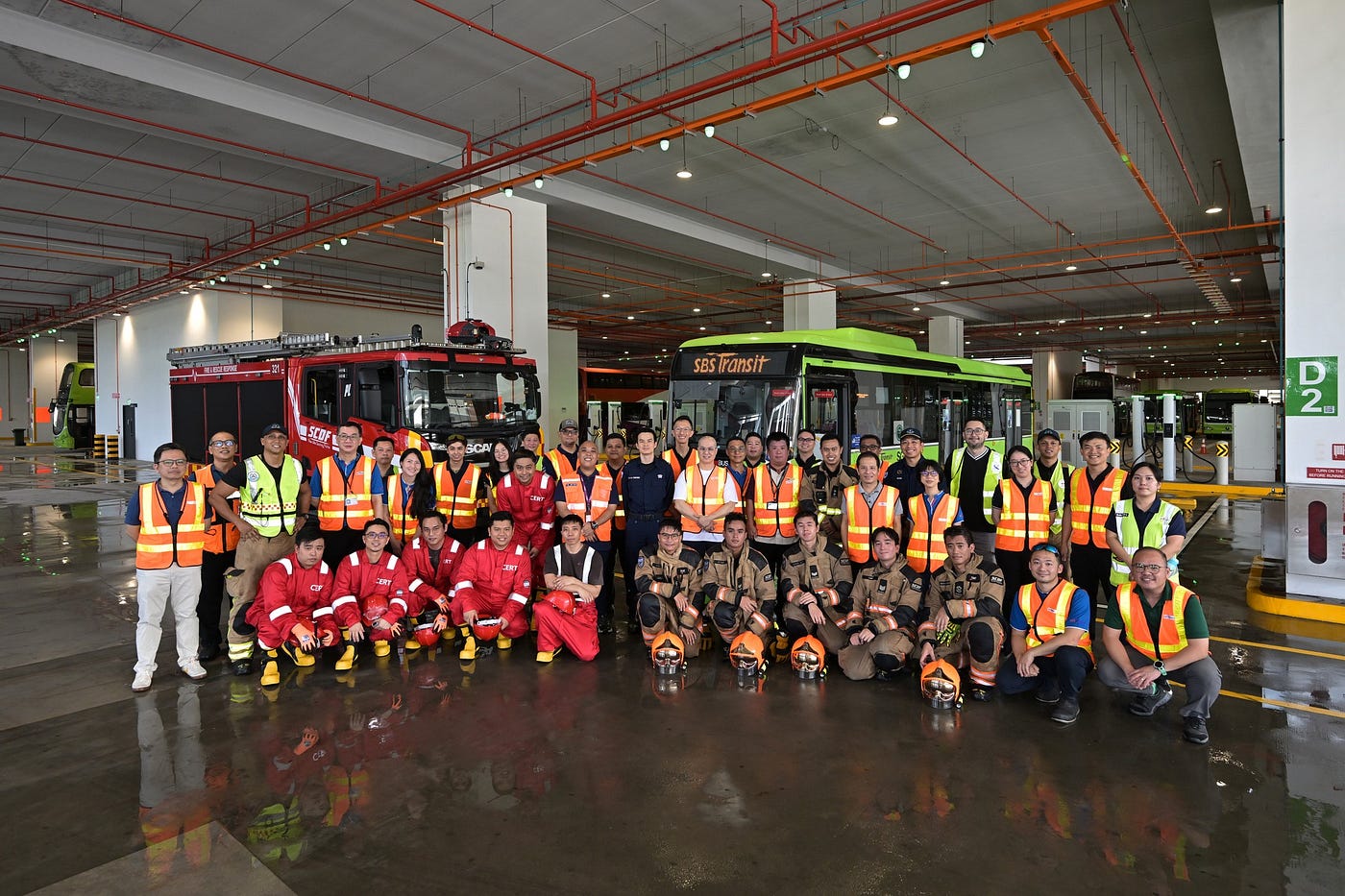
The first transformation is to extend myResponder to cover a broader share of emergencies. This can begin with company security teams in offices, malls, industrial facilities, and public attractions such as Sentosa and East Coast Park. Unlike strangers, these teams can be trusted to act appropriately across all kinds of emergencies, because they are trained, authorised, and embedded in the premises they protect.
This model allows SCDF to inform them of every emergency within their property — scaling up quickly, since around 30% of emergencies already come from commercial and industrial premises with organised response teams. For instance, about 1,000 emergencies are reported annually across CapitaLand’s 20-plus commercial properties. With this model, their own staff could be mobilised immediately, compared to today where only cardiac arrests or minor fires trigger alerts.
The same approach can extend to condominiums, with security guards as the baseline. Over time, residents themselves can be onboarded to strengthen estate safety. For HDB estates and landed homes, this could build on existing PA platforms like Community Emergency and Engagement (C2E) committees, coordinating residents to be ready 24/7.
Beyond fires and accidents, the platform could widen its scope — mobilising for road collisions, crimes in progress, child mistreatment, or even everyday disruptions like a lift breakdown or fallen tree branch. myResponder can grow beyond an “SCDF-only” tool into a whole-of-community platform for emergencies large and small.
Step 2: Mobilise the Community for Recovery
Emergencies do not end when the sirens fade. Families often face immense challenges afterwards: cleaning up a burnt home, caring for children, or arranging transport for weeks of medical appointments. Think of the breadwinner recovering from a fracture — unable to drive, needing support to get to physiotherapy or to send the kids to school.
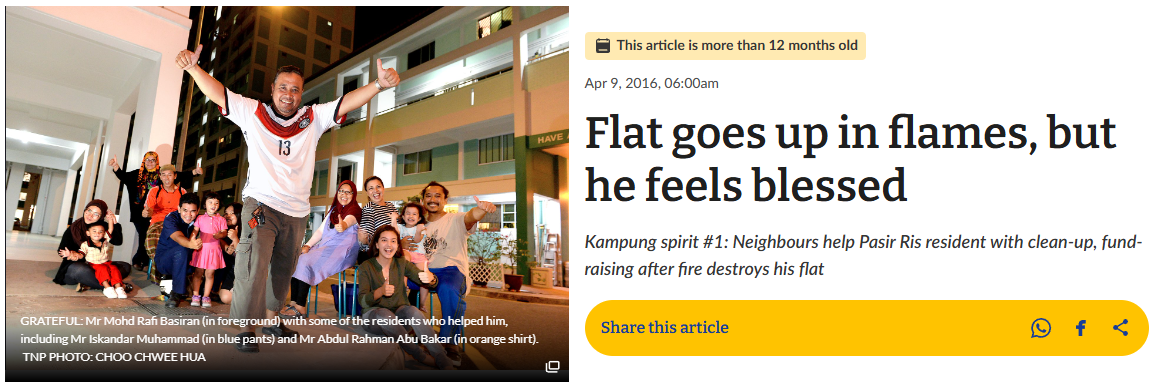
https://www.tnp.sg/news/singapore/flat-goes-flames-he-feels-blessed
Here, myResponder could close the gap. The same app that alerts a neighbour to bring an AED could also alert others to help with school runs, provide meals, or assist with transportation during recovery. The focus should remain on community help first — keeping the spirit of mutual aid at the core.
This expansion would not only help victims. Volunteers too would benefit. By seeing the aftermath of emergencies and participating in recovery, they would gain a deeper awareness of risks and a stronger motivation to pick up lifesaving skills. It would also reassure them that if something ever happened to their own family, they would not be alone. This is how resilience is built: not just by surviving crises, but by recovering together.
Step 3: Evolve into a Public–Private–People Platform
The next evolution is to sustain this vision. Government will always anchor myResponder’s emergency response layer to preserve trust. But business and community partners can provide the resources and funding to take the platform further.
The private sector has much to contribute — from fire safety technologies, to preventive health services, to insurance solutions. Every emergency, whether experienced or witnessed, is a powerful reminder of why these products exist. Those who have just helped out after an incident may even be compelled to double-check their own protection. If insurers could step in at that moment, the platform could channel customer acquisition costs into subsidies that make insurance more affordable — benefiting families, businesses, and society in a novel way.
In this model, government ensures neutrality, the private sector provides resources, and the community provides care. Together, myResponder could become Singapore’s first true public–private–people partnership for resilience.
Why It Matters
The benefits are clear:
- Operationally, SCDF — and eventually other agencies — would gain a trusted network covering most emergencies, not just the current niche.
- Socially, families would be supported from crisis through recovery, strengthening public confidence.
- Culturally, resilience would be shared — the responsibility not just of the state, but of businesses and neighbours too.
Singapore’s ageing population will increase demands on emergency services in the years ahead. A more distributed, community-powered model will be critical to meeting that need.
A Call to Action
myResponder began as an experiment in crowdsourced CPR. Its success proved that community response can save lives. The next chapter is to prove that community can also help families recover.
If we seize this opportunity, Singapore could become the first country in the world with an end-to-end resilience platform: connecting state, market, and society from the first alarm to the final stage of recovery. On that day, every family who dials 995 will know that help does not end when the fire truck departs or the ambulance door closes. It will continue until life is restored.
메타데이터
- post_id
- db8d01317e83
- slug
- from-emergency-to-recovery-the-next-chapter-of-myresponder-db8d01317e83
- url
- https://medium.com/@doidyboy/from-emergency-to-recovery-the-next-chapter-of-myresponder-db8d01317e83
- canonical_url
- https://medium.com/@doidyboy/from-emergency-to-recovery-the-next-chapter-of-myresponder-db8d01317e83
- author_url
- https://medium.com/@doidyboy
- status
- ok
- fetched_at
- 2026-06-24 11:06:28