Speed Is Not Free: What AI Changes in Software Engineering
Why productivity gains do not automatically translate into stronger engineering capability
Speed Is Not Free: What AI Changes in Software Engineering
Why productivity gains do not automatically translate into stronger engineering capability
In the past year, in my own work and in conversations with other engineers, AI-assisted development has moved from experiment to everyday practice. What started as curiosity is quickly becoming infrastructure.
Feature implementation cycles are shrinking. AI tools now handle much of the boilerplate, routine refactoring, and local logic work that used to consume significant time.
The productivity gains are real. But they introduce a trade-off that many organizations have not yet articulated clearly.
In software engineering, speed has never been free. It has always required balancing velocity against reliability and long-term maintainability.
AI does not remove that balance. It shifts it, often in ways that are less visible.
When implementation becomes cheaper, the natural temptation is to convert that gain directly into more output instead of reinvesting it in validation, review depth, and system robustness.
That is the hidden decision behind AI adoption: how deliberately we choose to allocate the gains it produces.
Different Types of Engineering Work
To understand where AI creates the most leverage, and where it does not, it helps to distinguish between different categories of engineering work.
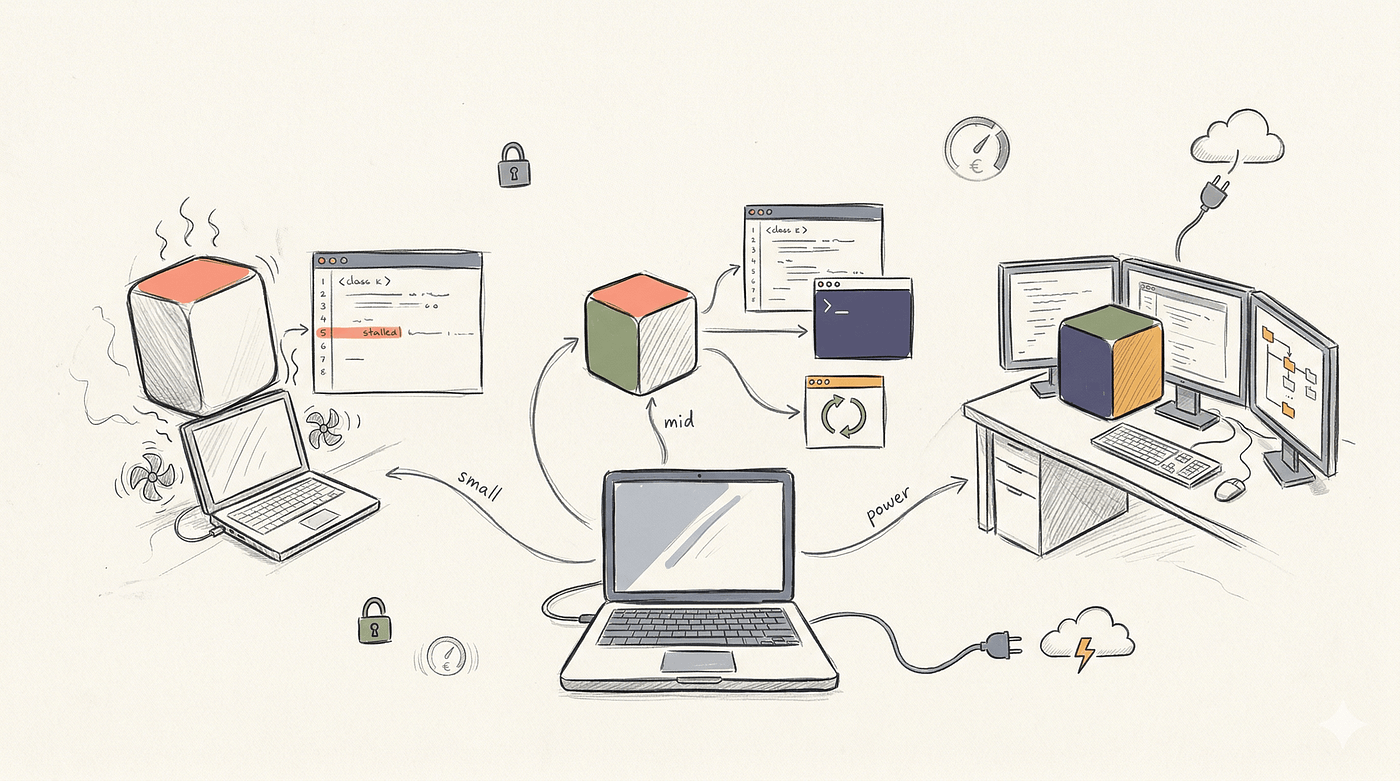
Isolated & Bounded Work includes well-defined functionality with clear inputs and outputs: greenfield features, isolated services, small codebases, and tasks with limited coupling. In these situations, context is explicit and constraints are visible. AI performs well here.
Context-Rich & Coupled Work looks different. Large or legacy systems, tightly connected modules, implicit assumptions, and backward compatibility constraints create a dense context that is rarely captured fully in a prompt or a single code snippet. AI can still help, but its effectiveness becomes sensitive to hidden dependencies and historical complexity.
Long-Horizon & Accountability-Critical Work is where engineers exercise judgment: reviewing complex changes, debugging production issues, managing performance regressions, safeguarding compatibility, troubleshooting legacy “big balls of mud,” and thinking through how today’s decisions will affect the system months or years from now. In these areas, AI may assist, but responsibility and trade-off decisions remain human.
How Technical Debt Accumulates Under Acceleration
The concern is rarely that AI produces obviously broken code. In many situations, AI-generated implementations are comparable to what a competent engineer would write.
The shift happens when throughput increases.
When implementation becomes faster, more code enters the system per unit of time. Review capacity and validation discipline do not automatically expand at the same pace. As a result, review depth often decreases, sometimes gradually and without anyone explicitly deciding that it should.
Small inconsistencies, duplicated abstractions, and unexamined edge cases begin to slip through. Individually, they appear minor. Over time, they increase cognitive friction, reduce clarity, and make future changes more expensive.
This is how technical debt typically forms. It grows through incremental relaxation of discipline.
Consider two practical scenarios.
First, AI increases the volume of changes submitted for review. If review capacity remains constant, engineers face higher mental strain. Under time pressure, reviews become shorter, less critical, and more focused on surface issues rather than architectural coherence.
Second, the same acceleration creates a temptation to delegate review tasks back to AI. Automated review can catch stylistic inconsistencies and simple defects. However, architectural drift, subtle coupling issues, and questionable trade-offs are harder to detect without deliberate human scrutiny. Over time, this can amplify the very debt the tooling was meant to reduce.
At the same time, the volume of generated code can outpace the team’s ability to truly understand it. Shared understanding does not grow automatically with output. As more implementation is produced faster, fewer engineers may fully grasp how components interact or why certain decisions were made. Over time, the team’s mental map of the system becomes thinner. When incidents occur, engineers must debug both the issue itself and their incomplete understanding of the codebase. The cost compounds.
Skill Formation and Exposure to Failure
A related concern is how AI acceleration affects skill formation.
Recent empirical research has begun to explore this question. A large-scale study published in Science examined the global diffusion and impact of generative AI in coding contexts, highlighting both productivity gains and shifts in how developers engage with tasks (Daniotti et al., 2026). While AI increased output, productivity gains do not automatically translate into deeper capability.
This aligns with a broader engineering reality. Judgment rarely develops through smooth success. It forms through repeated exposure to failure: debugging complex production issues, tracing regressions, reviewing flawed abstractions, and experiencing the long-term consequences of earlier design decisions. These are high-feedback experiences. They are often uncomfortable, but they build durable expertise.
If AI reduces exposure to those experiences without replacing them with deliberate validation and structured learning, rather than a forecast of a deteriorating discipline, this constitutes a structural phenomenon worth monitoring.
Leadership Maturity and Conscious Trade-Offs
The long-term impact of AI-assisted engineering will not be determined by tooling alone. It will be shaped by how deliberately organizations handle the trade-offs that acceleration introduces.
There are contexts where aggressive AI leverage is rational. Rapid prototyping, sales-driven demos, isolated systems, and short-lived internal tools may justify prioritizing speed over long-term robustness. In such cases, consciously accepting higher technical debt can be a valid strategic decision.
Problems arise when those trade-offs are made implicitly.
If increased throughput quietly reduces review depth, if architectural discussions shrink because implementation feels easy, or if validation discipline erodes under delivery pressure, the consequences accumulate slowly. They rarely surface immediately. They appear months later as slower changes, fragile integrations, and systems that require increasing effort to reason about.
Engineering has always required balancing speed with reliability. AI increases the pressure on that balance. Teams that handle it consciously will benefit. Teams that let it drift will eventually feel the consequences.
Over the past months, I have found myself thinking less about whether AI can write code and more about what its acceleration does to engineering culture.
Although I recognize the structural shortcomings of genAI, they are not the focus of this article. Despite those inherent limitations, the tools improve quickly and, in many cases, they are genuinely impressive. What concerns me is how easily productivity gains can be mistaken for capability gains.
Engineering has always required balancing speed with reliability. AI increases the pressure on that balance. In my view, the teams that benefit most from AI will not be the ones that move fastest, but the ones that remain deliberate.
I do not see this as a forecast of decline. I see it as a structural risk worth monitoring. If we make our trade-offs explicit, preserve exposure to difficult problems, and treat validation as a first-class activity, AI can strengthen engineering rather than dilute it.
If we choose acceleration consciously, and articulate the justification when we accept shortcuts, we keep control of the direction. That, to me, is the real responsibility in this moment.
References
Daniotti, Simone; Wachs, Johannes; Feng, Xiangnan; Neffke, Frank (2026). Who is using AI to code? Global diffusion and impact of generative AI. Science 391(6787): 831–835. DOI: 10.1126/science.adz9311
메타데이터
- post_id
- db9bace48b96
- slug
- speed-is-not-free-what-ai-changes-in-software-engineering-db9bace48b96
- url
- https://medium.com/@charley.borremans/speed-is-not-free-what-ai-changes-in-software-engineering-db9bace48b96
- canonical_url
- https://medium.com/@charley.borremans/speed-is-not-free-what-ai-changes-in-software-engineering-db9bace48b96
- author_url
- https://medium.com/@charley.borremans
- status
- ok
- fetched_at
- 2026-08-12 00:14:20