ISO 19650 and the Power of a Common Data Environment (CDE) in BIM Projects
In complex BIM projects, information is often more valuable than materials on site. Drawings, models, RFIs, emails, schedules, and…
ISO 19650 and the Power of a Common Data Environment (CDE) in BIM Projects
In complex BIM projects, information is often more valuable than materials on site. Drawings, models, RFIs, emails, schedules, and specifications all drive decisions, yet they’re usually scattered across inboxes, local drives, and messaging apps. This chaos is exactly what ISO 19650 tries to fix, and at the heart of it sits one core concept: the Common Data Environment (CDE).
In this blog, we’ll unpack what ISO 19650 is, why the CDE is so critical, and how you can practically implement these ideas in your own BIM workflows.
What is ISO 19650?
ISO 19650 is an international standard for managing information over the entire lifecycle of a built asset using BIM processes. It provides a common language and structured approach so that clients, consultants, and contractors can collaborate without reinventing the wheel on every project.
In simple terms, ISO 19650 helps you:
- Define who needs what information, when, and in what format.
- Standardize naming, classification, and status of documents and models.
- Reduce confusion, duplication, and rework caused by poor information management.
Instead of treating information as an afterthought, ISO 19650 puts it at the centre of project delivery and operations.
The Role of the Common Data Environment (CDE)

The Role of the Common Data Environment
The CDE is the practical engine of ISO 19650. It is a centralized digital workspace that acts as the single source of truth for all project information across the asset lifecycle.
Key characteristics of a CDE
- One place to store, manage, and share models, drawings, RFIs, reports, and documents.
- Controlled access, so every stakeholder sees only what they should see.
- Version control and audit trails, so nothing is “mysteriously changed” without a record.
When used properly, the CDE turns information chaos into a structured, predictable flow.
The Four Information “States” in a CDE
Different platforms may look different, but the logic behind a CDE is usually the same. Information passes through four main “states” as it matures.
Work in Progress (WIP)
- Private to individual teams or disciplines.
- Used for internal development, testing, and iteration.
- Not yet suitable for coordination or construction.
Shared
- Information is ready for coordination and review by other teams.
- Used for clash detection, design coordination meetings, and feedback.
- Everyone can see it, but it’s still not formally “approved” for site.
Published
- Information that has been approved and authorized for use in construction, procurement, or fabrication.
- Treated as a contractual reference point.
- Changes require a new revision, not silent overwriting.
Archive
- Superseded information stored for record, traceability, and legal compliance.
- Keeps a full history of how the project evolved over time.
- Valuable for claims, disputes, and lessons learned.
Rather than having countless unrelated folders, ISO 19650 encourages you to see information as moving through these states in a controlled way.
Why a CDE Changes the Game
A well-implemented CDE delivers tangible benefits for every stakeholder in the BIM ecosystem.
For design and engineering teams
- Less time searching for “the latest drawing”.
- A clear structure for issuing, reviewing, and updating information.
- Reduced risk of working on outdated models or documents.
For contractors and site teams
- Confidence that published information is approved and reliable.
- Fewer RFIs triggered by unclear or conflicting information.
- Better alignment between office and site.
For clients and asset owners
- A complete, structured digital record of the project.
- Cleaner handover into facilities management and operations.
- A better foundation for digital twins and long-term asset strategies.
Core Features to Look for in a CDE Platform
If you’re evaluating tools or improving your current setup, focus less on brand names and more on capabilities.
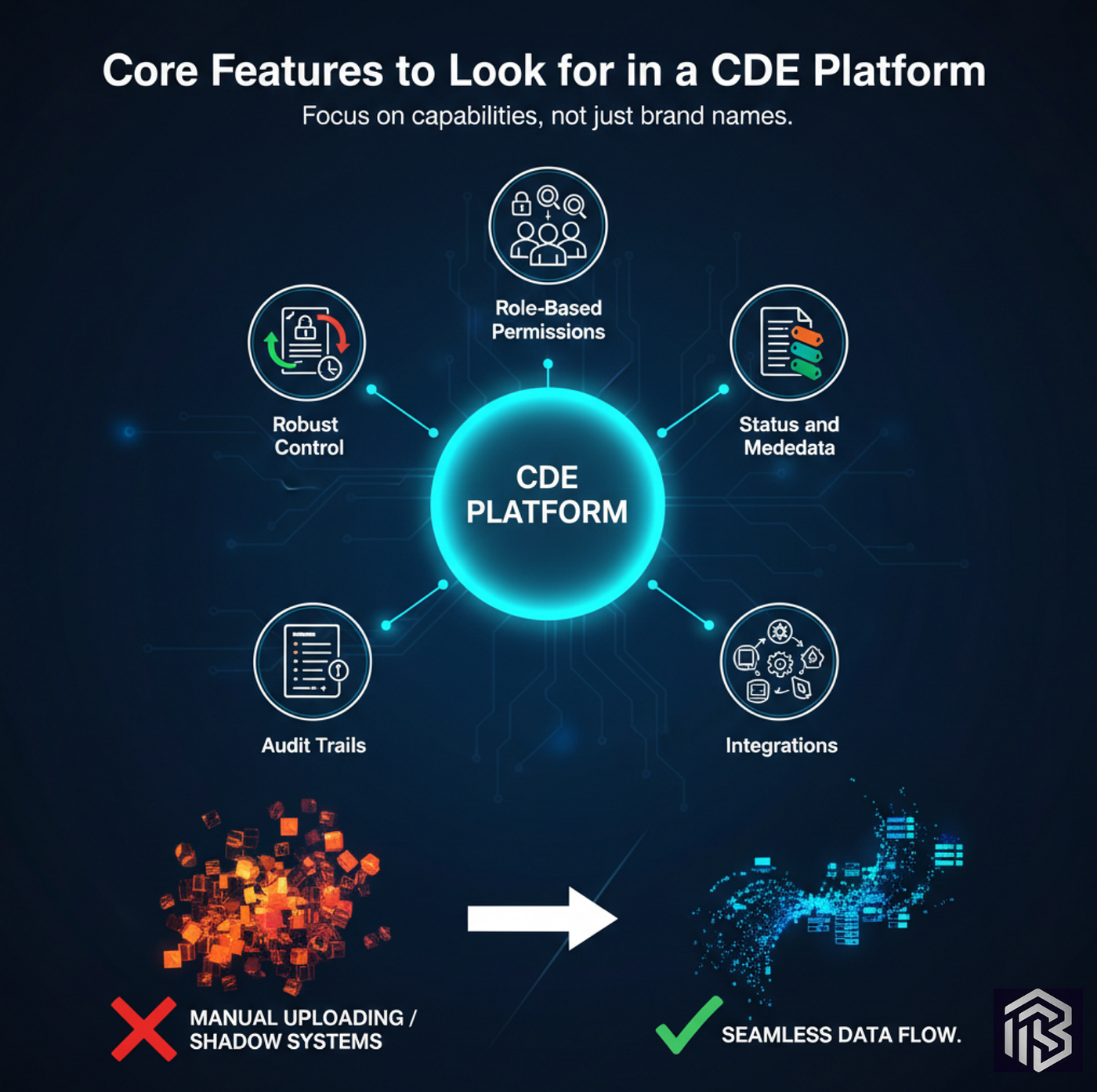
Core Features
- Robust version control Track every revision, who made it, and when. Prevent accidental overwrites and keep a clear history.
- Role-based permissions Not everyone needs to edit everything. Define who can view, upload, review, or approve content.
- Status and metadata Apply status codes (e.g., WIP, Shared, Published) and metadata like discipline, level, zone, or system. This makes filtering and searching far more powerful.
- Audit trails Log downloads, approvals, rejections, and comments. These trails are invaluable when resolving disagreements or tracing decisions.
- Integrations The best CDEs integrate cleanly with authoring tools, project management platforms, and field apps. This reduces manual uploading and “shadow systems”.
Implementing ISO 19650 and CDE in Your Organization
You don’t need to flip a magic switch and be “ISO 19650 compliant” overnight. A phased and realistic approach works best.
1. Start with a pilot project
- Choose a project with a cooperative client and team.
- Define clear information requirements and workflows.
- Use this project to test your processes and templates.
2. Define roles and responsibilities
- Appointing Party — typically the client or asset owner.
- Lead Appointed Party — often the main contractor or lead consultant.
- Appointed Parties — subconsultants, subcontractors, suppliers.
- Information Manager — the person or function responsible for information workflows and CDE governance.
Everyone should know what they must deliver and how they must deliver it.
3. Set up standards and templates
- File naming conventions.
- Folder / container structure aligned with WIP–Shared–Published–Archive.
- Standard statuses, review workflows, and approval procedures.
Document these in your BIM Execution Plan (BEP) so all parties understand and agree.
4. Train your teams
- Don’t assume people will “figure it out”.
- Provide short, practical sessions on:
- How to upload, review, and publish.
- How to apply naming conventions and metadata.
- How to avoid bypassing the CDE with email and messaging apps.
5. Monitor, refine, and scale
- Run periodic audits: Are people following the workflow? Where are they struggling?
- Adjust templates and procedures based on real feedback.
- Once the pilot is stable, roll out to more projects with confidence.
Typical Mistakes to Avoid
Even with the best intentions, CDEs can fail if misused.
- Treating the CDE as just a file dump, not a structured process.
- Allowing teams to send critical information via email instead of the CDE.
- Ignoring naming conventions and metadata, making search and filtering painful.
- Not assigning a clear Information Manager or governance structure.
- Overcomplicating processes so much that people resist using the system.
The goal is disciplined simplicity: enough structure to be reliable, but not so much bureaucracy that it kills productivity.
CDE from a Mechanical / MEP Perspective
From a mechanical or MEP standpoint, the CDE can dramatically improve coordination and buildability.
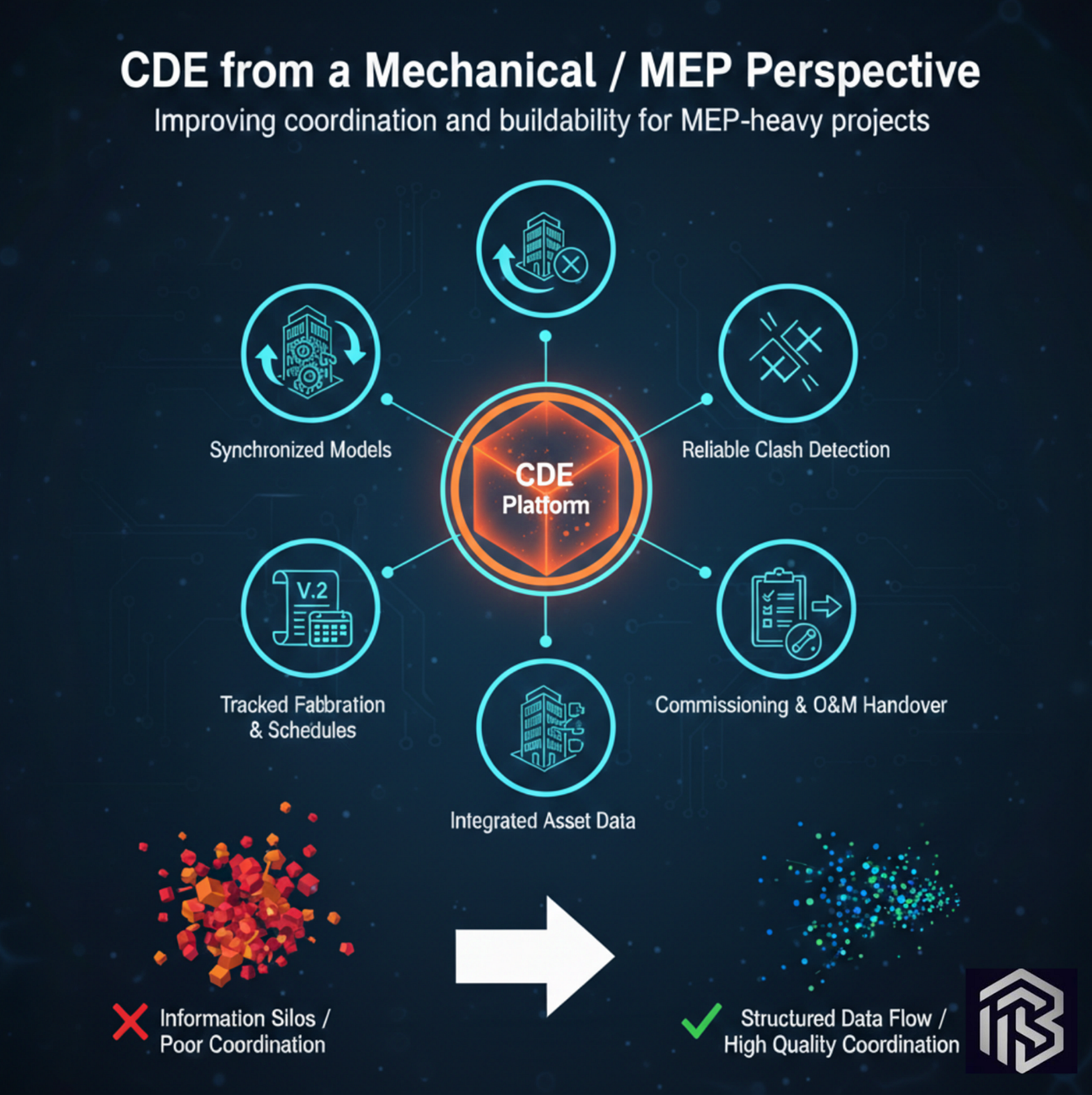
CDE Mechanical / MEP Perspective
- MEP models and drawings are always synchronized with architecture and structure.
- Clash detection becomes more reliable when everyone shares from a single, consistent source
- Fabrication drawings and schedules are easier to track once they’re published and versioned in the CDE.
- Commissioning, O&M manuals, and asset data can flow straight from design and construction into facilities management.
For MEP-heavy projects, the quality of your CDE often directly reflects the quality of your coordination.
Final Thoughts
ISO 19650 is not just a compliance label — it’s a mindset shift from “files scattered everywhere” to information as a managed asset. The Common Data Environment is where that mindset becomes reality.
If you’re already delivering BIM projects, adopting an ISO 19650-aligned CDE is one of the most impactful upgrades you can make. Start small, be consistent, and let information discipline become part of your team’s culture.
메타데이터
- post_id
- db9f2e4ebea7
- slug
- iso-19650-and-the-power-of-a-common-data-environment-cde-in-bim-projects-db9f2e4ebea7
- url
- https://medium.com/@BuiltInBimUS/iso-19650-and-the-power-of-a-common-data-environment-cde-in-bim-projects-db9f2e4ebea7
- canonical_url
- https://medium.com/@BuiltInBimUS/iso-19650-and-the-power-of-a-common-data-environment-cde-in-bim-projects-db9f2e4ebea7
- author_url
- https://medium.com/@BuiltInBimUS
- status
- ok
- fetched_at
- 2026-06-27 07:40:21