The Server is Optional: How Transformers.js v4 and WebLLM Just Redefined Browser AI
For years, the industry operated under a silent consensus: large-scale machine learning belonged on the server, while the browser was…
The Server is Optional: How Transformers.js v4 and WebLLM Just Redefined Browser AI
For years, the industry operated under a silent consensus: large-scale machine learning belonged on the server, while the browser was reserved for “toy demos” — simple image filters or tiny sentiment analysis models. The limitations were architectural: the overhead of JavaScript and the constraints of the browser sandbox meant that serious inference was a cloud-only mandate.
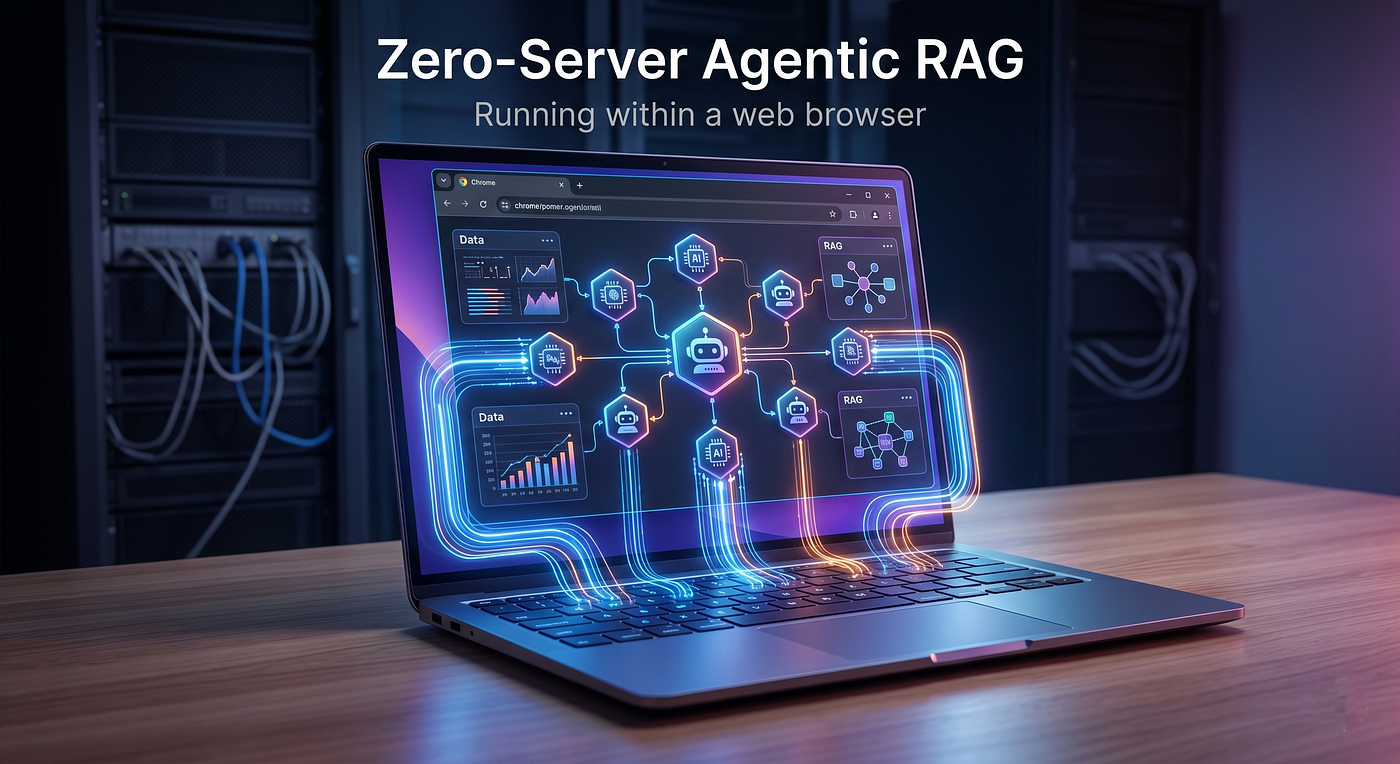
We are witnessing the death of that mandate.
With the release of Transformers.js v4 and the latest benchmarks from WebLLM, the browser has evolved into a high-performance execution environment. We aren’t just talking about small optimizations; we are seeing 20-billion parameter models running locally with performance that rivals native C++ applications. This is a fundamental shift that bypasses massive server costs, obliterates latency, and finally solves the privacy paradox by keeping data entirely on the user’s edge device.
1. WebGPU: From Browser Experiment to Backend Agnostic Powerhouse
The defining breakthrough of Transformers.js v4 is the complete replacement of the old “JavaScript-only” WebGPU backend with a brand-new C++ WebGPU runtime.
Previously, the library was locked to the browser’s specific APIs. By moving to a C++ core and collaborating with the ONNX runtime team, the engine is now backend agnostic. This is a massive win for architects: the exact same code you write for a Chrome Extension now runs with full hardware acceleration across Node.js, Bun, and Deno.
Simultaneously, WebLLM has pushed the boundaries of machine learning compilers like Apache TVM to generate highly optimized kernels. The result is a total destruction of the “web performance tax”:
WebLLM now achieves up to 80% of native performance for LLM inference.
“We worked closely with the ONNX runtime team to test it across all supported models and the results are incredible.” — The Transformers.js Development Team
2. The MoE Revolution: Massive Models on Consumer Hardware
The most frequent question I get is: How can a browser possibly handle a 20-billion parameter model? The answer lies in Mixture of Experts (MoE) and optimized operation implementation.
In traditional dense models, every parameter is activated for every token. MoE flips this, activating only a subset of “expert” networks per token. This keeps the compute budget low enough for real-time performance on consumer hardware. Transformers.js v4 makes this viable through custom MoE and QMoE ops in the ONNX runtime, allowing models that once required a server cluster to breathe inside a browser tab.
- GPT-OSS 20B: This 20-billion parameter giant now clocks in at 40 tokens per second locally.
- DeepSeek V3 & Granite 4.0-H: The library now supports cutting-edge research like IBM’s hybrid Granite 4.0-H, which uses interleaved Mamba and attention layers to optimize memory and speed.
- LFM 2.5: A 1.2 billion parameter model from LiquidAI that achieves blistering speeds by leveraging fused kernels to maximize GPU throughput.
3. Multimodal Excellence: Beyond the Text Box
We have moved past the era of “text-in, text-out.” Browser AI is now natively multimodal, supporting over 200 architectures. These aren’t just proofs of concept; they are high-signal models capable of state-of-the-art performance:
- Qwen 3.5: A heavy hitter that performs at the level of GPT-4o from just a few years ago, right in your browser.
- Chatterbox Turbo: Voice cloning using only 5 seconds of audio, supporting paralinguistic tags (e.g.,
[chuckle],[gasp]) for human-grade realism. - Voxtral Realtime: Streaming automatic speech recognition that runs 100% locally, ensuring total privacy for sensitive audio data.
- LFM2VL & TranslateGemma: Delivering real-time video captioning and high-fidelity translation across 55 languages without a single API call.
4. A Developer Experience (DX) Built for Production
A library is only as good as its production readiness. Version 4 introduces the ModelRegistry, a critical tool for visibility. Instead of “black box” loading, developers now have total control over:
- Accurate UX: The new
**progress_totalcallback** allows you to build precise loading bars by calculating total download sizes across all required files. - Enterprise Integration: The new
**env.fetchcapability** allows you to pass custom headers, auth tokens, or abort signals, making the library compatible with authenticated enterprise request pipelines. - Modular Architecture: The codebase has been refactored from a monolith into per-model files. Thanks to a switch to esbuild, build times have plummeted from 2 seconds to just 200 milliseconds, while the tokenizer has been decoupled into a standalone, zero-dependency 8.3kb library.
“This is by far the most stable release we’ve ever shipped.” — Nico, Transformers.js Co-developer
5. Efficiency: Quantization and Offline-First AI
The “magic” behind the speed is a relentless focus on optimization. Through 4-bit and 8-bit quantization, we can run a 3B parameter model at 90 tokens per second on an M3 laptop.
But the real game-changer for Progressive Web Apps (PWAs) is the environment control. By default, Transformers.js v4 now caches WASM runtime files. This enables true offline-first AI: once the initial model is loaded, your application remains fully functional even without an internet connection. By combining WebAssembly (WASM) for CPU-heavy sequence management and fused kernels for GPU acceleration, we’ve eliminated the performance bottlenecks that previously plagued web-based ML.
Conclusion: The Hybrid Future
The browser is no longer a second-class citizen; it is a first-class deployment target. The infrastructure is now in place to move from a cloud-only mindset to Hybrid Inference, where applications intelligently swap between cloud processing for heavy reasoning and local execution for low-latency, private, or cost-sensitive tasks.
The tools are ready. The performance is native-grade. And with over 3,000 compatible models currently on the Hugging Face Hub, the only question left is: What will you build when the server is optional?
메타데이터
- post_id
- dba04d37979b
- slug
- the-server-is-optional-how-transformers-js-v4-and-webllm-just-redefined-browser-ai-dba04d37979b
- url
- https://medium.com/@muhammad.awais.professional/the-server-is-optional-how-transformers-js-v4-and-webllm-just-redefined-browser-ai-dba04d37979b
- canonical_url
- https://medium.com/@muhammad.awais.professional/the-server-is-optional-how-transformers-js-v4-and-webllm-just-redefined-browser-ai-dba04d37979b
- author_url
- https://medium.com/@muhammad.awais.professional
- status
- ok
- fetched_at
- 2026-07-15 16:48:10