Beach Invasion of the Blue Jelly Blob
Velella velella wash ashore
MARINE LIFE
Beach Invasion of the Blue Jelly Blob
Velella velella wash ashore
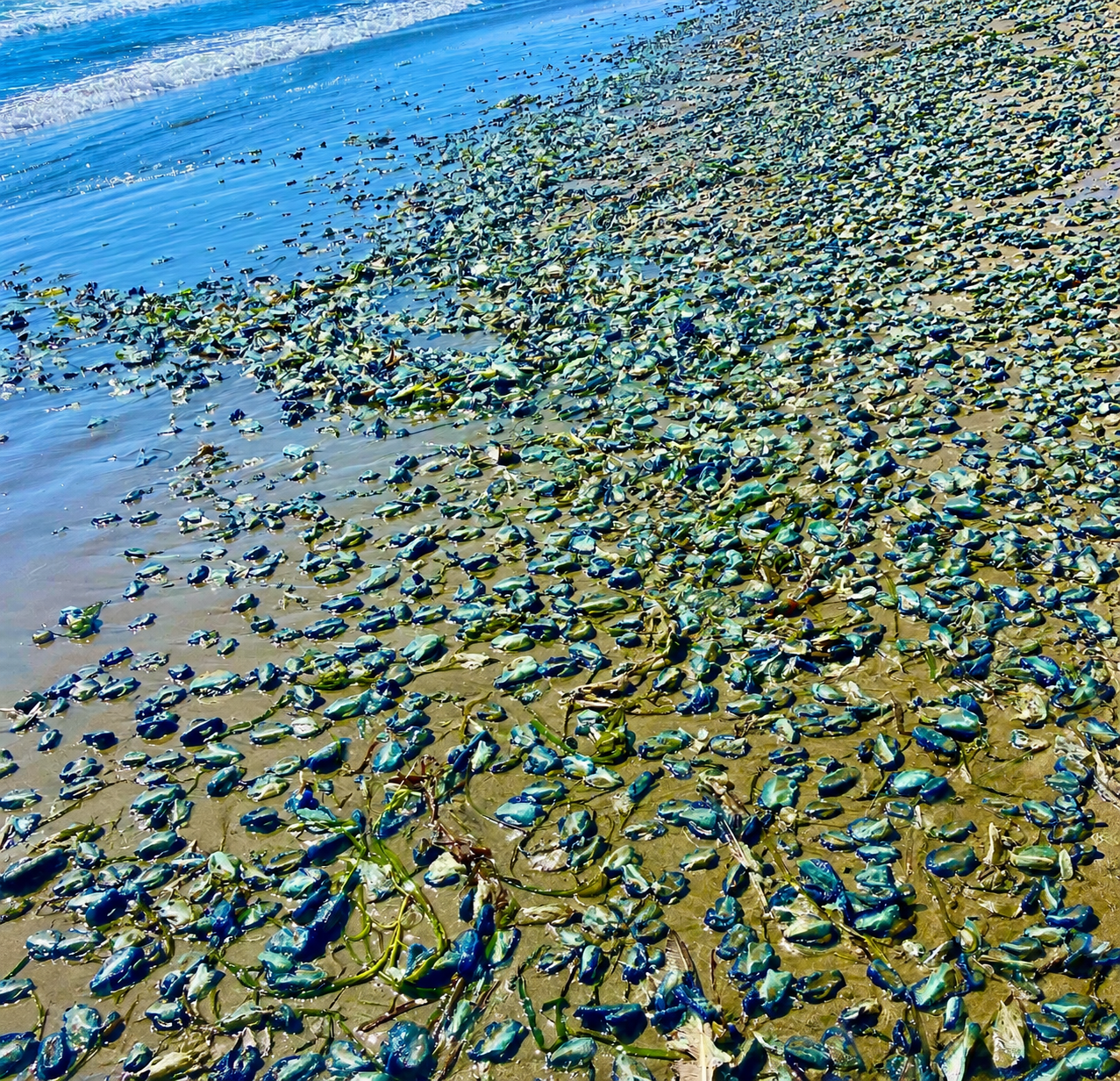
Photo by Author
Thousands of blue, oval-shaped, transparent jelly blobs have taken over California’s Central Coast beaches. It looks as though a radioactive lava lamp exploded along the shoreline, washing ashore in electric-blue clusters that are both beautiful and vaguely apocalyptic.
I’ve been on many a beach in California, but I’ve never encountered anything so surreal. I stopped passing beachgoers to ask what they were, but everyone seemed as clueless as I was and remarkably unconcerned.
Not me. Too Curious. Especially when my dog began slopping them up. I immediately put her back on a leash and got off the beach.
At first, I thought they were sea anemones. Sure looked like them, but after some cursory research via the National Park Service, I discovered that these crazy-looking invertebrates, which are related to the jellyfish without the sting, are called *Velella Velella* and a list of other names like purple sail, little sail, by-the-Wind Sailor, sea raft.
Typically measuring three to four inches in length, these oval-shaped invertebrates are free-floating hydrozoans (hydrozoans and part of the family of Porpitidae.) According to UC Santa Barbara, they “live on the surface of the open ocean” and rely on stinging tentacles to feed on plankton.
While they are characterized by their deep blue color, their most prominent feature is a small, translucent, stiff sail sticking up from the body. These sails, resembling cellophane candy wrappers, catch the wind and push them across the ocean surface.
Living entirely at the mercy of changing wind conditions, Velella velella frequently end their journeys washed ashore on California beaches.
Perhaps the most fascinating thing about these instinctless sailors is their built-in navigation system, based on a distinct asymmetry: their sails are permanently oriented either to the left or to the right of their long axis.
You can see these sails in the photo below.
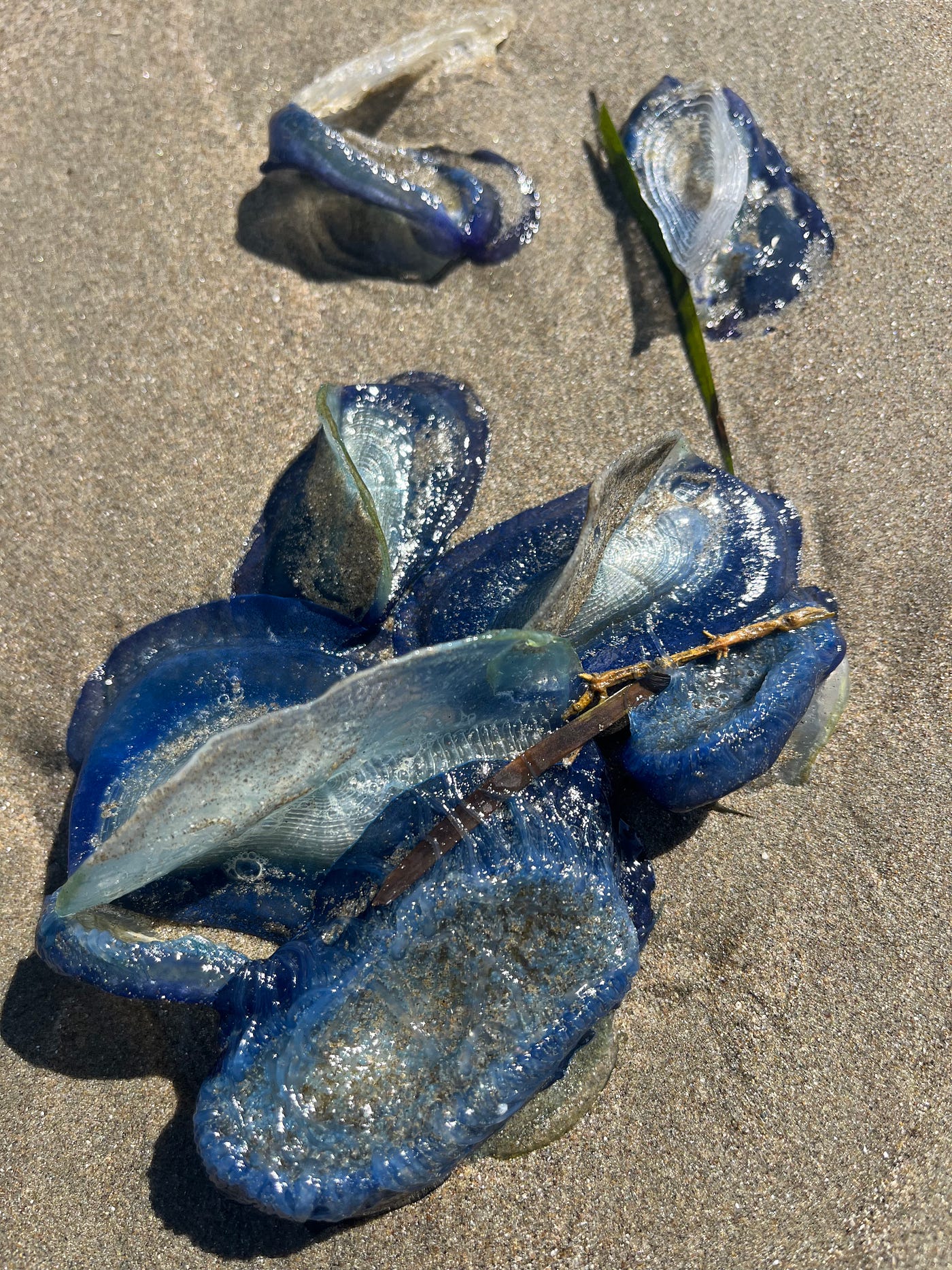
Photo by Author
The colonies on the California coast are typically left-handed sailers (no, they are not politically polarized). It is an evolutionary design element intended to use prevailing winds to keep them safely pushed offshore.
But when massive, unseasonal spring wind storms flip the script, entire right- or left-handed fleets are caught on the wrong tack, sending millions of identical clones on a one-way trip to the sand.
As beautiful as the initial electric-blue invasion is, it comes with a strict expiration date. Within a few days of baking on the sand, the vibrant cerulean pigments fade, leaving behind what look like thousands of crunchy, clear plastic potato chips.
Then comes the real test for local homeowners and beachgoers: the foul stench. As millions of gelatinous colonies decompose simultaneously, coastal windows slam shut, bandanas drape across noses, and the shoreline transforms into a pungent, odoriferous bowl of aging fish.
While a beach stranding is an evolutionary dead end for the Velella, out at sea, these massive blooms are a vital oceanographic lifeline. They serve as a floating buffet for some of the ocean’s most eccentric predators, each uniquely adapted to hunt at the sea-and-air interface.
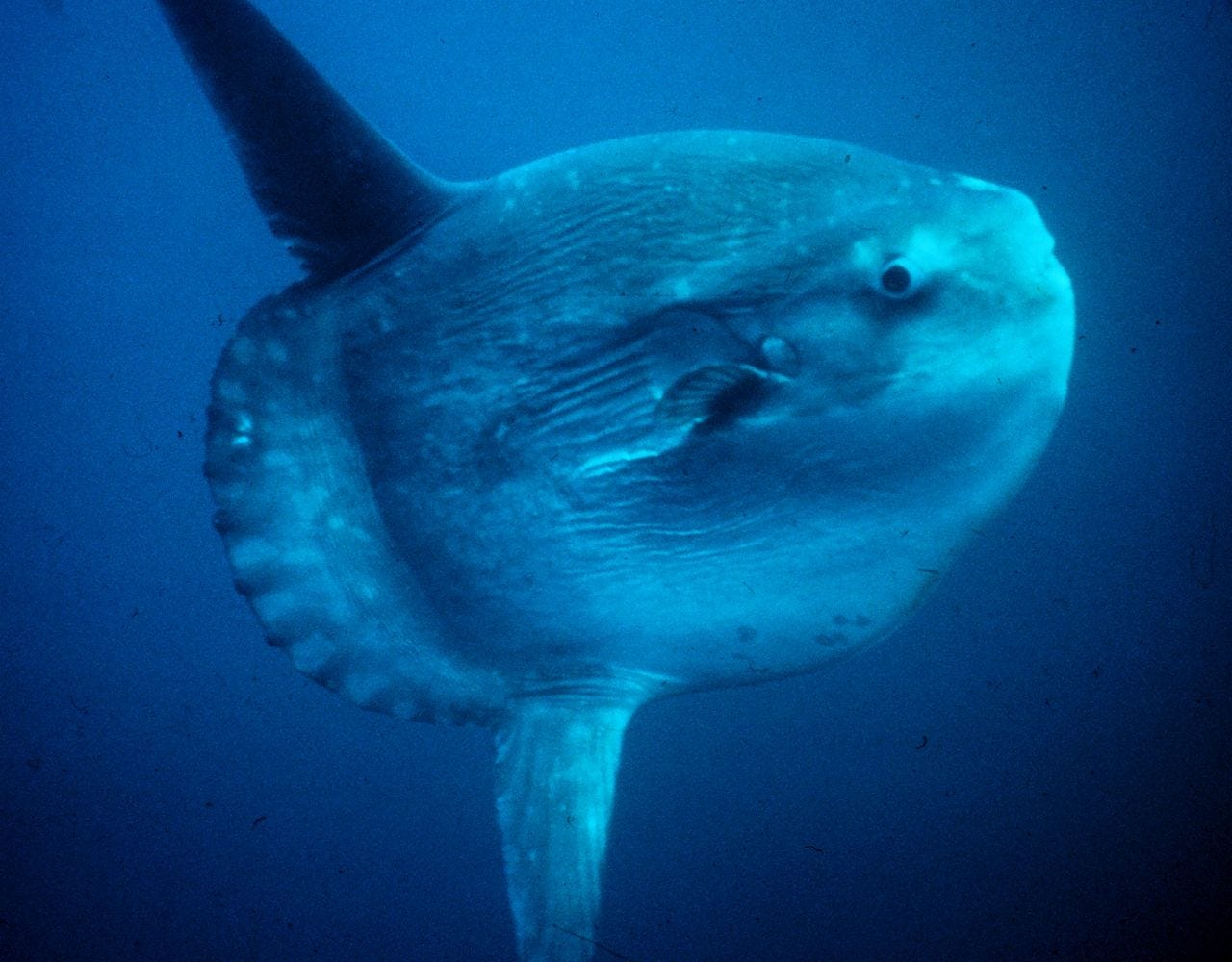
The most conspicuous creature is the Ocean sunfish (Mola mola), a lumbering, prehistoric-looking giant that cruises the California coast vacuuming up the blue colonies by the thousands.
https://commons.wikimedia.org/wiki/File:Mola_mola.jpg
Perhaps the most radical predator is the Blue Dragon Sea Slug (Glaucus atlanticus), a striking, finger-fringed nudibranch that floats on the surface tension of the water, completely immune to the Velella’s stinging cells, which it actively steals and weaponizes inside its own body for defense.
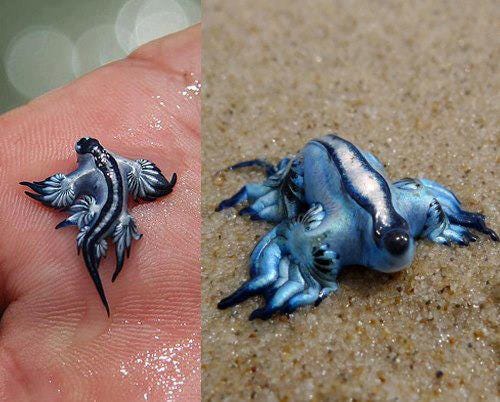
By Imtorn — Own work, CC BY-SA 3.0, https://commons.wikimedia.org/w/index.php?curid=21281406
Even migrating sea turtles are known to detour into these brilliant blue slicks, popping the helpless sailors like candy.
The ocean’s biodiversity is always staggering to witness. When colonies are forced onto land, they transfer large amounts of nutrient-rich marine carbon and nitrogen directly into the coastal ecosystem. (Well, maybe less since my dog slopped up some of it.)
It turns out Mother Ocean has a grand design for these trillions of tiny sailors, fueling everything from giant sunfish to the coastal soil itself.
Too bad no one told my dogs, who were convinced the entire ecological phenomenon was arranged strictly for their personal seaside snack, which they wholeheartedly threw up a few hours later on the living room carpet.
I’m just glad I clipped the leash on when I did; leaving the carbon and nitrogen to the coastline, and keeping the vet bills at bay.
메타데이터
- post_id
- dbc00ed80d81
- slug
- beach-invasion-of-the-blue-jelly-blob-dbc00ed80d81
- url
- https://medium.com/weeds-wildflowers/beach-invasion-of-the-blue-jelly-blob-dbc00ed80d81
- canonical_url
- https://medium.com/weeds-wildflowers/beach-invasion-of-the-blue-jelly-blob-dbc00ed80d81
- author_url
- https://medium.com/@marycappelli
- status
- ok
- fetched_at
- 2026-06-09 15:37:30