Was King Minos Actually Egyptian?
An attempt to make sense of the Minos/Manu/Menes web of cross-cultural influences
Was King Minos Actually Egyptian?
An attempt to make sense of the Minos/Manu/Menes web of cross-cultural influences
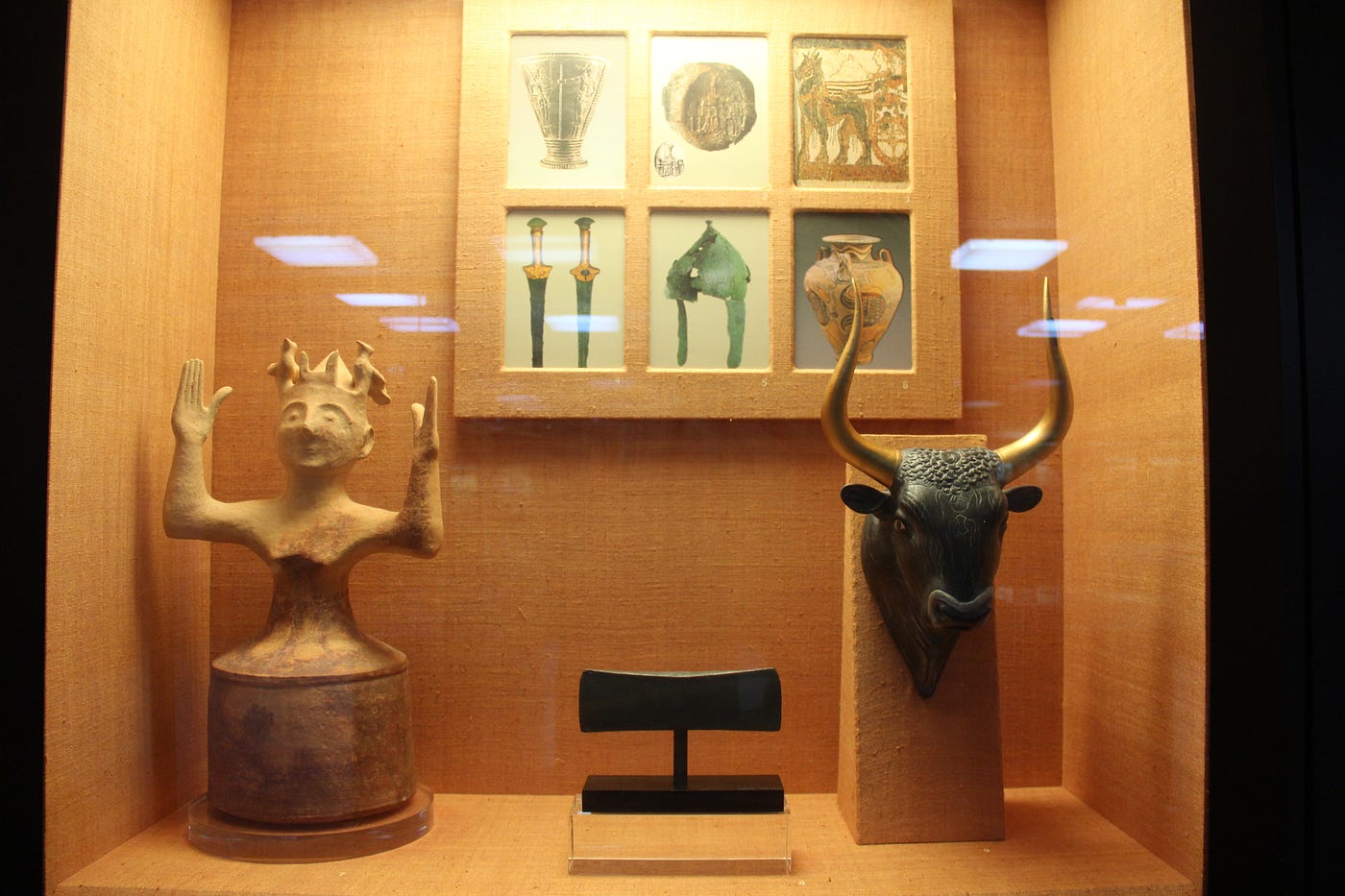
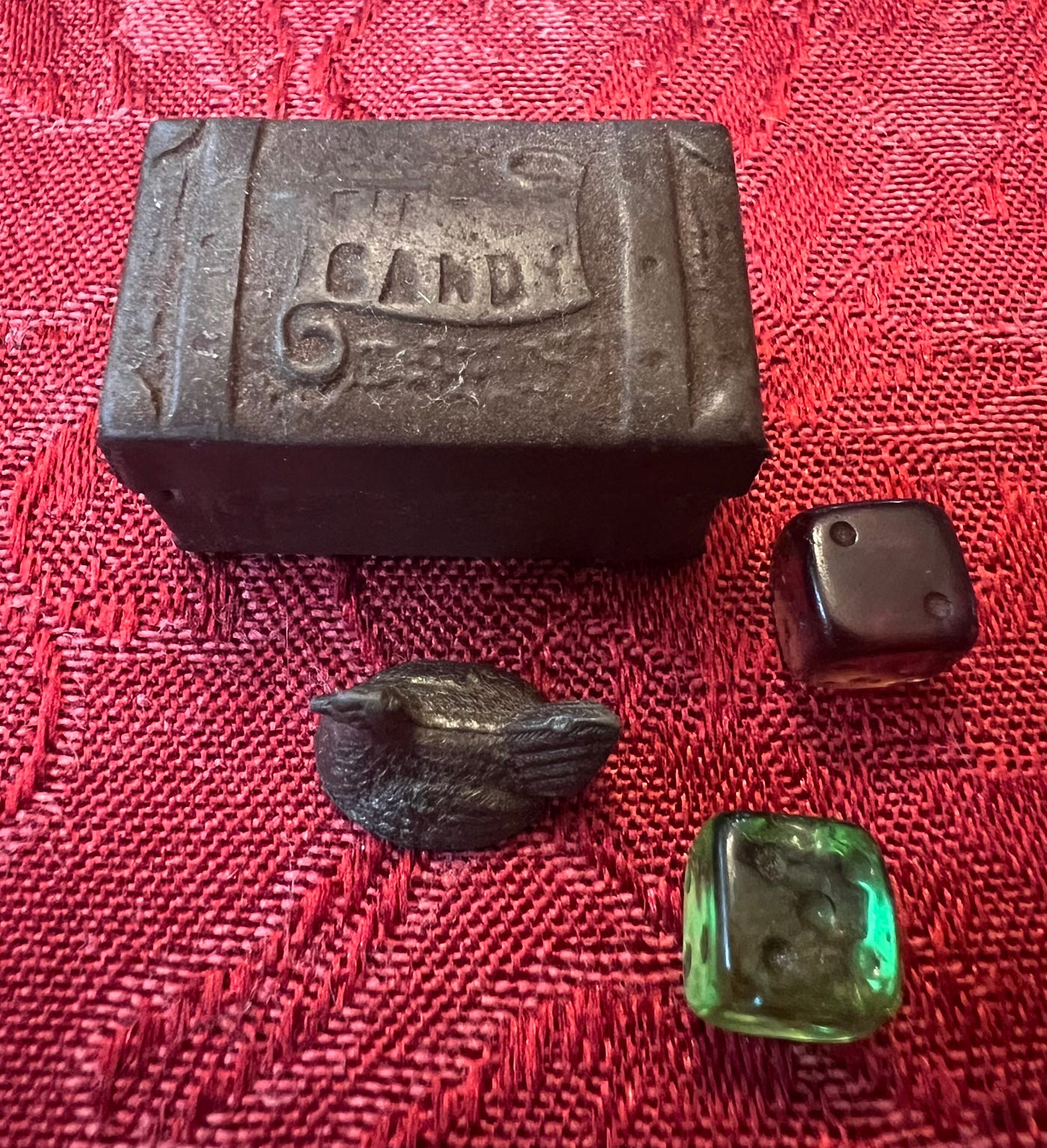
Minoan Artifacts Via Wiki Commons
According to the Ancient Greeks, the first pharaoh was Menes/Min, who united upper and lower Egypt into one kingdom. More recent historians have claimed instead that Mjn, pronounced Mane, was the title used by early Egyptian royalty, meaning ‘he who endures’, and probably also the name of a prehistoric Nubian hero whose story has been lost.
It is not hard to see how Mjn as Min might be corrupted into Minos, the name of the king of Crete in the Minotaur myth, through cultural diffusion.
Besides his association with the Minotaur, Minos is an ancestor figure known for being the world’s first naval commander according to Greek tradition, and later a judge of the dead in Hades alongside his brothers.
These more mythic attributes might have been borrowed from this original Nubian hero, upon whom he is based, or perhaps the Minoan kings, copying their Egyptian counterparts, also used the title Mjn, and Minos is a remnant of the official royal cult. In any event, this would make Minos at least partially an Egyptian figure.
I should point out that this connection is not purely my own theorizing. Wikipedia connects Minos and Menes as possibly being related, and this is my best guess of how that might work in practice.
Of course, this immediately runs into a major problem: most Indo-Europeanists claim that Minos is based upon Manu, one of the primordial twins of the proposed Proto Indo-European creation myth, and therefore cannot be Nubian in origin.
The idea of the primordial twins is that Manu, the first man, kills his twin Yemo to inherit the kingship of the earth. Supporters of this theory sometimes go further and claim that Manu is the basis for a Proto-Zeus as king of the day and Yemo is the basis for a Proto-Odin as king of the night; however, the general structure and meaning of the story are almost taken verbatim from the Cain and Abel portion of the Bible.
Manu and Yama, the proposed Vedic versions of the twins, are lawgivers, with Yama still being the judge of the dead in some forms of Buddhism, much the same way as Minos in Greek mythology.
In other words, this is incredibly tangled: Minos could easily be a reflection of either Mjn or Manu, and Manu is himself apparently the same figure as the Biblical Cain.
However, before anyone says ancient aliens or argues for the bizarre racist position that the founders of Egypt were European, let’s remember that we’re dealing with myths that existed for thousands of years before they were written down in cultures that did have contact with one another.
In opposition to the Kurgan theory, which states that Indo-Europeans originated on the Russian steppe during the Bronze Age, there is the Anatolian theory, which proposes that farmers from what is today Turkey brought Indo-European mythology westward into Europe and eastward into India some 6,000 years ago.
Turkey, Mesopotamia, and Egypt have probably been in contact through trade and through warfare since cities first appeared in these places. Which means that whether or not the original hero was Manu from Turkey or Mjn from Nubia, these stories had influenced each other back and forth until they became inseparable.
So to answer the question: What is the connection really between Minos, Manu, and Menes, the answer might honestly be that somewhere in prehistory, someplace along the trade routes which linked all these early centers together, there was an ancestor figure whose story is impossible to reconstruct, but who gave rise to them all.
It’s not a neat conclusion, but it is an interesting one to ponder.
메타데이터
- post_id
- dbd4cc707175
- slug
- was-king-minos-actually-egyptian-dbd4cc707175
- url
- https://medium.com/mythology-journal/was-king-minos-actually-egyptian-dbd4cc707175
- canonical_url
- https://medium.com/mythology-journal/was-king-minos-actually-egyptian-dbd4cc707175
- author_url
- https://medium.com/@moderndayseanchai
- status
- ok
- fetched_at
- 2026-08-04 14:47:27