Spooky Action at a Distance
What Einstein Feared and What We Still Don’t Fully Understand
Spooky Action at a Distance
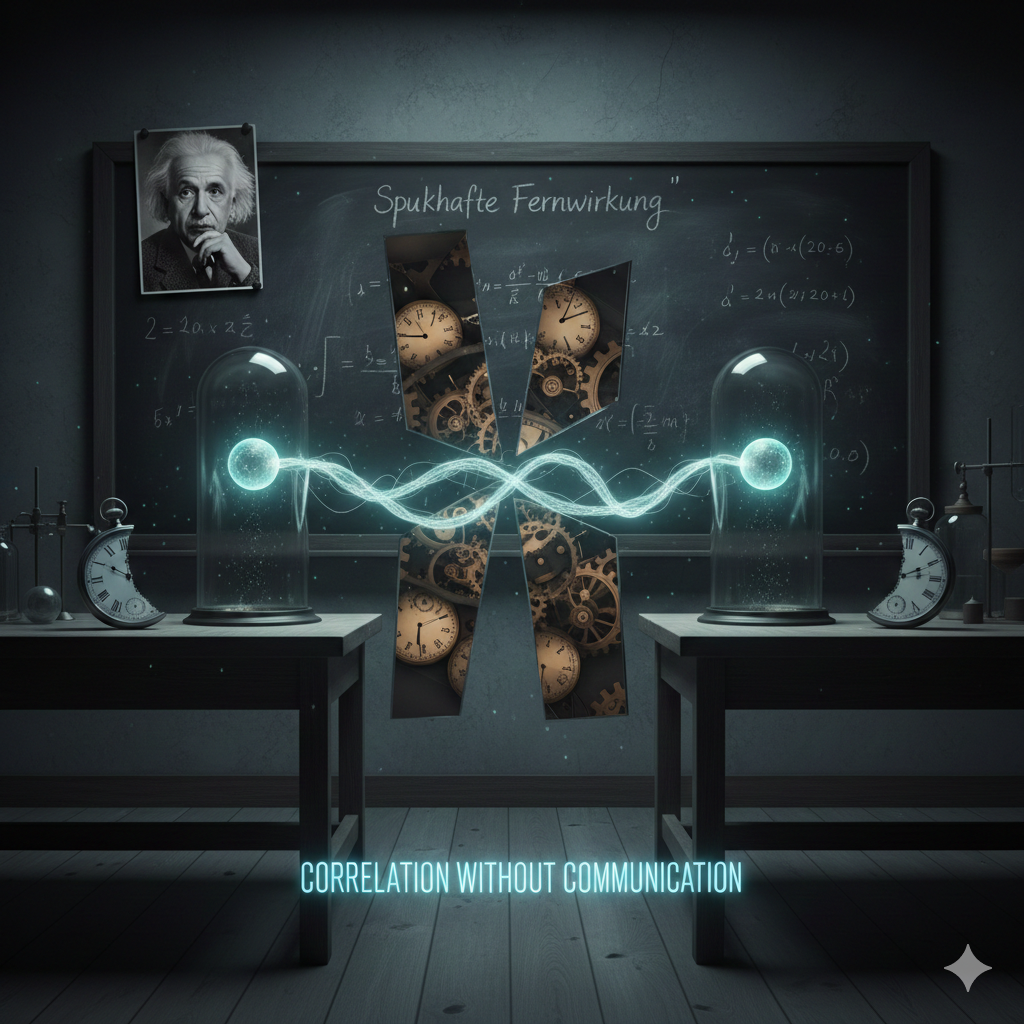
What Einstein Feared and What We Still Don’t Fully Understand
Albert Einstein did not coin the phrase “spooky action at a distance” as a compliment.
He used it as a warning.
In a 1947 letter, Albert Einstein described what he saw as a fatal flaw in quantum mechanics: the idea that two particles, once entangled, could influence each other instantaneously across space. To Einstein, this was not merely counterintuitive, it was unacceptable.
It violated locality. It threatened causality. And worst of all, it suggested that the universe might not be fully knowable in the way physics had promised for centuries.
Einstein called it spukhafte Fernwirkung spooky action at a distance because that was the only language that captured how unsettling it felt.
The Problem Einstein Couldn’t Ignore
Classical physics rests on a comforting assumption: things only affect other things by touching them, or by signals travelling through space over time.
Nothing jumps. Nothing cheats.
Quantum entanglement breaks that intuition cleanly in half.
When two particles become entangled, their properties are no longer independent. Measure one, and the state of the other is instantly determined, even if it is light-years away. There is no observable signal passing between them. No delay. No medium.
To Einstein, this implied one of two disturbing possibilities:
- Information was travelling faster than light
- Or quantum mechanics was incomplete
Einstein chose option two.
The EPR Rebellion
In 1935, Einstein, Podolsky, and Rosen published what became known as the EPR paradox. Their argument was subtle but devastating:
If quantum mechanics were correct and locality held true, then particles must carry hidden information, hidden variables that predetermine outcomes.
Quantum mechanics, they argued, was a statistical approximation of a deeper, deterministic reality we simply had not uncovered yet.
This was not denial. It was a demand for completeness.
And for a while, it looked reasonable.
When Reality Refused to Cooperate
Then came Bell.
In 1964, John Bell showed mathematically that no local hidden-variable theory could reproduce all the predictions of quantum mechanics. This wasn’t philosophy. It was a testable inequality.
Experiments followed. Repeatedly. Relentlessly.
They sided with quantum mechanics.
Not once. Not controversially. But decisively.
The universe, it turned out, does not respect locality in the way Einstein hoped.
The Subtlety Everyone Misses
Here is the part that still confuses people, sometimes even physicists.
Entanglement does not allow faster-than-light communication.
You cannot send messages. You cannot signal intent. You cannot violate causality.
What you get instead is something stranger:
Correlation without communication.
The universe appears to “decide” outcomes jointly, as a single system, regardless of spatial separation. Space still matters. Time still matters. But independence does not.
That is the real shock.
Why This Is Still Uncomfortable
We’ve learned to engineer around entanglement.
We use it for:
- Quantum key distribution
- Quantum teleportation
- Quantum computation
But we still struggle to explain what it means.
Does reality exist before measurement? Is information fundamental? Is spacetime emergent rather than primary?
Einstein lost the argument but not the concern.
His discomfort remains ours.
The Deeper Lesson
“Spooky action at a distance” is not a bug in quantum mechanics.
It is a mirror.
It reflects the limits of classical intuition in a universe that does not care how we prefer causality to work. We can calculate outcomes with absurd precision, build technologies on top of them, and still fail to answer the simplest question:
What is actually happening?
Einstein’s phrase endures not because he was wrong but because he was honest enough to say:
If this is how reality works, we should admit how strange it really is.
And perhaps that is the most scientific position of all.
메타데이터
- post_id
- dbe8d899dec8
- slug
- spooky-action-at-a-distance-dbe8d899dec8
- url
- https://medium.com/@insanemechanic/spooky-action-at-a-distance-dbe8d899dec8
- canonical_url
- https://medium.com/@insanemechanic/spooky-action-at-a-distance-dbe8d899dec8
- author_url
- https://medium.com/@insanemechanic
- status
- ok
- fetched_at
- 2026-06-26 03:39:16






