Kodo: The Japanese Ceremony Where You Don’t Smell Incense — You Listen to It
The most meditative practice you’ve never heard of.
Kodo: The Japanese Ceremony Where You Don’t Smell Incense — You Listen to It
The most meditative practice you’ve never heard of.
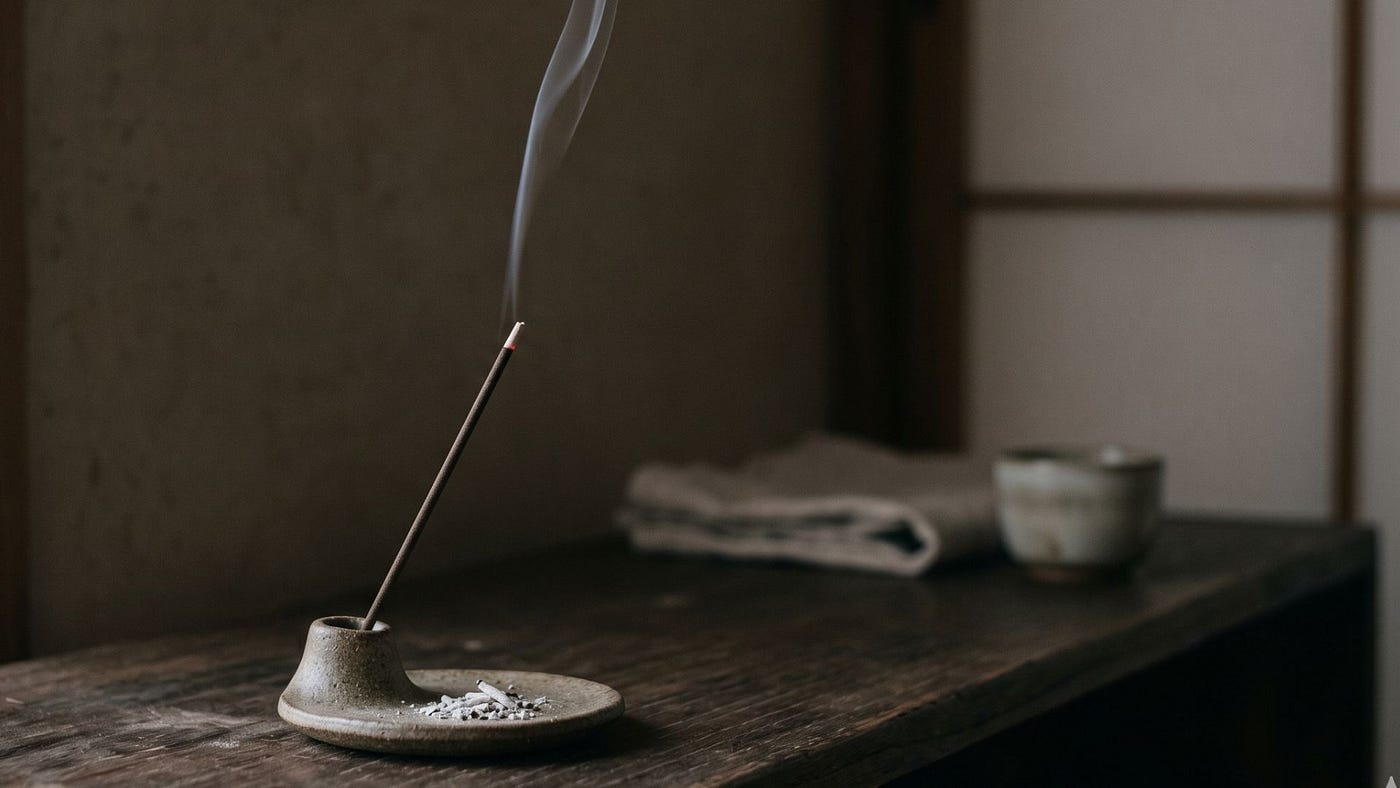
In Japanese, there are two verbs for experiencing incense.
One is kagu — to smell. The other is kiku — to listen.
In the world of kodo, the traditional Japanese art of incense, practitioners do not smell the fragrance. They listen to it. This is not a metaphor, or not only a metaphor. It is a deliberate choice of language that points toward a different quality of attention — one that is receptive rather than grasping, open rather than analytical.
And that quality of attention, it turns out, is the whole point.
What is kodo?
Kodo — written with the characters for “incense” and “way” — is one of the three classical Japanese arts, alongside kado (the way of flowers, or ikebana) and chado (the way of tea). Like its companions, kodo is far more than a sensory practice. It is a discipline — a way of cultivating presence, refinement, and a particular quality of mind through sustained engagement with something beautiful.
The history of kodo in Japan begins in the 6th century, when Buddhist monks brought incense from China and Korea as an offering for religious ceremonies. Over the following centuries, the practice evolved from ritual offering into art form. By the Heian period (794–1185 CE), the aristocratic classes had developed elaborate incense games and competitions, blending fragrances and composing poetry inspired by scent.
The formal art of kodo as we know it today was codified in the Muromachi period (1336–1573 CE), shaped by the same cultural forces that produced the tea ceremony, Noh theater, and the Zen-inflected aesthetics that define classical Japanese art.
The ceremony
A formal kodo ceremony is a study in deliberate slowness.
The host prepares the incense tools with the same care that a tea master prepares for a tea gathering. The implements — the incense burner, the ash press, the mica plate, the chopsticks, the incense container — are themselves objects of beauty, often antique, always chosen with attention to the season and the occasion.
The incense used in kodo is typically rikkoku gomi — “six countries, five tastes” — a classification system for the finest aromatic woods, particularly jinko (aloeswood or agarwood), one of the most precious and expensive natural materials in the world. A single gram of the finest agarwood can cost thousands of dollars. The fragrance it produces when heated — not burned, but gently warmed on a small piece of mica over a bed of carefully prepared ash — is unlike anything produced by commercial incense. It is subtle, complex, and completely unlike what most Westerners associate with the word “incense.”
Participants receive the incense burner in turn, cupping it in both hands, lifting it toward the face, and inhaling slowly — listening. In the incense games that are part of formal kodo practice, participants try to identify different woods, or to detect the subtle differences between samples that may smell nearly identical to an untrained nose.
The practice of listening
The instruction to listen rather than smell is an invitation to a different relationship with experience.
When we smell something, we tend to reach for it — to grasp it, identify it, categorize it, compare it to what we have smelled before. The analytical mind moves in quickly: this is sweet, this is woody, this reminds me of something.
Listening is different. Listening is receptive. It involves a quality of waiting — of allowing the experience to arrive rather than going after it. In kodo, this quality of receptive attention is cultivated deliberately, through repetition, through the formal structure of the ceremony, through the instruction of a teacher.
It is, in this sense, a form of meditation. Not sitting meditation, with its focused attention on breath or body. But a moving, embodied meditation — an engagement with beauty that trains the quality of mind that Zen practice points toward.
Why kodo matters now
We live in an era dominated by visual and auditory stimulation. Screens, speakers, notifications — the eyes and ears are constantly occupied. The other senses — smell, touch, taste — are relatively neglected.
Kodo invites a rebalancing. It asks you to put down the screen, to slow down, to attend to a sensory experience that cannot be photographed or recorded or shared — only directly encountered. The fragrance of fine agarwood, warmed in a small ceramic burner, in a quiet room, in the company of other people who are also listening — this is an experience that exists only in the present moment. You cannot save it. You cannot replay it.
It is, in its own way, a perfect embodiment of ichigo ichie — one time, one encounter, never again.
Want to explore the full history of kodo, learn about the six classical wood classifications, and discover where to experience a kodo ceremony in Japan? Read the complete guide on Zen Echoes:
→ Kodo: The Japanese Art of Listening to Incense
Zen Echoes explores Japanese Zen philosophy, mindful living, and cultural travel for English-speaking readers.
메타데이터
- post_id
- dbeb927a58dd
- slug
- kodo-the-japanese-ceremony-where-you-dont-smell-incense-you-listen-to-it-dbeb927a58dd
- url
- https://medium.com/@zenechoes/kodo-the-japanese-ceremony-where-you-dont-smell-incense-you-listen-to-it-dbeb927a58dd
- canonical_url
- https://medium.com/@zenechoes/kodo-the-japanese-ceremony-where-you-dont-smell-incense-you-listen-to-it-dbeb927a58dd
- author_url
- https://medium.com/@zenechoes
- status
- ok
- fetched_at
- 2026-07-11 02:24:24