AS2, AS3, and AS4 Protocols: A Detailed Overview
1. Introduction
AS2, AS3, and AS4 Protocols: A Detailed Overview
1. Introduction
AS2, AS3, and AS4 are part of the Applicability Statement (AS) family of protocols developed for secure electronic data interchange (EDI) and business-to-business (B2B) communication over the internet. These protocols were designed to replace older, costly systems such as Value-Added Networks (VANs) with direct, secure, and reliable internet-based data exchange mechanisms. [commport.com]
All three protocols are standardized by organizations such as the IETF and OASIS, and they ensure:
- Data confidentiality (encryption)
- Data integrity (hashing, signatures)
- Authentication (certificates)
- Non-repudiation (proof of delivery)
2. AS2 (Applicability Statement 2)
2.1 Overview
AS2 is the most widely used EDI communication protocol, especially in industries like retail, logistics, and healthcare. It enables secure, real-time exchange of data over HTTP or HTTPS.
2.2 How AS2 Works
AS2 operates using a point-to-point connection between trading partners:
- A business system generates an EDI document (e.g., purchase order).
- The message is:
- Encrypted (S/MIME)
- Digitally signed
-
Sent over HTTP/HTTPS
-
Receiver decrypts and verifies it
-
Receiver sends back an MDN (Message Disposition Notification) as an acknowledgment.
This MDN provides non-repudiation, confirming the message was successfully received and processed.
2.3 Key Features
- Transport: HTTP / HTTPS
- Security: S/MIME encryption and digital signatures
- Real-time acknowledgments (MDN)
- Point-to-point communication
- Supports all file types (EDI, XML, JSON, etc.) [cleo.com]
2.4 Advantages
- High adoption (industry standard)
- Strong security and compliance support (e.g., HIPAA)
- Real-time delivery confirmation
- Cost-effective (no VAN required)
2.5 Limitations
- Requires constant connectivity
- Complex partner setup and certificate management
- Less flexible for large-scale integrations
3. AS3 (Applicability Statement 3)
3.1 Overview
AS3 was developed to address limitations of AS2 by using FTP/SFTP instead of HTTP. Unlike AS2, it does not require a persistent connection.
3.2 How AS3 Works
AS3 works similarly to AS2 in terms of security but differs in transport:
- Data is prepared and secured (encryption + signature)
- Transferred via FTP, SFTP, or other file-based systems
- Supports push and pull mechanisms
- Optional acknowledgment via MDN [edibasics.com]
3.3 Key Features
- Transport: FTP / SFTP
- Security: Encryption and digital signatures (similar to AS2)
- Supports large file transfers
- Push-pull communication model
- No need for always-on connection [en.wikipedia.org]
3.4 Advantages
- Better suited for large file transfers
- Flexible (can use multiple transport protocols)
- Works well with existing FTP infrastructure
- Supports asynchronous communication
3.5 Limitations
- Less widely adopted than AS2
- Slower compared to real-time protocols
- FTP-based systems may require additional security configurations
4. AS4 (Applicability Statement 4)
4.1 Overview
AS4 is the latest and most advanced protocol, designed for modern web services-based B2B integration.
It is built on:
- SOAP (Web Services)
- XML
- WS-Security
4.2 How AS4 Works
AS4 uses a web services messaging model:
- Business message is wrapped in a SOAP envelope
- Security is applied using WS-Security (XML encryption/signatures)
- Message is exchanged using HTTP/HTTPS
- Delivery acknowledgments and error handling are built-in
It supports both:
- Push model (sender initiates)
- Pull model (receiver retrieves messages) [en.wikipedia.org]
4.3 Key Features
- Transport: HTTP / HTTPS with SOAP
- Security: WS-Security (XML encryption & signatures)
- Payload-agnostic (supports any data format)
- Supports multiple payloads and compression
- Advanced reliability & retry mechanisms [aayutechnologies.com]
4.4 Advantages
- Highly scalable and flexible
- Better interoperability across systems
- Supports modern architectures (SOA, cloud)
- Advanced delivery patterns (push/pull, async, sync)
- Built-in reliability and error handling
4.5 Limitations
- More complex implementation
- Requires web services infrastructure
- Lower adoption compared to AS2 (though growing)
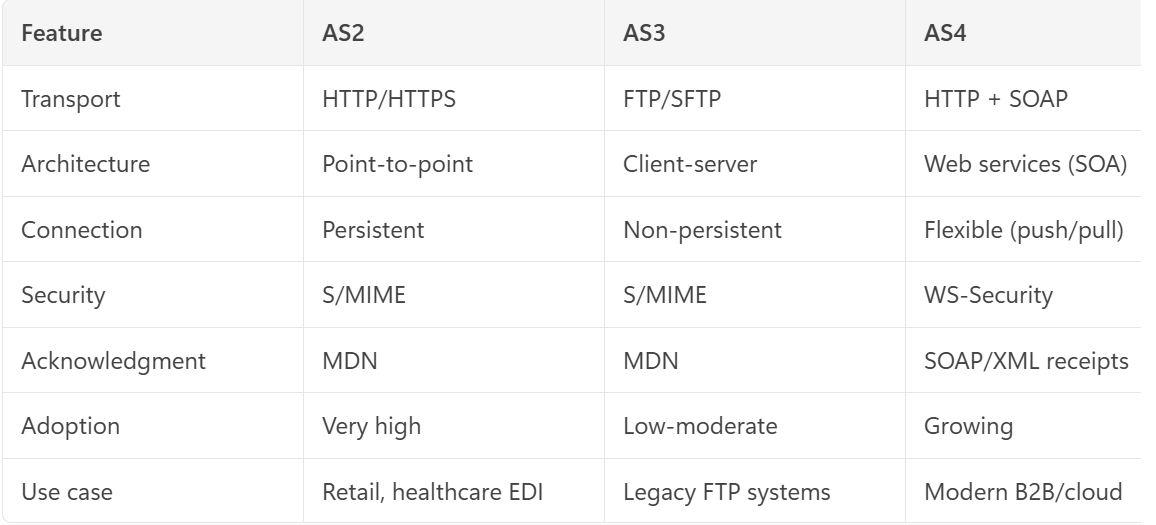
5. Key Differences Between AS2, AS3, and AS4
6. Use Cases and Industry Adoption
AS2
- Retail supply chains (e.g., Walmart mandates)
- Healthcare data exchange
- Logistics and manufacturing [ordersync.io]
AS3
- Enterprises with existing FTP infrastructure
- Banking or legacy systems with batch transfers
AS4
- Government and regulated sectors (e.g., Europe PEPPOL)
- Cloud-based integrations
- Complex multi-partner ecosystems
7. Conclusion
AS2, AS3, and AS4 represent the evolution of secure B2B communication protocols:
- AS2 remains the dominant standard due to its simplicity and widespread adoption
- AS3 provides flexibility for FTP-based environments but is less common
- AS4 is the future-ready protocol, offering scalability, interoperability, and support for modern web services
In practice, the choice depends on:
- Trading partner requirements
- Infrastructure capabilities
- Need for scalability and modernization
메타데이터
- post_id
- dbeeee10a352
- slug
- as2-as3-and-as4-protocols-a-detailed-overview-dbeeee10a352
- url
- https://medium.com/@nilargha2013/as2-as3-and-as4-protocols-a-detailed-overview-dbeeee10a352
- canonical_url
- https://medium.com/@nilargha2013/as2-as3-and-as4-protocols-a-detailed-overview-dbeeee10a352
- author_url
- https://medium.com/@nilargha2013
- status
- ok
- fetched_at
- 2026-07-13 06:23:13