Cat Portrait Ideas Beyond the Usual Cute Photo
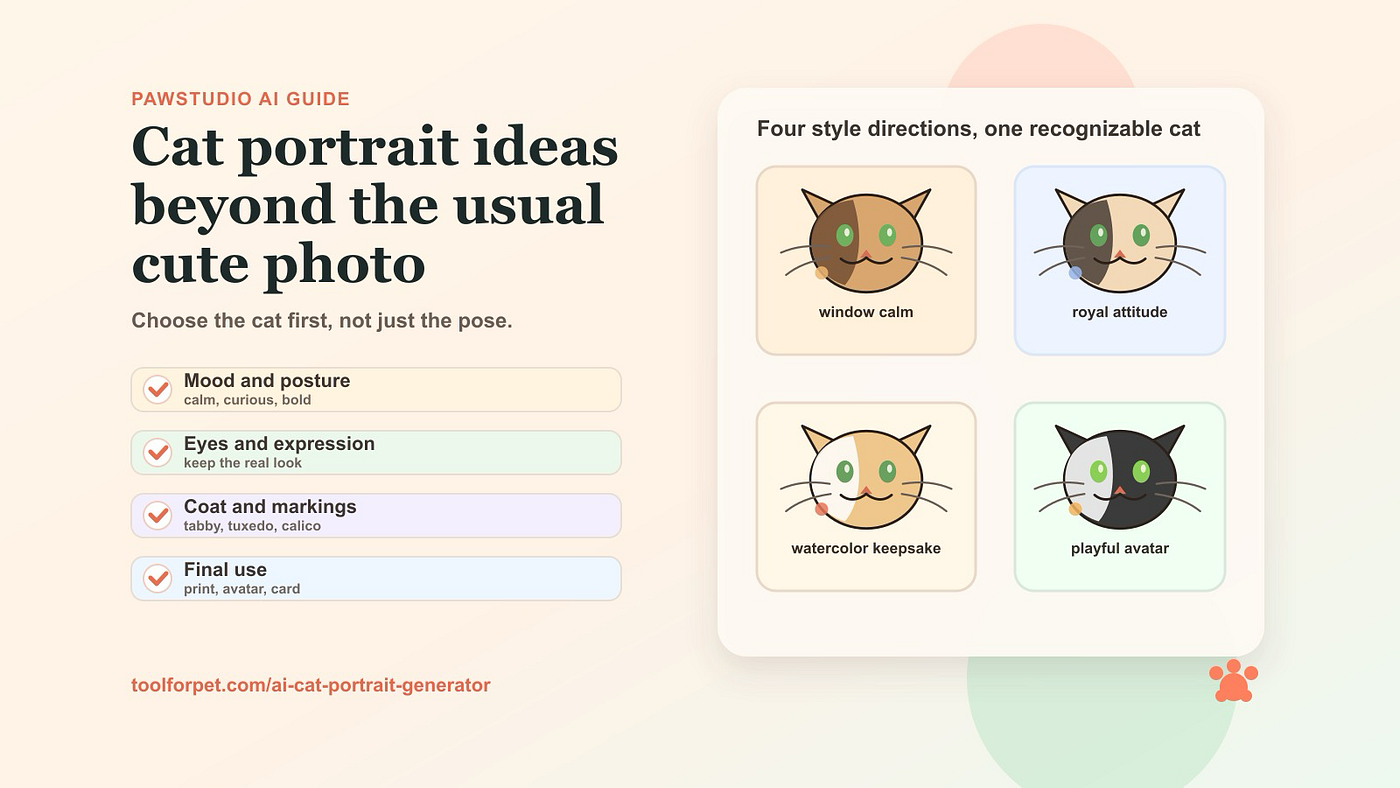
A cat portrait works best when it keeps the small signals that make a cat feel specific: posture, eyes, coat color, habits, and mood.
Cat Portrait Ideas Beyond the Usual Cute Photo
A cat portrait works best when it keeps the small signals that make a cat feel specific: posture, eyes, coat color, habits, and mood.
Cats are easy to photograph and hard to capture.
Almost every cat owner has a phone full of cute photos: a curled-up nap, a dramatic stretch, a suspicious side-eye, a paw over the face, a sunbeam on the floor. Those pictures are lovely, but not every cute cat photo becomes a strong portrait.
A cat portrait has a slightly different job. It should feel like the cat, not just like a cat. That means the idea needs to protect the details people recognize: the shape of the face, the eyes, the way the cat sits, the coat pattern, the tail, and the strange little attitude that makes one cat different from another.
This is especially useful when you are thinking about an AI cat portrait. Style can add charm, but the best result usually starts with a clear creative direction and a photo that already says something true about the cat.
Here are cat portrait ideas that go beyond the usual cute photo while still keeping the cat at the center.
Start with the cat’s default mood
Some cats are soft and sleepy. Some are elegant and serious. Some look mildly offended at all times. Some are tiny chaos machines. Some behave like they own every room they enter.
The easiest way to make a cat portrait feel personal is to start with that default mood.
Before choosing a style, describe the cat in three plain words:
- Curious, alert, watchful
- Calm, warm, sleepy
- Bold, dramatic, royal
- Playful, fast, mischievous
- Gentle, shy, quiet
- Grumpy, expressive, theatrical
Those words help you avoid choosing a style only because it is trendy. A quiet senior cat may look beautiful in soft window light. A confident long-haired cat may carry a royal portrait. A kitten may fit a sticker or storybook style. A black cat with bright eyes may be strongest in a clean, high-contrast scene rather than a busy fantasy background.
Good cat portrait ideas usually begin with personality, not decoration.
Use the eyes as the emotional center
For many cats, the eyes are the whole story.
A cat looking directly at the camera can feel intense, funny, noble, or mysterious depending on the expression. A cat looking away can feel peaceful or cinematic. Half-closed eyes can make a portrait feel soft and trusting. Wide eyes can make it feel alert or playful.
If the portrait is meant to be a keepsake, choose a photo where the eyes are visible and in focus. This matters more than having the most interesting background. A slightly plain photo with clear eyes can produce a stronger portrait than a dramatic photo where the face is dark or blurry.
Eye color also matters. Green, amber, blue, copper, and mixed tones can all become part of the portrait idea. If your cat has striking eyes, avoid heavy filters or styles that flatten the color.
The goal is not to make the eyes larger or more dramatic than reality. The goal is to keep the expression recognizable.
Choose a style that respects the coat
Cat coats carry a lot of identity.
A tuxedo cat, tabby, calico, tortoiseshell, orange cat, gray cat, black cat, white cat, point-color cat, or long-haired cat all bring different visual challenges. Some patterns are bold from across the room. Others are subtle and need clean lighting to show up.
If the cat has strong markings, choose a portrait idea that keeps the face large enough to show them. A tabby “M” on the forehead, white socks, a split-colored face, a dark nose, or a tail pattern can be the detail that makes the portrait feel accurate.
For black cats, contrast is everything. A black cat on a dark couch or in a dim corner can lose shape quickly. A better source photo has light on the face and visible edges around the ears and body. For white cats, avoid overexposed photos where the fur turns into a blank shape. For orange cats, warm styles can be beautiful, but too much orange in the background can make the whole portrait feel flat.
The coat should guide the style. It should not disappear under it.
Think about the final use before choosing the idea
A cat portrait for a framed print is different from a portrait for a phone wallpaper. A profile avatar is different from a holiday card. A gift for a cat owner is different from a playful post for social media.
For a framed keepsake, a calm centered portrait often works best. The cat’s face, eyes, and coat should be clear. For a phone wallpaper, a vertical layout with space above or below the cat may be more useful. For a social avatar, a close crop can work better because the image needs to read at a small size. For a card, you may want a little extra background space for text.
This decision sounds practical, but it affects the whole creative direction.
If you know the portrait will be printed, avoid overly tiny details. If you know it will be shared online, a bolder crop may help. If it is a gift, choose a style that fits the owner’s taste, not only the cat’s funniest moment.
Let indoor settings become part of the story
Many cats are indoor cats, and that can actually make the portrait more personal.
A favorite windowsill, blanket, chair, bookshelf, staircase, rug, or sun patch can tell a quiet story about the cat’s life. You do not always need a fantasy scene or dramatic background. Sometimes the most meaningful portrait is a refined version of the place where the cat is most themselves.
Useful indoor portrait ideas include:
- A window-light portrait for a calm cat
- A cozy blanket portrait for a sleepy cat
- A bookshelf or writing-desk scene for a curious cat
- A clean studio crop for a cat with strong markings
- A playful sticker-style portrait for a kitten
- A royal painting for a cat with serious presence
- A soft watercolor style for a gentle keepsake
The setting should support the cat’s mood. If the background competes with the face, simplify it.
Avoid making the idea too busy
Cat portraits can become cluttered very quickly.
A moonlit window, flowers, fish, yarn, books, stars, nameplate, crown, butterflies, and dramatic smoke all in one image may sound charming, but the cat can get lost. The more elements you add, the harder it is for the portrait to preserve likeness.
A stronger idea usually has one clear visual promise:
- A black cat in soft window light
- A tabby as a classic oil portrait
- A calico in a warm watercolor keepsake
- An orange cat as a playful sticker avatar
- A white cat in a clean minimal studio portrait
- A long-haired cat in a gentle storybook style
- A senior cat in a quiet framed keepsake
One cat, one mood, one style. That is enough.
Choose the source photo with care
The source photo does not have to be professional, but it should be readable.
Look for a photo where the cat’s face is clear, the eyes are visible, and the body shape or markings are not hidden by shadows. Avoid extreme blur, heavy filters, screenshots from old social posts, or photos where the cat is very small in the frame.
If the cat is lying down, make sure the face still has enough detail. If the cat is moving, choose a moment where the expression is not distorted. If the cat is curled up, decide whether the portrait is about the face, the sleeping shape, or the cozy mood.
For multi-cat households, separate portraits usually work better than forcing every cat into one crowded image. Each cat has its own expression and markings. A matching set of two or three portraits can feel more polished than a single busy group scene.
Use style as translation, not disguise
The best cat portrait styles translate the cat into a new visual language without hiding the real animal.
An oil painting can make a cat feel classic. Watercolor can make the portrait feel gentle. A minimal avatar can make the cat easy to use on social profiles. A storybook style can work beautifully for playful cats or kittens. A cinematic style can fit a cat with intense eyes and a strong silhouette.
But the style should not erase the cat’s identity. If the output could belong to any cat of the same color, the idea is too generic.
That is why I am building PawStudio AI around style choice and source-photo clarity. The cat-focused workflow is here: https://toolforpet.com/ai-cat-portrait-generator/
The best cat portrait still feels like your cat
A cat portrait does not need to be serious to be meaningful. It can be funny, elegant, soft, moody, minimal, colorful, or strange in exactly the way cats often are.
But it should still feel connected to the cat someone actually knows.
That connection comes from simple choices: a clear photo, visible eyes, recognizable markings, a style that fits the cat’s mood, and a final format that matches how the portrait will be used.
When those choices line up, the portrait becomes more than another cute cat image. It becomes a version of the cat that feels specific enough to keep.
메타데이터
- post_id
- dbf2d2eec544
- slug
- cat-portrait-ideas-beyond-the-usual-cute-photo-dbf2d2eec544
- url
- https://medium.com/@pawstudioai/cat-portrait-ideas-beyond-the-usual-cute-photo-dbf2d2eec544
- canonical_url
- https://medium.com/@pawstudioai/cat-portrait-ideas-beyond-the-usual-cute-photo-dbf2d2eec544
- author_url
- https://medium.com/@pawstudioai
- status
- ok
- fetched_at
- 2026-06-18 00:10:23