China Completes World’s First 50/50 Green Hydrogen and Coal Co-Firing Project
China has completed what is described as the world’s first project to co-fire green hydrogen and coal at a 50/50 ratio.
China Completes World’s First 50/50 Green Hydrogen and Coal Co-Firing Project
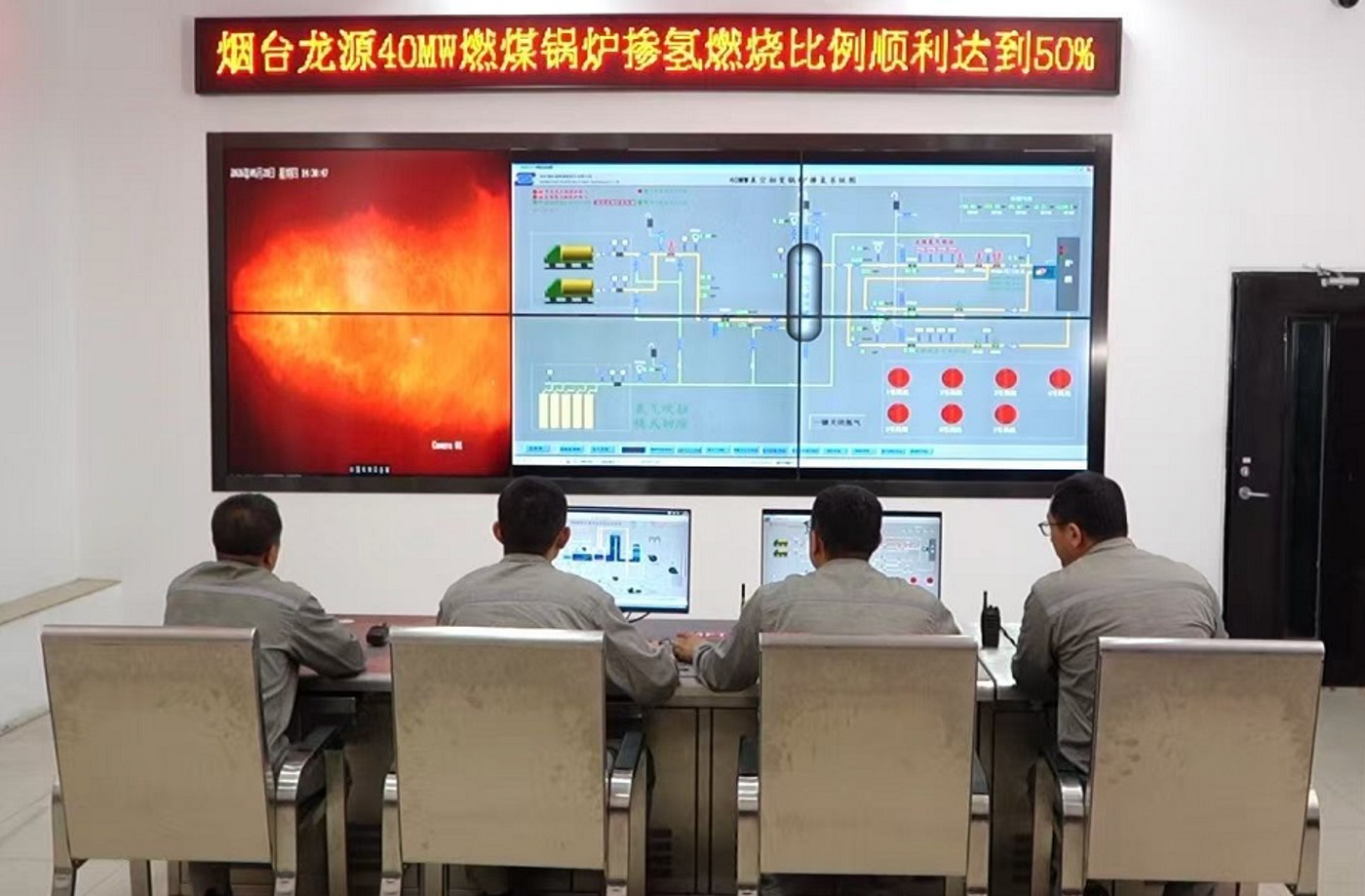
China has completed what is described as the world’s first project to co-fire green hydrogen and coal at a 50/50 ratio.
The pilot was implemented by Yantai Longyuan, a subsidiary of the state-owned China Energy group, at a 40 MW pilot power unit in Shandong Province.
The project used a fully self-developed burner designed for the joint combustion of hydrogen and pulverised coal. It also included a full-scale safety system aimed at preventing hydrogen leakage and controlling the combustion process.
According to the company, the technology can cut coal consumption and reduce direct carbon dioxide emissions by around 50%, while also significantly lowering nitrogen oxide emissions.
This is technically important because hydrogen co-firing in coal-fired power plants has historically remained at much lower levels. In previous projects, both in China and internationally, the hydrogen share was usually below 10%. Higher hydrogen shares can create combustion instability, deflagration risks and higher NOx emissions.
The new low-emission hydrogen-coal burner is designed to address several of these challenges, including rapid flame propagation and the difficulty of controlling combustion conditions at high hydrogen shares.
For context, China has the world’s largest coal-fired power fleet, with around 1,300 GW of installed capacity. The 40 MW pilot is therefore very small in system terms — roughly 0.003% of China’s coal power capacity — but it may be significant as a technology demonstration.
China is actively promoting the modernisation of coal-fired power plants to reduce emissions and improve flexibility. In this context, 50% green hydrogen co-firing offers a potential route for cutting emissions from existing coal assets. Rather than shutting down plants immediately or relying only on efficiency upgrades, the approach is based on partial fuel substitution.
In July 2024, China’s National Development and Reform Commission and National Energy Administration published an action plan for the low-carbon transformation of coal-fired power plants for 2024–2027. The plan states that selected low-carbon coal power projects should reduce carbon dioxide emissions per kilowatt-hour by around 50% compared with the average carbon intensity of coal-fired power plants in 2023.
In April 2025, China also released a special implementation plan for upgrading the next generation of coal-fired power plants. The goal is to build a new technical performance framework around four areas: carbon reduction, safety and reliability, flexible operation and intelligent management.
The new hydrogen-coal co-firing demonstration is presented as a possible technological pathway for large-scale carbon reduction at existing coal-fired power plants. It may also support the integration of coal power with new energy systems, especially where coal plants are increasingly expected to provide flexibility and backup capacity for variable renewable energy.
Until now, several Asian countries have focused more heavily on ammonia-coal co-firing as a hydrogen-based route for reducing emissions from coal power. This was partly because pure hydrogen was often considered difficult to use in existing coal-fired units.
The Chinese pilot suggests that this pathway may be broader than previously assumed.
However, several major questions remain. The technology still needs larger-scale demonstration and long-term operational validation. The economics are also uncertain: the cost of green hydrogen, including production, compression, storage and delivery, will strongly influence whether the technology can be deployed at scale.
Another important issue is emissions accounting. A 50% hydrogen share can substantially reduce direct stack CO₂ emissions, but the full climate benefit depends on whether the hydrogen is genuinely renewable and how its upstream lifecycle emissions are measured.
For Europe, the project is relevant mainly as a technology signal rather than a direct policy model. European coal power is generally moving toward phase-out rather than long-term retrofitting. Still, the Chinese pilot highlights a broader question for hard-to-abate energy systems: how far existing fossil infrastructure can be repurposed before full replacement becomes cheaper, cleaner and more practical.
메타데이터
- post_id
- dbf94a1a7a95
- slug
- china-completes-worlds-first-50-50-green-hydrogen-and-coal-co-firing-project-dbf94a1a7a95
- url
- https://medium.com/areas-producers/china-completes-worlds-first-50-50-green-hydrogen-and-coal-co-firing-project-dbf94a1a7a95
- canonical_url
- https://medium.com/areas-producers/china-completes-worlds-first-50-50-green-hydrogen-and-coal-co-firing-project-dbf94a1a7a95
- author_url
- https://medium.com/@erofeev.yury
- status
- ok
- fetched_at
- 2026-06-15 20:49:13