The Active Measures Playbook in the 21st Century Information War Cold War 2
In the realm of international politics, the Cold War’s legacy continues to shape the dynamics between the United States and Russia.
Information Warfare — Information War — Cold War
The Active Measures Playbook in the 21st Century Information War Cold War 2
In the realm of international politics, the Cold War’s legacy continues to shape the dynamics between the United States and Russia.
Recent shifts in U.S. foreign policy under President Donald Trump have raised concerns about America’s strategic positioning and its implications for global power balances.
From Cold War Consensus to Strategic Ambiguity
Historically, U.S. foreign policy was anchored in a bipartisan commitment to alliances like NATO, a firm stance against adversaries such as the Soviet Union, and active participation in multilateral institutions. This approach aimed to uphold a liberal international order and counterbalance Soviet influence.
However, the advent of the Trump administration marked a departure from these principles. Embracing an “America First” doctrine, the administration questioned longstanding alliances and international agreements, introducing a level of unpredictability that unsettled both allies and adversaries.
Recalibrating Relations with Russia
One of the most notable shifts has been the Trump administration’s approach to Russia. Efforts to improve U.S.-Russia relations have included high-level meetings and discussions aimed at resolving conflicts such as the war in Ukraine. While dialogue is essential, critics argue that certain concessions, like proposing territorial compromises in Ukraine, may embolden Russian ambitions and undermine U.S. credibility.
Furthermore, the administration’s decision to withdraw from agreements like the Paris Climate Accord and the World Health Organization, coupled with reduced support for traditional allies, has created a vacuum that Russia is poised to exploit.
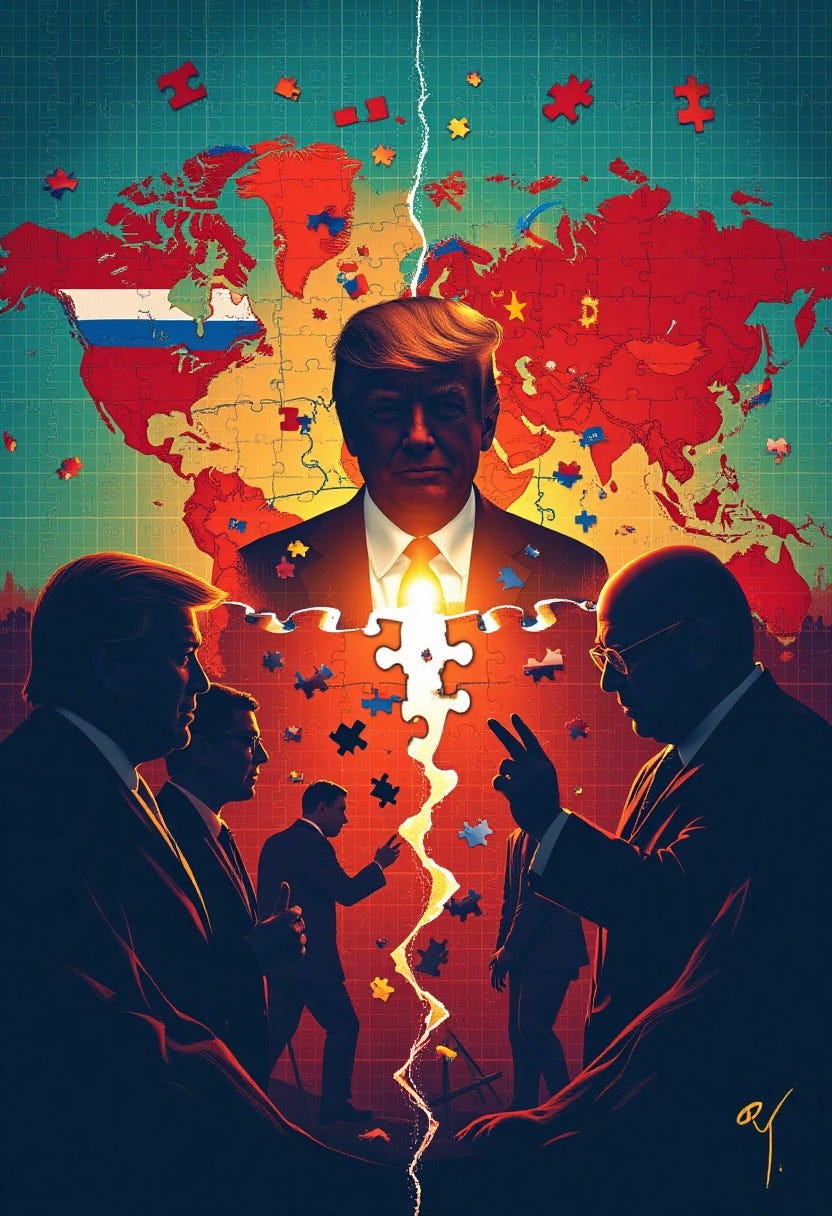
Implications for Global Power Dynamics
From our closest allies in Europe and Asia to global partnerships, the Trump administration’s approach has led to perceptions of the United States as an unreliable and unpredictable ally. Trump’s transactional approach, including imposing tariffs on key trading partners such as Canada, Mexico, and the European Union, has not only disrupted global trade but has also led to retaliatory measures, creating economic instability. This shift has strained longstanding alliances, eroded trust, and positioned the U.S. as something of an outcast in global diplomacy.
The resulting vacuum has provided opportunities for Russia and China to position themselves as more stable, predictable, and assertive alternatives, potentially reshaping global leadership dynamics in their favor. Russia, in particular, has actively sought to expand its influence in Eastern Europe and the Middle East, areas where U.S. engagement has noticeably declined.
Moreover, the perception of U.S. unpredictability may encourage other nations to seek alternative alliances, potentially leading to a more fragmented and multipolar world order.
[embed]
International Backlash: A Message from Canada
Recent remarks from Canada reflect the growing frustration and backlash against Trump’s foreign policy decisions. Following aggressive statements by Texas Governor Greg Abbott suggesting Canada needed to learn a lesson, Canadians have responded with boycotts targeting U.S. states economically dependent on Canadian tourism and trade, such as Texas and Kentucky. The boycott highlights Canada’s stance that Trump’s approach violates international norms, disregards respect for sovereign nations, and undermines the global order founded on cooperation and mutual respect. Canada’s firm response signals broader international resistance against the Trump administration’s confrontational and isolationist tactics.
Russia’s Increased Influence and the NATO Question
Significantly, Russia under Vladimir Putin has increasingly advocated for the enforcement of the “not one inch eastward” commitment purportedly made to Gorbachev during the collapse of the Soviet Union. While years ago Putin lacked sufficient geopolitical influence to effectively enforce such policies, the current political landscape has allowed Russia to assert its position more aggressively, placing NATO’s eastern expansion at the forefront of international debate and further complicating U.S.-Russia relations.
Can America Survive an Active Measures Asset at the Helm?
The question arises whether America can withstand the long-term effects of leadership that may inadvertently serve the interests of strategic adversaries. The Trump administration’s approach, marked by unpredictability and transactional diplomacy, raises critical questions about vulnerabilities to foreign influence and strategic manipulation. Maintaining robust democratic institutions, bipartisan commitment to strategic clarity, and clear communication of national interests will be essential for America’s resilience in navigating these unprecedented challenges.
Is America Committing Strategic Suicide?
America’s recent foreign policy decisions, characterized by isolationist tendencies, strategic ambiguity, and diminished global engagement, raise the troubling question of whether the U.S. is committing strategic suicide. By undermining key alliances, empowering adversaries, and creating economic uncertainty, America risks eroding the foundations of its global leadership. Addressing these self-inflicted vulnerabilities will be crucial if America is to avoid further decline and restore its international credibility and influence.
Evaluating the Current U.S. Political Landscape
Does the current U.S. political landscape represent an ideal Cold War scenario for Russia’s Putin, and should it be considered as such? The internal polarization, coupled with external diplomatic isolation, presents conditions that mirror aspects of Cold War dynamics. More concerning is the strong possibility that Trump’s actions, under the guise of “America First,” may actually fulfill strategic obligations or interests beneficial to Russia. Rather than embracing or unintentionally facilitating Cold War-like tensions, the United States should strive for diplomatic engagement, internal unity, and strategic clarity to prevent unnecessary geopolitical confrontations and promote long-term global stability.
Navigating the New Geopolitical Landscape
While the intention behind recalibrating foreign policy may be to prioritize national interests, the execution requires careful consideration of long-term strategic consequences. Maintaining robust alliances and a clear commitment to international norms are essential to preserving the U.S.’s role as a global leader. As the geopolitical landscape evolves, the U.S. must balance domestic priorities with the responsibilities that come with its position on the world stage.

메타데이터
- post_id
- dbf9c6dab324
- slug
- the-active-measures-playbook-in-the-21st-century-information-war-cold-war-2-dbf9c6dab324
- url
- https://information-warfare.com/the-active-measures-playbook-in-the-21st-century-information-war-cold-war-2-dbf9c6dab324
- canonical_url
- https://information-warfare.com/the-active-measures-playbook-in-the-21st-century-information-war-cold-war-2-dbf9c6dab324
- author_url
- https://medium.com/@hase_fiero
- status
- ok
- fetched_at
- 2026-06-27 07:40:21