Cloud Telephony vs Traditional PBX Which Is Better for Businesses in 2026
Business communication has changed significantly over the past few years. Earlier, companies depended on physical phone systems installed…
Cloud Telephony vs Traditional PBX Which Is Better for Businesses in 2026
Business communication has changed significantly over the past few years. Earlier, companies depended on physical phone systems installed inside offices, with wiring, hardware, and maintenance teams. Today, that model is quickly being replaced by internet-based systems.
This shift is not just a trend. It is backed by real data. According to IMARC Group, the global cloud telephony market reached 23.9 billion dollars in 2024 and is expected to grow to 47.8 billion dollars by 2033.
This clearly shows that businesses are moving toward cloud telephony services to improve flexibility, reduce costs, and support modern work environments. However, many businesses still want clarity on how it works and whether it is better than traditional PBX systems.
What is Cloud Telephony
Cloud telephony is a phone system that works over the internet instead of traditional telephone lines. It is hosted and managed by cloud telephony providers, which means businesses do not need to install hardware or manage complex infrastructure.
In simple terms, when a customer calls your business, the call is routed through the internet to a cloud server. That system then directs the call to the right person or department. Employees can answer calls using a mobile phone, laptop, or desktop, making the entire system flexible and location-independent.
This is why cloud telephony is often called a modern communication system for businesses. It removes the limitations of physical setups and allows companies to operate more efficiently.
How Cloud Telephony Works
Cloud telephony runs on VoIP technology, which stands for Voice over Internet Protocol. Instead of using traditional phone lines, it converts voice into digital data and sends it over the internet.
When someone makes a call, the voice is converted into data packets, transmitted through the internet, and then reassembled into audio at the receiver’s end. This entire process happens in real time, which is why users experience smooth and clear communication.
As long as the internet connection is stable, the system performs efficiently and reliably.
What is Traditional PBX
Traditional PBX, or Private Branch Exchange, is an on-premise phone system installed within an office. It relies on physical wiring, hardware equipment, and landline connections to function.
These systems were widely used for internal communication and external calls. However, they are limited in flexibility because they are tied to a physical location. Any upgrades or expansions require additional hardware, which increases both time and cost.
While PBX systems were effective in the past, they are not designed for the fast, flexible needs of modern businesses.
Key Differences Between Cloud Telephony and PBX
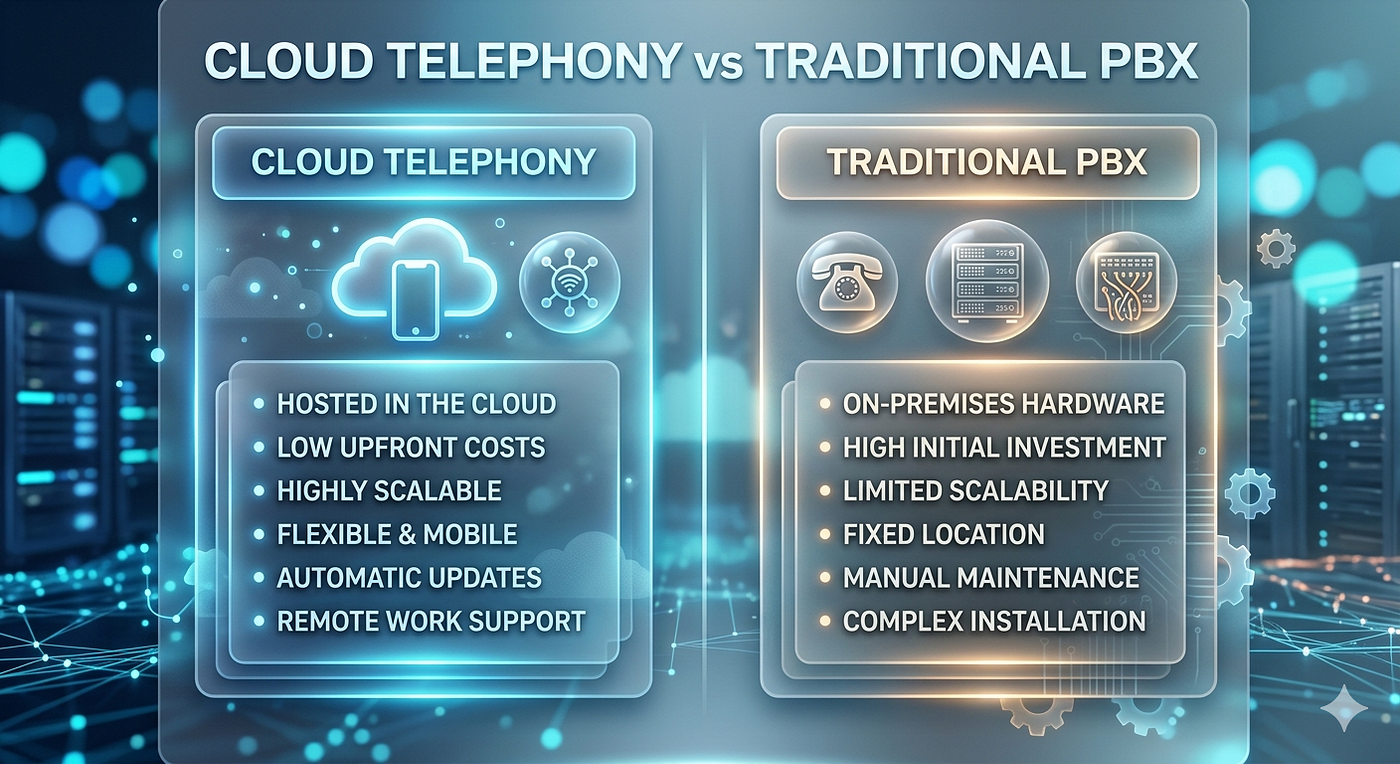
One of the biggest differences between these two systems is how they are set up. Traditional PBX requires hardware installation, wiring, and technical support, which can take days or even weeks. In contrast, a cloud telephony solution can be set up within a few hours, as everything is managed online.
Cost is another major factor. PBX systems involve high upfront investment along with ongoing maintenance costs. Cloud telephony services, on the other hand, follow a subscription-based model. Businesses pay only for what they use, which makes budgeting easier and more predictable. According to Jadhavar Business Intelligence, VoIP-based systems can reduce communication costs by up to 40 percent compared to traditional systems.
Scalability is also much simpler with cloud telephony. In a PBX system, adding new users requires additional hardware and setup. With cloud telephony, businesses can add or remove users instantly through a dashboard, making it ideal for growing teams.
Another key difference is accessibility. PBX systems are limited to office environments, whereas cloud telephony allows employees to work from anywhere. This flexibility has become especially important with the rise of remote and hybrid work models.
Finally, cloud telephony providers offer advanced features such as IVR, call recording, analytics, and CRM integration. These features help businesses improve customer experience and make better decisions. PBX systems typically offer only basic calling functionality.
Market Growth and Adoption
The adoption of cloud telephony is growing rapidly, especially in India. According to IMARC Group, India’s VoIP market was valued at 4.33 billion dollars in 2024 and is expected to reach 10.94 billion dollars by 2033.
This growth is driven by increasing internet penetration, the rise of startups, and the need for flexible communication systems. Businesses are no longer willing to invest heavily in hardware when more efficient and scalable cloud telephony solutions are available.
Real Business Impact
One of the biggest challenges businesses face is missed calls. Many potential customers do not call back or leave messages if their call is not answered. This leads to lost opportunities and reduced revenue.
Cloud telephony helps solve this problem by ensuring that calls are managed efficiently. Features like call routing, IVR, and automated responses ensure that customers are always connected to the right person. This improves response time and overall customer experience.
In high-volume environments, cloud systems can handle thousands of calls without failure, something that is difficult to achieve with traditional PBX systems.
Cloud Telephony Pricing in India
Cloud telephony services are generally affordable and flexible. In India, the typical pricing structure includes a setup cost ranging from 2000 to 10000 rupees. Virtual numbers usually cost between 500 and 1500 rupees per year.
Call charges are typically between 0.40 and 0.80 rupees per minute, while toll-free calls cost around 1 rupee per minute. This pricing model allows businesses to scale their communication systems without large upfront investments.
When to Choose Cloud Telephony
A cloud telephony solution is a good choice for businesses that want flexibility and growth. It is especially useful for startups, small businesses, and companies with remote teams.
If your business requires automation, call tracking, or integration with CRM tools, cloud telephony services provide all these capabilities in one platform. It also allows you to scale operations quickly without worrying about infrastructure.
When PBX Still Makes Sense
Although cloud telephony is the preferred option for most businesses, PBX can still be useful in certain situations. For example, businesses operating in areas with poor internet connectivity may rely on PBX systems for stability.
Similarly, companies that have already invested heavily in PBX infrastructure may continue using it or adopt a hybrid approach instead of switching completely.
Limitations of Cloud Telephony
Cloud telephony is not without its challenges. The biggest limitation is its dependence on internet connectivity. If the network is unstable, call quality may be affected.
Another factor to consider is the long-term subscription cost. While initial costs are low, monthly payments can add up over time. Additionally, switching between cloud telephony providers may require effort, especially when migrating data and workflows.
Despite these limitations, the overall benefits make it a strong choice for most businesses.
How to Choose the Right Cloud Telephony Provider
Choosing the right provider is important for long-term success. Businesses should look for providers that offer essential features such as IVR, analytics, and integrations.
It is also important to choose a provider with transparent pricing and no hidden costs. Ease of use is another key factor, as the system should be simple to manage without technical expertise.
Reliable customer support ensures that any issues are resolved quickly, minimizing downtime and disruptions.
Final Answer Which Is Better
If we compare both systems clearly, cloud telephony offers more flexibility, scalability, and advanced features. It supports modern work environments and helps businesses grow efficiently.
Traditional PBX is now limited to specific use cases where internet access or infrastructure control is a concern.
For most businesses in 2026, cloud telephony is the better choice.
Conclusion
Cloud telephony is a modern communication system that uses the internet to manage business calls efficiently. It eliminates the need for hardware, reduces costs, and provides advanced features that improve customer experience.
With strong market growth and increasing adoption, cloud telephony services are becoming the standard for business communication. Businesses that adopt this technology can operate more efficiently and stay competitive in a fast-changing environment.
메타데이터
- post_id
- dbf9fffa6464
- slug
- cloud-telephony-vs-traditional-pbx-which-is-better-for-businesses-in-2026-dbf9fffa6464
- url
- https://medium.com/@the.arjun2255/cloud-telephony-vs-traditional-pbx-which-is-better-for-businesses-in-2026-dbf9fffa6464
- canonical_url
- https://medium.com/@the.arjun2255/cloud-telephony-vs-traditional-pbx-which-is-better-for-businesses-in-2026-dbf9fffa6464
- author_url
- https://medium.com/@the.arjun2255
- status
- ok
- fetched_at
- 2026-06-27 18:20:27