Euler’s Number: The Rhythm of Expansion
Among the four constants that anchor the architecture of consciousness — 137, φ, π, and e — Euler’s number, e, tells the story of growth…
Euler’s Number: The Rhythm of Expansion

Among the four constants that anchor the architecture of consciousness — 137, φ, π, and e — Euler’s number, e, tells the story of growth. If φ is the spiral of becoming, and π is the circle of relation, e is the rhythm of expansion. It is the mathematics of compounding, the law of increase, the measure of how life evolves when it is allowed to flow in right relation.
Discovered in the 18th century by Leonhard Euler, one of mathematics’ great visionaries, e emerges wherever growth is continuous and compounding. It defines interest that accrues not in fixed steps, but in a flow that accelerates with each turn. In biology, finance, and physics alike, e is the silent law beneath all processes of accumulation, evolution, and unfolding. Its value — 2.7182818284590… — opens into infinity, an endless stream likeπ.
Look into its digits, and the story deepens. The first zero arises at the 13th place, the liminal threshold of becoming. Thirteen is the age of passage, the crossing from childhood into adulthood, from innocence into awareness. It signals that all growth requires liminality: a crossing, a risk, a threshold moment. Growth is not steady; it leaps when we pass through the unknown. It is the pressing up against what is known for sure, so that the new may emerge. In this, we experience the very essence of creative tension.
And before that zero, the rhythm itself speaks. e begins with 2 — for all creation arises in relation. Nothing grows alone. Then comes 7 — understanding, the wisdom of mutuality, without which growth collapses into exploitation. And then a dance unfolds: 1, 8, 2, 8, 1, 8, 2, 8… repeating like a heartbeat. One and two entwined, over and over. This is the rhythm of relation: I and you, self and other, mirrored in resonance. It is harmonic growth, growth that does not lose sight of love, the original reason for becoming. When the one and the two stay aligned, creation flowers. It moves into four, the perception of kind through a lens of kindness, and into five, the felt sense of common unity, and into nine, the return to infinity, the completion of one cycle that simply folds into the next. This is growth that expands not only outward, but inward and upward too — a spiral that carries us deeper into coherence.
Euler’s number is thus more than arithmetic. It is the mathematics of trust. To live in e is to live in the flow of compounding will to act, compounding kindness, compounding relationship, compounding love. Each small act builds upon the last, until the pattern emerges — a life grown into harmony, oneself expanded into the infinite. Growth is not simply proliferation. Growth is the blossoming of consciousness, the evolution of love expressed in form. In this, it is pro-life. It represents the establishment of original thought as fresh insight aligns with prior understanding through bonds of mutual accord, allowing consciousness to evolve, individually and collectively.
To this end, e is the whisper of evolution itself, the assurance that life, when lived in wise relation, does not merely endure. It flourishes. It multiplies. It becomes more than it was, without ever losing what it is. The 2.7 is significant, a mathematical imprint of Carl Jung’s astute observation that “Wisdom accepts that all things have two sides.”
The Dance of Φ and e — The Geometry of Growth
If the golden ratio, Φ, reveals the divine proportion through which beauty becomes form, then Euler’s number, e, unveils the divine impulse through which form becomes life. Together, they whisper the hidden equation of becoming — that growth and harmony are not separate laws, but two movements of a single breath.
Where Φ governs the symmetry of relationship — the elegant spacing between parts that allows wholeness to be felt — e governs the pulse of transformation, the subtle mathematics of living expansion. One holds the secret of form, the other, of flow. And yet, when their currents meet, something remarkable occurs: a near-perfect reflection in the mirror of number itself. For when we raise Φ to the power of e, and e to the power of Φ, we find that both return almost precisely the same value — 4.8105 — a quiet astonishment hidden in the heart of mathematics. It is as though number itself were bowing toward symmetry, as though the universe, through its own code, confessed a secret affection between the geometry of love and the rhythm of life.
This is the dance of Φ and e: one, the spiral’s shape, the other its breath. Φ sets the curvature — the divine mean through which life organises itself in beauty. e animates it, driving the exponential unfolding of that beauty through time. Together they trace the path of the golden spiral, that ancient form found in galaxies, hurricanes, pinecones, and the shells of living things. Within it, growth never breaks proportion; it expands in such a way that each turn of the spiral contains the same relationship to the last. It is growth without distortion — expansion that preserves coherence. In this way, Φensures harmony, while e ensures vitality.
And so it is with us. When the inner architecture of our lives grows in proportion to the love that gave it birth, we too move in the rhythm of the golden spiral. Our expansion remains balanced. We do not grow away from ourselves, but deeper into ourselves — into the coherence of our own becoming. To live according to the golden ratio is to align our actions with the geometry of truth; to breathe in the spirit of e is to allow that truth to unfold through us as continuous creation.
In this union, we find a universal principle: love sustains form; understanding sustains growth. Φ is the harmonic law that holds the field in beauty; e is the ever-quickening spirit that moves it forward. Together they form the pulse of the cosmos — the geometry of life itself — where every living thing expands in golden proportion to the love it carries within.
And perhaps this is the deeper lesson encoded in their near-perfect symmetry — a mathematical prescription for right relation. It reminds us that we may succeed without having to win while another loses, that growth need not come at the cost of harmony. True progress is mutual. The most favourable conditions for life arise not from dominance, but from proportion — from the fertile equilibrium where each part grows in respect to the whole. To live by this measure is to move with the universe’s own intelligence, where flourishing and fairness are one and the same.
Interlude II: The Rhythm of Expansion
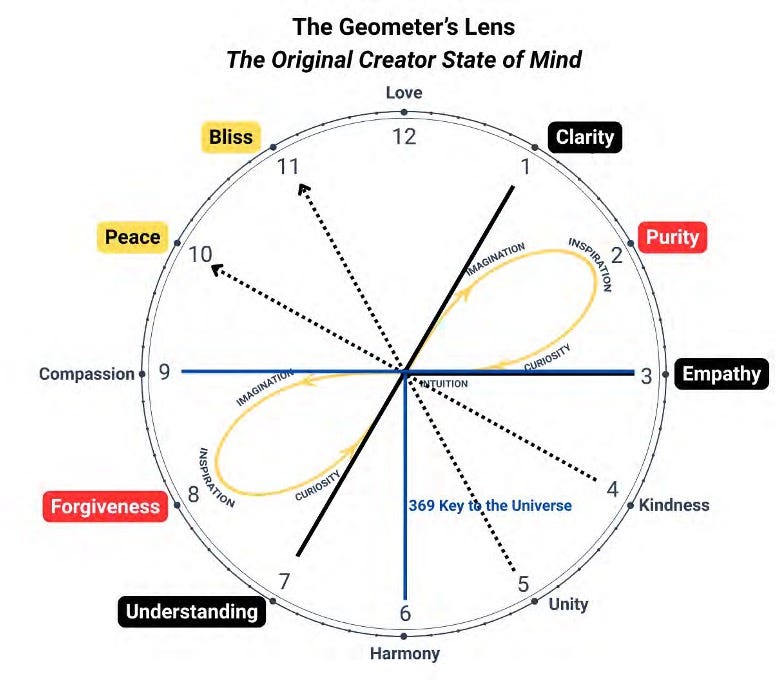
All creation begins with a whisper — a subtle stirring at the edge of awareness. Intuition rises first, emanating from the field as potential. It finds shape through imagination, the lens through which consciousness learns to see itself. From this imaginal ground, inspiration is born — the quickening of energy toward expression. And when that inspiration awakens in us an urge to enquire or explore, curiosity begins to move. This is the rhythm of expansion — the living cycle through which consciousness discovers itself anew.
In this architecture of becoming, curiosity informed by understanding holds the rhythm, just as Euler’s number (e) holds the curve of exponential growth. It is the measure of our willingness to ask, to reach, to grow beyond what we already know. It is a measure of our “why”, the sense of purpose that puts a fire in the belly. Every inquiry is an act of faith — an opening through which the universe responds. The larger the question we dare to ask of ourselves, the greater the field of possibility that responds in return. Curiosity is the energy of expansion made conscious, just as it forms the pathway to understanding; it is e as spirit — the exponential pulse of becoming.
In contrast, imagination gives form to the unseen. Like Phi, the golden ratio, it provides the symmetry through which possibility becomes perceivable. Imagination is the chrysalis of transformation — that alchemical interval between dissolution and rebirth. When the caterpillar surrenders to its own undoing, it dissolves into a fluid state filled with imaginal cells — pure potential awaiting design. These cells do not build something new from scratch; they remember what has always been possible. They hold within them the blueprint of flight. So too with us: imagination is the divineremembrance of what we may yet become.
Together, these two — curiosity and imagination — form the oscillating rhythm of creation: the pulse of expansion and the proportion of becoming. One sets the tempo, the other gives the dance its shape. Curiosity opens the field through inquiry; imagination brings the field into form through vision. In every cycle of creation, we move between them — question and vision, seeking and seeing, expansion and embodiment — until what began as potential becomes perception, and perception becomes participation in the living whole.
To live by this rhythm is to align oneself with the deeper mathematics of life — the truth that growth and harmony need never compete. We may expand without consuming, evolve without erasing, create without conquering. Just as e and Φ mirror one another in almost perfect resonance, so too can we learn to grow in right relation, to imagine more fully without displacing what already is. In this, we find the mature artistry of life — creativity as communion, evolution as cooperation, expansion as love made visible.
The Doorway of Wonder
Curiosity and imagination are the twin keys of creation — one opens, the other reveals. Together, they teach us that growth and harmony are not opposites, that we may rise further when we choose to rise together.
When we allow curiosity to ask freely and imagination to see clearly, we participate in the rhythm of the universe itself — expansion held in proportion, becoming held in love. In this harmony of inquiry and vision, the mind begins to rememberits source.
And it is from that remembrance — from this marriage of wonder and awareness — that we find the courage to stepbeyond the known, into the infinite field where nothing is separate, and all is forgiven.
This essay forms part of an ongoing body of work exploring consciousness, creativity, symbolic structure, and the deeper patterns that shape human experience.
Many of these reflections emerge through what I call the Geometer’s Lens — a framework for understanding perception, meaning, and becoming through recurring patterns found across nature, mathematics, story, and the human mind. Feel free to check out this first essay in this series: **137: Out of Nothing, Everything**
Further writings and books, including In the Eye of the Beholder, can be found at Genius Leaves Clues
메타데이터
- post_id
- dbfae88f2c81
- slug
- eulers-number-the-rhythm-of-expansion-dbfae88f2c81
- url
- https://medium.com/genius-leaves-clues/eulers-number-the-rhythm-of-expansion-dbfae88f2c81
- canonical_url
- https://medium.com/genius-leaves-clues/eulers-number-the-rhythm-of-expansion-dbfae88f2c81
- author_url
- https://medium.com/@justin.edgar
- status
- ok
- fetched_at
- 2026-06-09 15:37:30