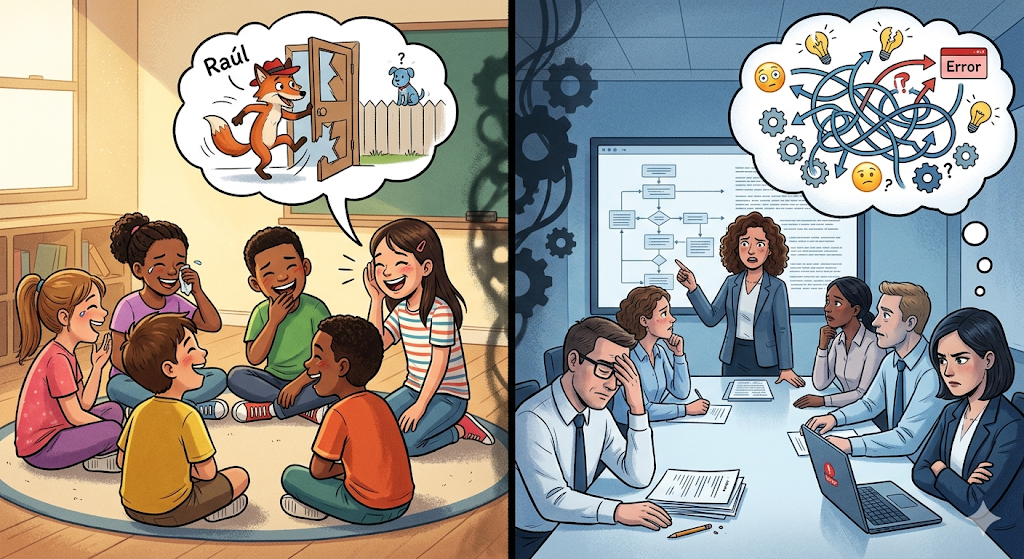
The “Hamster Wheel” Trap: Why Checking Off 50 Tasks a Day Means Your Team Is Failing
Let’s be brutally honest. We’ve all experienced that Friday afternoon when we close the computer feeling like we just ran a marathon…
The “Hamster Wheel” Trap: Why Checking Off 50 Tasks a Day Means Your Team Is Failing

Let’s be brutally honest. We’ve all experienced that Friday afternoon when we close the computer feeling like we just ran a marathon. You’re mentally and physically exhausted. If you look at your to-do list, it looks like a victorious battlefield: you checked off 40, maybe 50 items. You replied to every email, cleared your inbox, attended six meetings, and put out three last-minute fires.
You go home feeling incredibly “productive.”
But then the end of the quarter arrives. You sit down with your leadership team to review the real numbers, the company’s growth, the launch of that new product that was supposed to change everything… and you discover, to your horror, that the needle hasn’t moved even a millimeter.
How is it possible that a team working 10 hours a day, always “busy” and stressed, isn’t making meaningful progress?
Welcome to the biggest optical illusion in the modern corporate world: you’re confusing movement with progress. Your team isn’t climbing a mountain; they’re running at full speed on a hamster wheel.
The Anatomy of the Hamster Wheel
A hamster in captivity can run up to 8 kilometers in a single night inside its wheel. If you measure its effort by sweat, energy invested, and the speed of its tiny legs, the hamster is a high-performance athlete. It works extremely hard. But when morning comes, it’s still in exactly the same corner of the same cage where it started.
In our companies, we’ve created ecosystems that reward this behavior. We applaud the person who is always running, the one who answers emails at 11 p.m., and the one who seems to be juggling ten projects at once.
We’ve glorified the idea of being “busy.” But being busy is not a metric of success; often, it’s a symptom of a lack of clarity.
When a team doesn’t have a clear and visible strategic direction, the human brain does something fascinating and dangerous: it goes into survival mode and starts seeking easy wins.
The Dopamine Trap and “Toxic Efficiency”
To understand why we love checking things off a list, we need to talk about basic neuroscience.
Every time you mark a task as “Done” in your notebook or digital task manager, your brain releases a small dose of dopamine, the reward hormone. It feels wonderful.
The problem is that your brain is blind to strategic impact. Biologically, it rewards you with the same amount of dopamine whether you check off a task that says “Reply to logistics email” (which takes 2 minutes and doesn’t change the company’s direction) or one that says “Design the architecture for the new software” (which takes 3 weeks and could double sales).
Because of this flaw in the reward system, if you give an employee a list with 10 urgent but trivial tasks and 1 deep but vital task, they will almost always choose to complete the 10 small tasks first.
The result? At the end of the day, the employee checked off 10 things. They received 10 dopamine hits. They feel ultra-productive. But the one task that would actually move the company forward gets postponed until “tomorrow.”
Multiply this across every member of your team and you end up with an entire organization running on the wheel: solving daily micro-problems, feeling efficient, but systematically failing to be effective.
Efficiency vs. Effectiveness: The Difference That Saves Businesses
Peter Drucker, the father of modern management, summarized it with a powerful phrase: “There is nothing so useless as doing efficiently that which should not be done at all.”
- Efficiency is doing things quickly. It’s answering 50 emails in an hour. It’s running fast on the wheel.
- Effectiveness is doing the right things. It’s not opening your email all morning because you’re writing the code that will automate those 50 emails forever. It’s getting off the wheel and walking one kilometer — but toward the North.
The great tragedy of fragmented collaborative work is that it encourages empty efficiency. If your team manages their day through email inboxes or chat messages, they are reacting to other people’s priorities. Their task list is not dictated by the company’s strategy — it’s dictated by the last person who shouted at them digitally.
How to Break the Wheel and Find the North
If you notice your team is exhausted but your business is stagnant, you need a deep cultural intervention. Here’s how to change your company’s paradigm so people stop running in place.
1. Stop Applauding Volume and Start Measuring Weight
We must change the way we evaluate work. An employee who delivers a single block of deep work per week (for example, a structured new campaign) is infinitely more valuable than one who answers 200 chat messages a day.
In your review meetings, ban phrases like “I was very busy.” Change the narrative to: “What was the most important thing you moved forward today?” Weigh the impact of tasks — don’t count their quantity.
2. Give Them Context, Not Just Commands
If you tell a bricklayer only “put bricks here quickly,” they will place many bricks. But if they don’t know they are building a cathedral, they may end up building a wall in the wrong place.
Every task you assign to your team must include the why embedded in it. If a designer knows the banner they’re creating is the centerpiece for the quarterly sales goal, they won’t treat it as just another task to check off — they’ll give it the strategic weight it deserves.
3. Limit “Work in Progress” (WIP)
The best way to stop someone from chasing easy wins is by limiting their options. Implement strict rules where a team member cannot have more than two or three active tasks at the same time.
If they can’t jump to small tasks to avoid the difficult work, they’ll be forced to face the deep task, finish it, and actually move forward.
4. Create an Unbreakable Line of Sight
The antidote to the hamster wheel is visibility. Everyone in the company — from the CEO to the intern — should be able to see a map (a visual board) where it’s obvious how today’s daily tasks connect to the big goal of the year.
If a task is not anchored to a larger objective, it simply shouldn’t be done.
The Silence After Running
Getting off the hamster wheel feels strange at first.
When your team stops compulsively reacting to immediate messages and begins dedicating hours to deep work, the office (or digital environment) becomes quieter. That frantic sense of urgency and constant chaos disappears.
Many leaders panic when they encounter this silence. They think that if people aren’t running and shouting, they aren’t working. You must resist that impulse. That silence is the sound of real productivity. It’s the sound of thoughtful work, strategy taking shape, and real progress happening.
The value of your company is not measured by how many cards your team moved today. It’s measured by the impact of the pieces they built.
If you’re ready to help your team step off the hamster wheel and want to build the centralized system they deserve to align their daily efforts with your company’s big goals, we designed GGyess exactly for this. A platform where deep work, context, and strategic direction live in one place — allowing your team to stop being merely “busy” and start becoming truly unstoppable.
메타데이터
- post_id
- dc16cbb0bdda
- slug
- the-hamster-wheel-trap-why-checking-off-50-tasks-a-day-means-your-team-is-failing-dc16cbb0bdda
- url
- https://medium.com/@GGyess/the-hamster-wheel-trap-why-checking-off-50-tasks-a-day-means-your-team-is-failing-dc16cbb0bdda
- canonical_url
- https://medium.com/@GGyess/the-hamster-wheel-trap-why-checking-off-50-tasks-a-day-means-your-team-is-failing-dc16cbb0bdda
- author_url
- https://medium.com/@GGyess
- status
- ok
- fetched_at
- 2026-07-10 20:29:33