How Do Concrete Vaults Actually Work?
At first, a vault looks straightforward:
How Do Concrete Vaults Actually Work?
At first, a vault looks straightforward:
You deposit an asset. You receive shares. Your balance increases over time.
But behind this simple flow, Concrete vaults operate as a coordinated system that manages capital, executes strategies, and compounds value continuously.
What You Experience as a User
When you interact with a vault, the process feels minimal:
- deposit funds
- receive vault shares
- monitor metrics like eRate and NAV
There are no constant actions required. No manual reward claiming. No frequent repositioning.
This simplicity is intentional.
The complexity is handled by the system itself.
Vault Shares: Representing Your Ownership
Vault shares define your position in the vault.
They represent a proportional claim on the total assets inside the system.
For example:
- if you hold a certain percentage of shares, you own that same percentage of the vault
- your ownership changes only when you deposit or withdraw
- the value of that ownership changes as the vault grows
In short:
Shares determine how much of the vault belongs to you.
NAV: The Total Value Inside the Vault
NAV (Net Asset Value) reflects the total value of all assets managed by the vault.
It is the aggregate of everything happening inside:
- deployed capital
- accumulated yield
- strategy performance
When NAV increases, it means the vault has generated value.
This growth is shared proportionally among all shareholders.
eRate: The Value Per Share
eRate represents the value of a single vault share.
As the vault performs over time:
- NAV increases
- eRate increases
- each share becomes more valuable
You do not need more shares to benefit.
Instead, the value of each share appreciates as the system generates yield.
This is how automated compounding is reflected in practice.
Where the Yield Comes From
Yield is generated through a combination of strategies rather than a single source.
These may include:
- lending assets in DeFi markets
- providing liquidity where demand exists
- participating in yield-generating mechanisms
- capturing incentives across protocols
The vault does not rely on one opportunity. It coordinates multiple strategies to maintain efficiency.
Active Capital Management
Concrete vaults are actively managed systems.
Capital is not left idle. It is continuously:
- allocated to selected strategies
- rebalanced when conditions change
- adjusted to optimize performance
- compounded as returns accumulate
This is a key distinction between simply holding assets and participating in managed DeFi.
The vault behaves more like a system operator than a static storage pool.
The Importance of Time
Vault performance is closely tied to time.
Short-term results can fluctuate, but long-term participation allows:
- compounding to take effect
- strategies to complete cycles
- rebalancing to improve outcomes
- costs to be amortized over duration
In simple terms:
Time allows the system to fully express its efficiency.
Putting It All Together
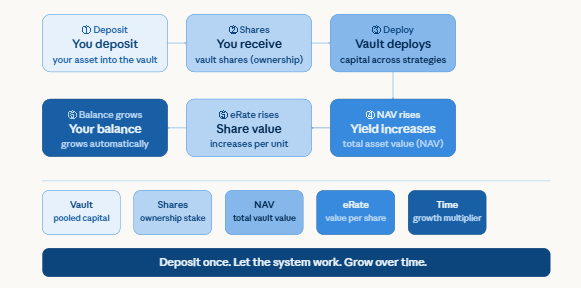
Here is the full flow of how a vault operates:
- A user deposits assets
- The user receives vault shares
- The vault allocates capital into strategies
- Strategies generate yield over time
- NAV increases as total value grows
- eRate increases as share value rises
- The user’s balance grows proportionally
This process continues as long as the capital remains in the vault.
A Simple Mental Model
To understand Concrete vaults clearly, you can reduce everything to a few core concepts:
- Vault = a pooled capital system
- Vault shares = ownership of that system
- NAV = total value inside the vault
- eRate = value of each share
- Time = driver of growth
- Management = continuous optimization of capital
Why This Approach Matters
Traditional DeFi often requires users to manage multiple moving parts:
- switching between protocols
- tracking yields
- claiming rewards
- adjusting positions manually
Vault infrastructure simplifies this by consolidating execution into a single system.
Concrete vaults aim to:
- keep capital continuously deployed
- automate compounding
- reduce idle assets
- streamline user interaction
- improve capital efficiency over time
Final Perspective
Concrete vaults are not just a deposit-and-earn tool.
They are a system designed to manage capital efficiently while abstracting away operational complexity.
Instead of users actively managing strategies, the vault handles allocation, compounding, and optimization internally.
This shift represents a broader evolution in DeFi:
from manual participation to system-driven capital management
Explore Concrete at **app.concrete.xyz**
메타데이터
- post_id
- dc2f7d287bc2
- slug
- how-do-concrete-vaults-actually-work-dc2f7d287bc2
- url
- https://medium.com/@ataur6264/how-do-concrete-vaults-actually-work-dc2f7d287bc2
- canonical_url
- https://medium.com/@ataur6264/how-do-concrete-vaults-actually-work-dc2f7d287bc2
- author_url
- https://medium.com/@ataur6264
- status
- ok
- fetched_at
- 2026-06-17 08:20:12