AI video does not cost a fortune. But it does not cost $50 either.
A student in my community shipped a brand video for $1,400 that three agencies quoted at $80K, $115K and $140K. The cost myth is dead. The…
AI video does not cost a fortune. But it does not cost $50 either.
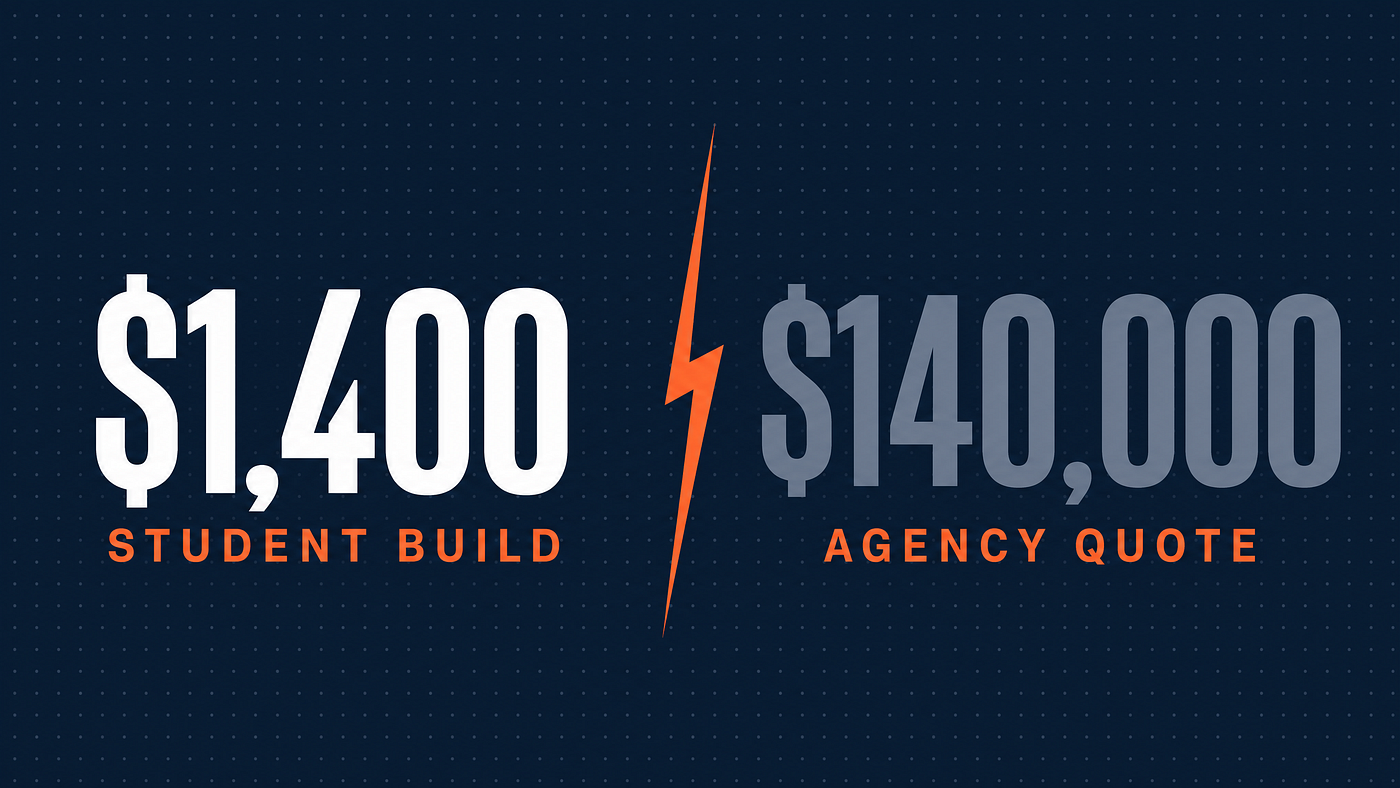
A student in my community shipped a brand video for $1,400 that three agencies quoted at $80K, $115K and $140K. The cost myth is dead. The workflow tax is real.
AI video has a strange pricing problem. People who have not tried it think it costs a fortune. People who just tried it think it costs almost nothing. Both are wrong, and the gap between those two beliefs is where every marketing team I work with is currently losing money.
A student in my community at AI Video Bootcamp recently ran the math on her first AI brand video. Her tools came to $42. Operator time, an editor review, and legal sign-off pushed the all-in cost to $1,400. The same 60-second piece had been quoted by three agencies at $80,000, $115,000, and $140,000.
That gap is the conversation I have with marketing leaders almost weekly. The cost story for AI video has flipped, but the failure story has not. Most teams either overpay an agency that has not adapted yet, or they trust a $50 tool bill and ship something that gets killed in legal review. The tools are cheap. The work, done right, is not. And the math in between is where most companies are losing money this year.
What the tools actually charge you
Here are this week’s prices on the dashboards I check.
On fal.ai, Wan 2.6 Pro starts at $0.14 to $0.28 per second of finished video. Seedance 2.0 image-to-video sits at $0.30 per second for 720p and $0.68 for 1080p. Kling 3.0 Pro image-to-video runs $0.112 per second with audio off and $0.168 with audio on. Veo 3.1 first-to-last-frame in 4K with sound is the premium pick at $0.60. A 60-second clip costs roughly $7 to $41 in pure model spend.
A polished piece needs more. OpenAI’s GPT Image 2.0 and Google’s Nano Banana Pro are priced very differently. GPT Image 2.0 runs on token-based pricing that comes out to roughly $0.03 to $0.10 per branded still depending on size and quality. Nano Banana Pro is flat-rate at $0.15 per standard image and $0.30 at 4K. So 10 to 25 frames add another $1 to $8 depending on which model you pick.
ElevenLabs Multilingual v3 charges $0.10 per 1,000 characters. A one-minute voice-over costs about ten cents in pure compute, but realistically plan on $1 once you have tested voices and adjusted the script.
The tools to render one polished 60-second piece in 2026 cost $10 to $50 ifyou nail the first take. You will not nail the first take.
For every shot you keep, you will throw away two or three. Industry tracking puts the real ratio at three to one. A 60-second piece with eight to twelve shots really means 25 to 60 takes, plus pickups for warped text, brand color drift, and the scene where the model invents a sixth finger. The $10 to $50 quietly becomes $30 to $150 before anyone touches an editor.
Stack the operator’s hours, the eval reviewer, the music license, and the legal sign-off, and a post-able 60-second AI piece costs $1,200 to $2,000 to ship the first one, and $700 to $1,200 each once your process is dialed in.
A mid-tier agency 60-second deliverable runs $15,000 to $50,000. An AICP-grade broadcast spot averages $387,000. The gap is real. It is closer to 10x to 25x. That is still enormous. It just is not free.
So why is your team still failing?
Gartner has projected that 40 percent of generative AI projects will be abandoned by 2027. 95 percent of enterprise AI initiatives have not shown measurable returns in their first year. In the AI video community I run, with more than 23,000+ creators using AI for business video, I see the same pattern weekly. Teams sign up for the tools, see the cheap line item on the invoice, and quietly stall a quarter later.
The reason is not the model. It is the workflow. When the spreadsheet says “$50 per asset,” you are counting one thing and ignoring four others. I call those four the workflow tax. They are where the budget actually goes.

The four workflow taxes
The first is the iteration tax. Three takes for every one you keep is not a flaw. It is the cost of doing this work. Teams that do not budget for the throwaways run out of credits in week two and decide AI video “doesn’t work.”
The second is the eval tax. AI video makes specific mistakes that repeat: warped text, malformed hands, brand colors that drift, the small but fatal hallucination at second seven. Catching them takes someone with taste, not a junior intern. Most companies skip the seat and ship work that gets killed in legal.
The third is the re-render tax. Traditional video lets you cut a 30-second spot down to 15 seconds without re-shooting. AI video usually does not. Change the duration, the brief, or the brand color, and you are often starting over from the prompt up.
The fourth is the rights and compliance tax. Voice clone consent, deepfake disclosure, training-data exposure. California’s AB 723 is now actively enforced in real estate, with the rental version, AB 2025, advancing through committee. A two-hour legal review on a $50 video clip is real overhead. That is the ceiling on volume, and most teams hit it before they finish their second campaign.
The reframe
AI video is not a budget question anymore. It is a question of how you organize the people running it.
The companies winning at this built a four-seat pipeline. An operator who runs the tools. An editor with taste. An evaluator who catches the mistakes before they ship. A compliance owner who carries the rights and the disclosure language. That pipeline, on fractional headcount, runs around $8,000 a month. It will out-ship a $140,000 agency contract every quarter.

The four seats are not four full-time hires. In practice it is a senior operator at 30 to 40 hours a week, a fractional editor at 8 to 12 hours, an evaluator who is often the brand manager or art director already on payroll, and a compliance owner who is either your existing in-house counsel or a fractional legal advisor on retainer. The four seats are roles, not people. One smart person can hold two of them on a small team. What kills companies is when zero people hold any of them, and the spreadsheet still says the work costs $50.
If your CMO asks what AI video costs, the answer is not a number. It is a question back. What are we actually trying to ship, and who on our team owns the pipeline that ships it?
How to start tomorrow
If you are a marketing leader reading this and you do not have a four-seat pipeline yet, here is the smallest version of it.
Pick one campaign. Not the brand video. Something with three to five 15-second social cuts. Assign the operator seat to the person on your team who already plays with the AI tools after hours. They exist. You know who they are. Give them a budget of $300 for tool credits and one full week.
Assign the eval seat to your brand manager or art director. Their job is one call: ship or kill. That call should take 20 minutes per asset, not two days.
Assign the compliance seat to whoever already reads your contracts. Give them one page of guidance: the disclosure language, the voice clone consent rule, the training-data clause. One page. Not a 40-page policy you will never read again.
Run the campaign. Measure the bill. Measure the time-to-ship. Measure the kill rate. Then come back and decide whether to scale. The companies that are running this play in 2026 are shipping ten to twenty AI assets a week on a team that, on paper, looks the same size as their competitor doing two.
And if you are starting from zero, with nobody on your team yet who “plays with the AI tools after hours,” the fastest fix is to put your future operator into a community that already has the workflow figured out. AI Video Bootcamp is the largest paid generative AI community in the world and the course I run. Membership is $9 a month, which is the price of two or three coffees. Most new operators ship their first usable AI asset inside the first week. That is the fastest version of building the four-seat pipeline from scratch.
The bottom line
The cost myth is dead. The $50 tool bill is real. The $140,000 agency invoice for the same deliverable is also real. Both are misleading in opposite directions.
The workflow tax is the real number. It is the operator hours, the eval seat, the throwaway takes, the legal review, the re-renders when the brief changes. Budgeted correctly, a polished 60-second piece costs $700 to $1,200 once your team is dialed in. Budgeted incorrectly, that same piece costs you nothing on the spreadsheet and your entire campaign in the audit.
The companies that figure out the difference are the ones whose video output will look unrecognizable a year from now. The companies that don’t will keep cycling through “we tried AI video, it didn’t work for us” while their competition ships ten times their volume on a quarter of the budget.
Your turn
If you are running an AI video pipeline today, I want to know two things. Which of the four taxes is hitting your team the hardest right now? And which seat in the four-seat pipeline is still empty? Drop both in a comment.
I will read every one. The 23,000-creator AVB community is having this conversation in private channels every week, and the answers in public comments here will help the next marketing leader who lands on this article searching for “why our AI video pilot stalled.”
메타데이터
- post_id
- dc48dc1fba1e
- slug
- ai-video-does-not-cost-a-fortune-but-it-does-not-cost-50-either-dc48dc1fba1e
- url
- https://medium.com/@mateostarcevicfilipovic/ai-video-does-not-cost-a-fortune-but-it-does-not-cost-50-either-dc48dc1fba1e
- canonical_url
- https://medium.com/@mateostarcevicfilipovic/ai-video-does-not-cost-a-fortune-but-it-does-not-cost-50-either-dc48dc1fba1e
- author_url
- https://medium.com/@mateostarcevicfilipovic
- status
- ok
- fetched_at
- 2026-07-27 00:54:22






