The Power of Truth: Fredrick Douglass’s Fight for Freedom
How the “The Narrative of the Life of Frederick Douglass” (1845), Sparked the Conscience of a nation.
The Power of Truth: Fredrick Douglass’s Fight for Freedom
How the “The Narrative of the Life of Frederick Douglass” (1845), Sparked the Conscience of a nation.
By: Thalia Soler
Introduction
When Fredrick Douglass published The Narrative of the Life of Fredrick Douglass, an American Slave in 1845, he did far more than tell his story, he transformed how America viewed slavery. Written just seven years after his daring escape, Douglass’s autobiography exposed the brutal reality of bondage while proving the intellectual and moral equality of Black people. Through his vivid storytelling and eloquent prose, Douglass challenged the falsehoods used to justify slavery and called for immediate abolition.
His narrative was not only an act of remembrance but also an act of rebellion, one that turned personal suffering into piblic power. As a scholar Henry Louis Gates Jr. notes, Douglass “turned himself into a text, a work of art, a weapon against slavery” (Gates). This essay explores Douglass’s life, his landmark book, and its enduring legacy as one of the most influential works in American history.
About the Author
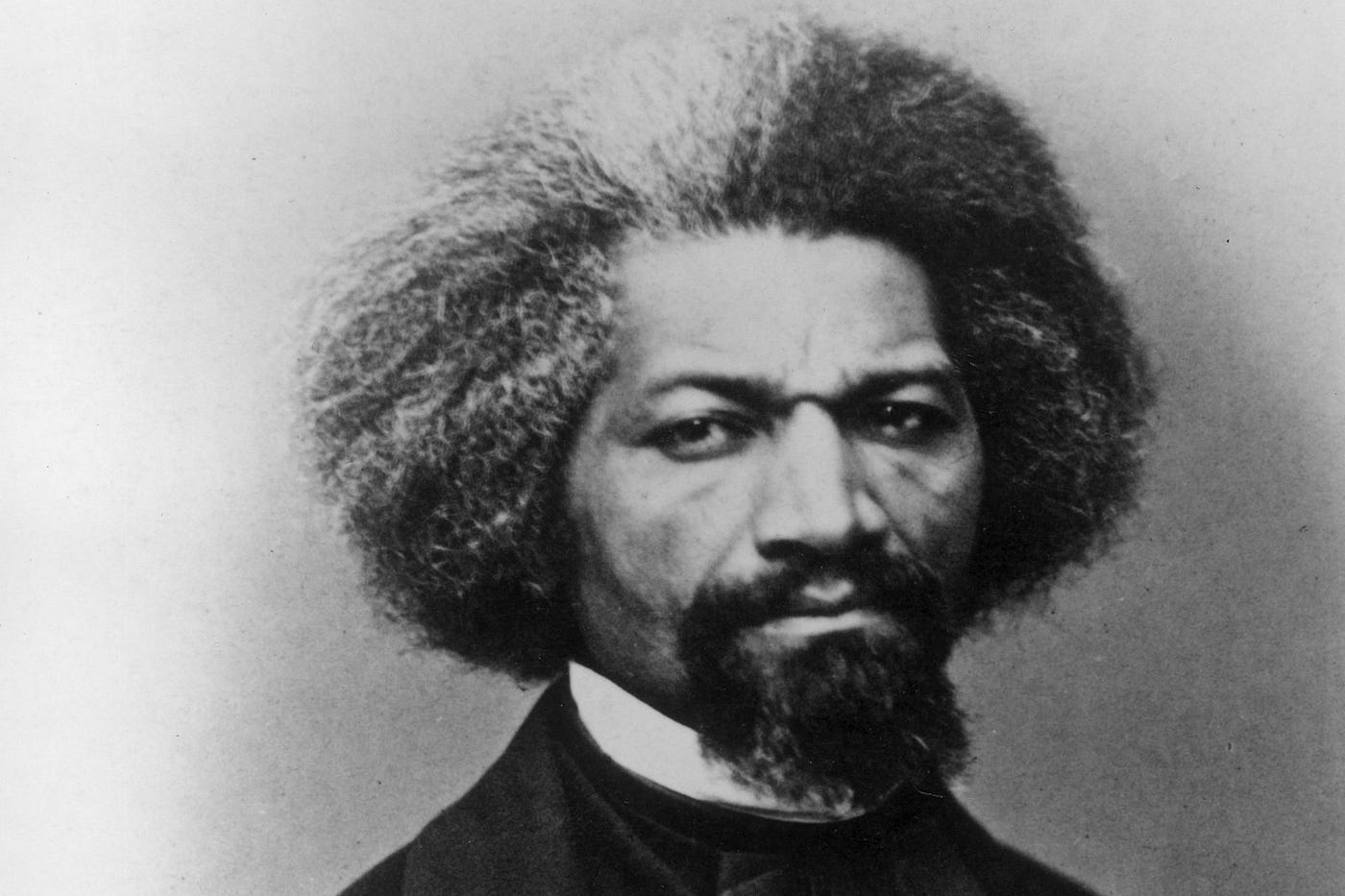
Fredrick Douglass was born into slavery in Talbot County, Maryland, around 1818. His early life was marked by separation, violence and resistance. Douglass never knew his exact birthday and was separated from his mother as an infant… a common practic designed to weaken family bonds among enslaved people. As a child, he was moved from plantatiom to plantation, witnessing and experiencing the cruelties of the system firsthand.
A turning point came when Douglass was sent to live in Baltimore with the Auld family. There, his mistress Sophia Auld began to teach him the alphabet. Although she was forbidden to continue, Douglass secretly taught himself to read and write, a dangerous act that became the foundation of his freedom. He later reflected, “Once you learn to read, you will be forever free” (Douglass 47)

Frederick Douglass delivering a speech in a crowded room in 1892
About the Book
Publsihed in 1845, The Narrative of the Life of Fredrick Douglass recounts his journey from enslavement to self-liberation. The book combines autobiography, political argument, and moral philosophy. Douglass’s writing style is both poetic and precise, blending vivid sensory detail with deep reflection. He recounts brutal beatings, emotional trauma, and psychological manipulation — but also small acts of resistance, such as secretly reading newspapers or fighting back against an overseer.
One of the book’s central themes is the link between literacy and liberation. Learning to read allowed Douglass to understand the hypocrisy of slavery and gave him the tools to fight it. Another major them is the corruption of power, he shows how slavery degrades both the enslaved and the enslaver.
His narrative also uses irony and imagery to great effect. For instance, when describing “ Christian”, slaveholders who prayed while whipping their slaves, Douglass exposes the moral contradictions of American Christianity. As literary crtic Deborah M. Garfield observes, “Douglass weaponizes literacy and irony to dismantle the institution the sought to silence him” (Garfield).

Chapter from Frederick Douglass’s draft manuscript of his autobiography, Life and Times of Frederick Douglass, ca. 1880.
Legacy
The impact of Douglass’s Narrative was immediate and far-reaching. It became one of the most powerful abolitionist tools of the nineteenth century, selling over 30,000 copies within five years (Library of Congress). For many white readers, it was their first direct, credible account of slavery’s brutality told by someone who had lived it.
Douglass’s success also proved false the racist belief that Black people were incapable of intellectual or literary achievement. His eloquence and reasoning forced readers to confront the humanity of enslaved individuals. As William Lloyd Garrison wrote in his preface, Douglass’s words “dispel the darkness of prejudice” (Garrison).
Beyond abolition, Douglass’s ideas influenced broader movements for social justice. His advocacy for women’s rights, education, and civic equality helped shape the post–Civil War era. In many ways, Douglass laid the groundwork for later civil rights leaders like Martin Luther King Jr., who cited Douglass’s belief that “power concedes nothing without a demand.”
Today, Douglass’s Narrative remains essential reading not only for its historical truth but for its timeless relevance. In an era still grappling with racial inequality, Douglass’s life reminds us that knowledge is resistance…and that words can change the world.

Statue of Fredick Douglass in Harlem, NYC.
Works Cited
Douglass, Frederick. The Narrative of the Life of Frederick Douglass, an American Slave. Boston: Anti-Slavery Office, 1845.
Garfield, Deborah M. “Speech, Silence, and the Unspeakable: Frederick Douglass’s Literary Voice.” American Literary History, vol. 3, no. 4, 1991, pp. 707–732.
Gates Jr., Henry Louis. “Frederick Douglass: A Voice for Freedom.” PBS African American Lives, 2012, www.pbs.org/wnet/african-american-lives/profiles/frederick-douglass/.
Garrison, William Lloyd. Preface to The Narrative of the Life of Frederick Douglass. Boston: Anti-Slavery Office, 1845.
Library of Congress. “Frederick Douglass Papers.” Library of Congress Digital Collections, www.loc.gov/collections/frederick-douglass-papers/.
메타데이터
- post_id
- dc5dc11c92bb
- slug
- the-power-of-truth-fredrick-douglasss-fight-for-freedom-dc5dc11c92bb
- url
- https://medium.com/@thaliasoler/the-power-of-truth-fredrick-douglasss-fight-for-freedom-dc5dc11c92bb
- canonical_url
- https://medium.com/@thaliasoler/the-power-of-truth-fredrick-douglasss-fight-for-freedom-dc5dc11c92bb
- author_url
- https://medium.com/@thaliasoler
- status
- ok
- fetched_at
- 2026-06-09 15:37:30