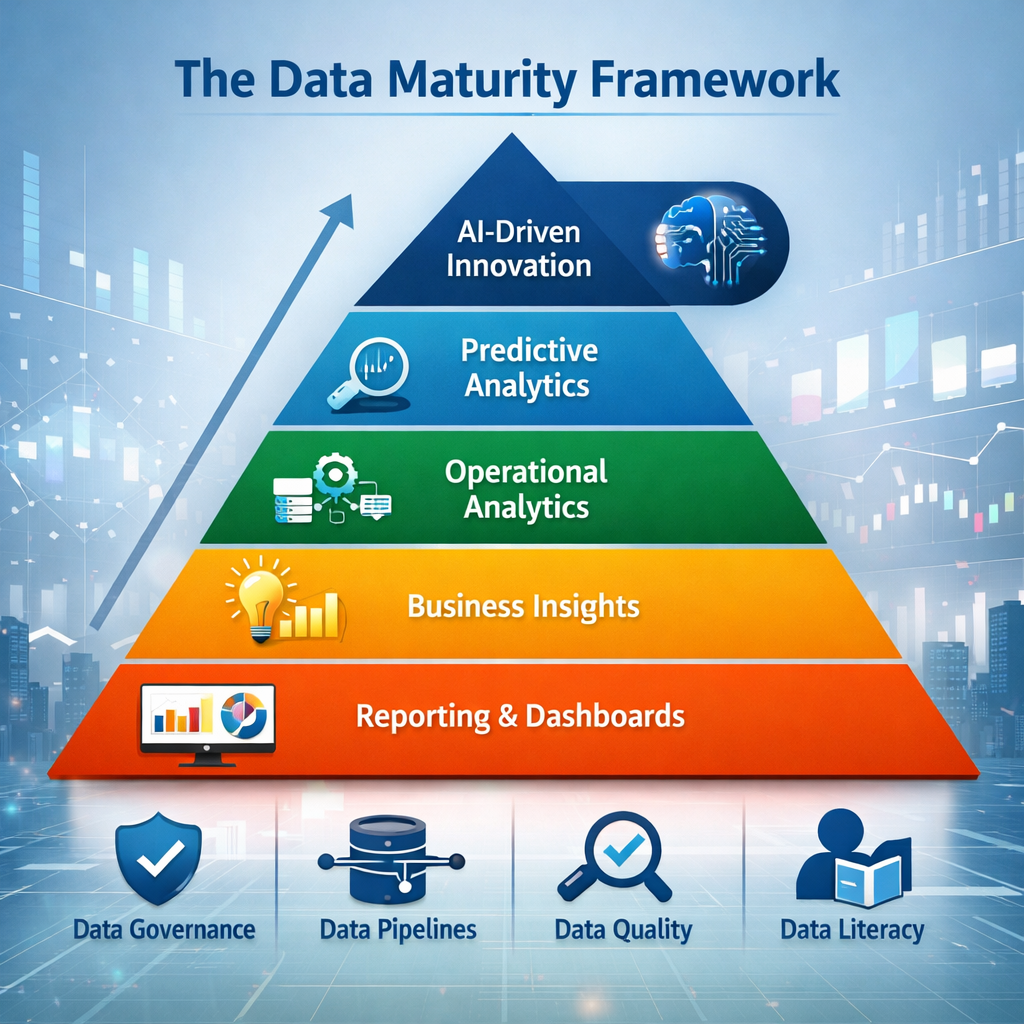
The Data Maturity Checklist Every Modern Enterprise Needs
In Brief
The Data Maturity Checklist Every Modern Enterprise Needs
In Brief
Data maturity defines how well organizations turn data into reliable decisions. This checklist helps enterprises evaluate data foundations, integration, governance, and analytics adoption while building a scalable strategy supported by trusted reporting and tools like a Power BI dashboard.

Data maturity has become the defining factor separating organizations that experiment with analytics from those that scale intelligence across the business. The conversation is no longer about whether companies collect enough data; it is about whether that data is reliable, unified, and actionable at the moment decisions are made.
Many enterprises invest heavily in dashboards, warehouses, and reporting tools, yet struggle to translate insights into consistent operational impact. This gap exists because data maturity is not a tooling milestone — it is a capability that spans architecture, integration, governance, and organizational behavior. Without a structured framework, teams often move quickly into visualization while foundational layers such as data quality, semantic modeling, and ownership remain fragmented.
A practical data maturity checklist helps organizations evaluate these layers systematically. Instead of abstract maturity models, a checklist focuses on observable signals: whether business metrics are standardized, whether pipelines are resilient, whether teams trust the numbers, and whether analytics workflows extend beyond static reporting. Enterprises that adopt this approach progress faster from descriptive analytics to predictive and decision intelligence.
The importance of enterprise data maturity has grown alongside the modern data stack. Cloud platforms have reduced infrastructure friction, but they have also increased data sprawl. Multiple SaaS tools, real-time streams, and departmental warehouses introduce complexity that cannot be solved by dashboards alone. Initiatives such as data maturity assessment and data integration consulting are therefore becoming foundational steps before expanding analytics investments.
Business intelligence platforms play a critical role in this journey. A well-structured Power BI dashboard built through Power BI consulting services reflects underlying data maturity. When these elements align, analytics shifts from reactive reporting to proactive decision support.
This article presents a practical checklist that modern enterprises can use to evaluate their current state, identify maturity gaps, and design a scalable roadmap. By understanding where capabilities break down — whether in data pipelines, governance, or adoption — organizations can move beyond dashboard proliferation toward a cohesive data strategy that supports growth, efficiency, and AI readiness.
Data Foundation Checklist
The first signal of strong data maturity is not advanced analytics — it is a stable, well-designed data foundation. Enterprises that skip this stage often create impressive dashboards on top of inconsistent pipelines, which leads to metric conflicts, rework, and declining trust. A data foundation checklist focuses on whether the organization can reliably capture, store, and model data before attempting scale.
At this stage of the data maturity journey, the primary objective is consolidation without losing context. Data typically originates from SaaS platforms, transactional systems, customer touchpoints, and operational tools. Mature organizations ensure these sources are cataloged, ingestion patterns are standardized, and data latency expectations are clearly defined. This prevents ad-hoc extraction workflows that later create governance and quality issues.
A strong foundation also requires a clear storage strategy. Whether companies adopt a warehouse, lakehouse, or hybrid approach, the decision should align with analytics consumption patterns rather than vendor preference. Enterprises progressing in enterprise data maturity design environments where raw, cleaned, and curated layers are separated. This layered approach enables experimentation while protecting business reporting from upstream volatility.
Another critical checkpoint involves metric definition. Many organizations build multiple reports measuring the same KPI differently because semantic modeling is postponed. Establishing canonical definitions early — revenue logic, customer lifecycle stages, operational SLAs — prevents dashboard sprawl later. When teams open a Power BI dashboard for internal reviews, consistency should be assumed rather than debated.
Data quality observability is equally important. Mature foundations include validation rules, anomaly detection, and lineage visibility so teams understand where numbers originate and when pipelines fail. Instead of reacting to broken reports, organizations proactively monitor freshness, completeness, and schema drift. This shifts analytics from reactive troubleshooting to predictable operations.
Ownership is often the most overlooked element in the data maturity checklist. A technically sound architecture still fails if responsibility is unclear. Enterprises moving beyond early maturity assign domain ownership for datasets, establish review cycles for schema changes, and define escalation paths when data issues impact decision-making. This governance foundation enables scale without central bottlenecks.
The role of data integration consulting frequently begins at this stage, particularly when legacy systems, fragmented SaaS environments, or mergers introduce structural complexity. By designing ingestion frameworks, transformation standards, and semantic layers, integration efforts accelerate the transition from siloed reporting to unified analytics.
A mature data foundation does not aim for perfection; it aims for reliability and repeatability. When pipelines are predictable, definitions are standardized, and ownership is visible, organizations create the conditions necessary for advanced analytics, AI adoption, and real-time decision workflows. Every subsequent stage of data maturity builds on this groundwork.
Data Integration Checklist
As organizations progress beyond the initial data foundation, the next maturity barrier is integration. Data rarely lives in a single system; it spreads across CRM platforms, product databases, finance tools, marketing automation, and third-party applications. Without a cohesive integration strategy, analytics becomes fragmented regardless of how advanced the visualization layer appears.
A mature data integration approach standardizes ingestion patterns instead of building one-off pipelines. Enterprises define how batch, real-time, and event-driven data flows into the analytics environment and establish reusable transformation logic. This reduces technical debt and ensures new data sources can be onboarded quickly without redesigning architecture each time.
Another checkpoint involves handling schema evolution. SaaS tools change frequently, and brittle pipelines can silently break business reporting. Mature organizations implement versioning, automated testing, and monitoring so integration workflows adapt without disrupting downstream analytics. This is particularly important when operational dashboards — including executive Power BI dashboard views — depend on near real-time accuracy.
Integration maturity also includes identity resolution and data modeling across domains. Customer, product, and transaction data must align to enable cross-functional insights. When these relationships are unclear, organizations remain stuck in descriptive reporting. Strong integration practices enable cohort analysis, lifecycle analytics, and advanced forecasting.
This is where data integration consulting provides significant acceleration. Instead of treating pipelines as engineering tasks, consulting frameworks design scalable ingestion architectures, semantic layers, and orchestration standards. The outcome is not just unified data but a reusable analytics backbone that supports future AI initiatives.
Governance Checklist
Governance represents the shift from usable data to trusted data. Many enterprises have integrated pipelines but still experience conflicting metrics because governance frameworks are informal or reactive. Data maturity requires explicit rules around ownership, access, definitions, and lifecycle management.
The first governance checkpoint is metric standardization. Business KPIs must be defined once and reused across dashboards, reports, and embedded analytics. Without a semantic layer, teams recreate logic independently, leading to dashboard proliferation and decision friction.
Access management is another indicator of maturity. Instead of unrestricted data exposure or overly restrictive central control, mature organizations implement role-based access aligned with business domains. This allows self-service analytics while protecting sensitive information.
Lineage visibility strengthens trust. Decision makers should understand where numbers originate, which transformations were applied, and how fresh the data is. When leaders trust the lineage behind a Power BI dashboard, conversations shift from validating numbers to interpreting insights.
Governance also includes data lifecycle policies — retention rules, archival strategies, and documentation practices. Enterprises progressing in data governance maturity treat datasets as products with defined owners, SLAs, and review cycles. Many enterprises implement **data governance consulting frameworks** to standardize metric definitions.
Analytics Adoption Checklist
A technically sound data platform does not guarantee maturity if analytics adoption remains limited. The true measure of data maturity is whether insights influence daily workflows across teams.
Adoption maturity begins with usability. Dashboards must answer specific operational questions rather than display generic metrics. Organizations that design analytics around decision moments — sales reviews, supply planning, marketing optimization — see higher engagement.
Self-service analytics is another checkpoint. Mature enterprises reduce dependence on central teams by providing curated datasets, semantic models, and guided exploration environments. This allows business users to analyze data without breaking governance rules.
Embedding analytics into operational tools marks a higher maturity level. Instead of switching platforms, teams interact with insights within CRM systems, product interfaces, or internal portals. A Power BI dashboard embedded into internal workflows transforms analytics from reference material into action triggers.
Training and change management also influence maturity. Organizations that invest in data literacy programs experience faster cultural adoption and more consistent metric usage.
Data Maturity Assessment Checklist
A data maturity assessment provides a structured way to identify capability gaps. Rather than evaluating tools, assessments examine processes, architecture, governance, and organizational alignment.
Key assessment questions include:
- Are business metrics defined centrally and reused consistently?
- Do data pipelines have monitoring, testing, and ownership?
- Can teams access trusted data without engineering support?
- Is analytics used for forecasting and decision automation, not just reporting?
- Are governance policies documented and enforced?
Mature assessments combine technical evaluation with stakeholder interviews. Leadership perception of data reliability often differs from operational reality, and bridging that gap is essential for roadmap design.
Organizations conducting regular data maturity assessment cycles move faster because improvements become measurable rather than abstract.
Data Maturity Roadmap Checklist
A roadmap translates assessment insights into execution. The most effective roadmaps prioritize sequence rather than scale — building foundational reliability before expanding analytics complexity.
Early roadmap phases typically focus on integration standardization, semantic modeling, and data quality monitoring. These initiatives create immediate impact by reducing reporting conflicts.
Mid-stage roadmap priorities include governance rollout, self-service enablement, and analytics embedding. This stage shifts analytics from centralized production to distributed consumption.
Advanced roadmap initiatives involve predictive modeling, real-time analytics, and decision intelligence. At this level, data maturity supports automation rather than manual interpretation.
Successful roadmaps balance quick wins with platform strategy. Enterprises that attempt large transformations without incremental milestones often stall despite significant investment.
Common Mistakes That Slow Data Maturity
Many organizations underestimate how process gaps limit maturity more than technology limitations.
A common mistake is dashboard-first thinking. Building visualization layers before defining semantic models creates long-term inconsistency. Another issue is fragmented ownership, where datasets exist without clear accountability.
Tool sprawl also slows maturity. Introducing multiple analytics platforms without a unified metric layer increases confusion rather than flexibility. Similarly, neglecting change management leads to low adoption even when technical capabilities improve.
Finally, organizations often delay governance because it appears restrictive. In reality, governance enables scale by reducing ambiguity.
The Future of Data Maturity
The next phase of data maturity is defined by decision intelligence. As AI integrates into business workflows, organizations must move beyond dashboards toward systems that recommend and automate actions.
Semantic layers are becoming central because AI requires consistent business definitions. Real-time data pipelines enable operational responsiveness, while observability ensures models rely on trustworthy inputs.
Future-ready enterprises treat data products as core infrastructure. Integration, governance, and analytics converge into a unified platform that supports experimentation without sacrificing reliability. In this environment, maturity is measured by how quickly insights translate into measurable outcomes.
Conclusion: From Reporting to Decision Infrastructure
Data maturity is not a destination but an operational capability that evolves alongside business complexity. Enterprises that adopt a checklist approach gain clarity on where gaps exist and how to prioritize improvements.
The progression from fragmented reporting to unified analytics, governed metrics, and decision intelligence requires deliberate investment in foundations, integration, governance, and adoption. Tools such as a Power BI dashboard play an important role, but their impact depends on the architecture and processes supporting them.
Organizations that accelerate data maturity create compounding advantages: faster decision cycles, improved forecasting accuracy, stronger cross-functional alignment, and readiness for AI-driven workflows. By using this checklist as a reference, enterprises can move beyond isolated analytics initiatives toward a scalable data strategy that supports long-term growth.
Also read:
How to Build Clean, Analysis-Ready Datasets Using Data Analytics
Is AI Replacing Data Engineering? What Businesses Should Know
Azure Data Engineering Strategy: What to Outsource vs Build In-House
메타데이터
- post_id
- dc5ee31714e2
- slug
- the-data-maturity-checklist-every-modern-enterprise-needs-dc5ee31714e2
- url
- https://medium.com/@moxleyph/the-data-maturity-checklist-every-modern-enterprise-needs-dc5ee31714e2
- canonical_url
- https://medium.com/@moxleyph/the-data-maturity-checklist-every-modern-enterprise-needs-dc5ee31714e2
- author_url
- https://medium.com/@moxleyph
- status
- ok
- fetched_at
- 2026-07-29 15:25:31