From Prototype to Production — Environment Aware Control (Part 5)
By this point, most teams have a working system.
From Prototype to Production — Environment Aware Control (Part 5)
By this point, most teams have a working system.
Requests are safe. Routing decisions are in place. Costs are visible and somewhat controlled. On the surface, things look stable. But a different kind of problem begins to emerge — one that is less obvious, but equally important.
The system behaves the same everywhere.
Environments
In many setups, development, staging, and production environments are treated as variations of the same configuration. The same models are used, the same policies are applied, and the same limits are enforced. This simplifies implementation, but it introduces a subtle mismatch between intent and behaviour.
Because environments are not interchangeable.
They serve different purposes.
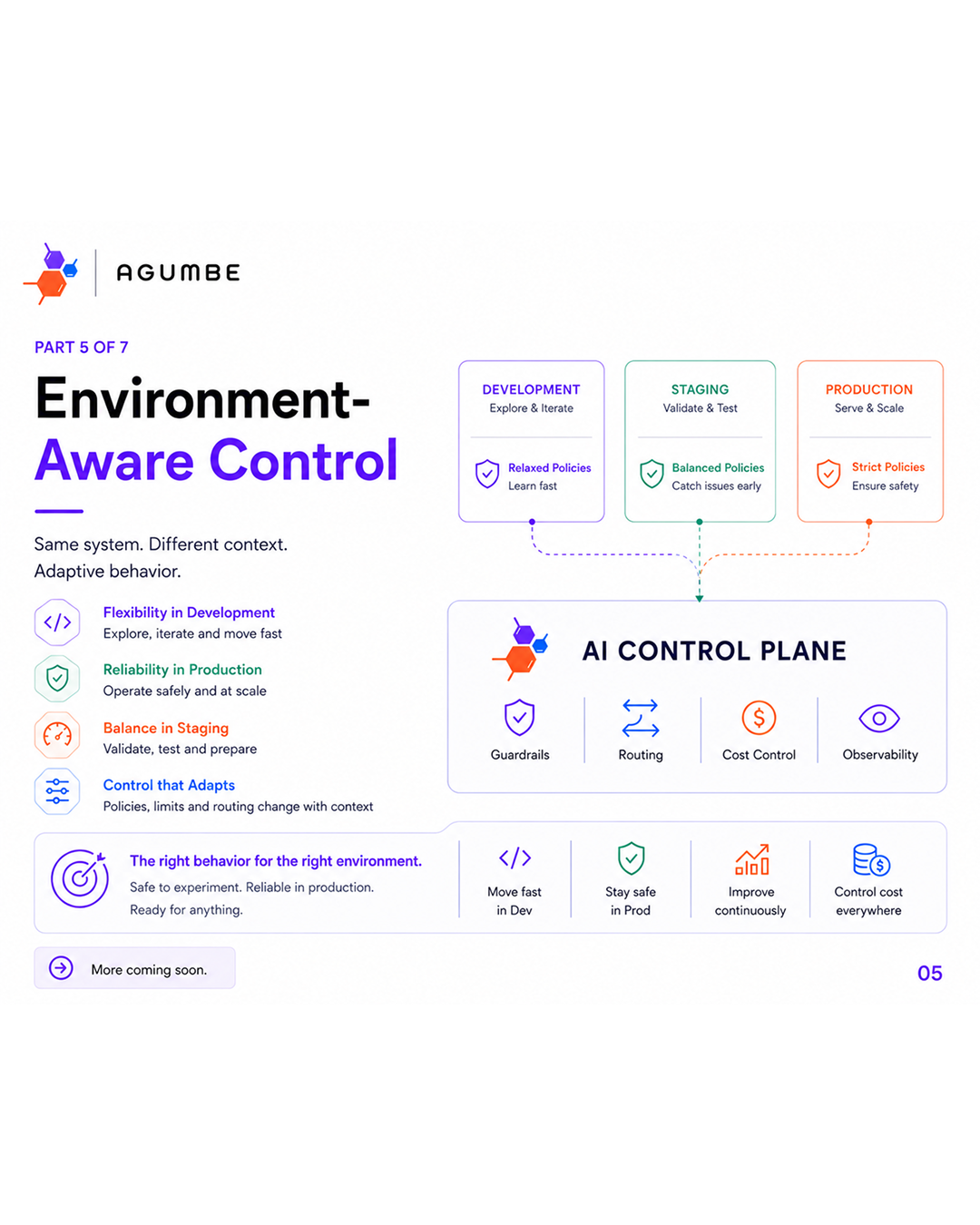
Development environments are designed for exploration. They need flexibility, lower cost constraints, and the ability to experiment freely. Teams may want to test different models, iterate on prompts, or run workflows that would not be acceptable in production.
Production environments, on the other hand, require stability. They need stricter guardrails, tighter cost controls, and predictable behaviour under load. The margin for error is smaller, and the consequences of failure are higher.
Staging environments sit somewhere in between, acting as a bridge between experimentation and reliability.
When all of these environments behave identically, teams are forced into trade-offs.
If production-level restrictions are applied everywhere, development slows down. If development-level flexibility is allowed everywhere, production becomes fragile.
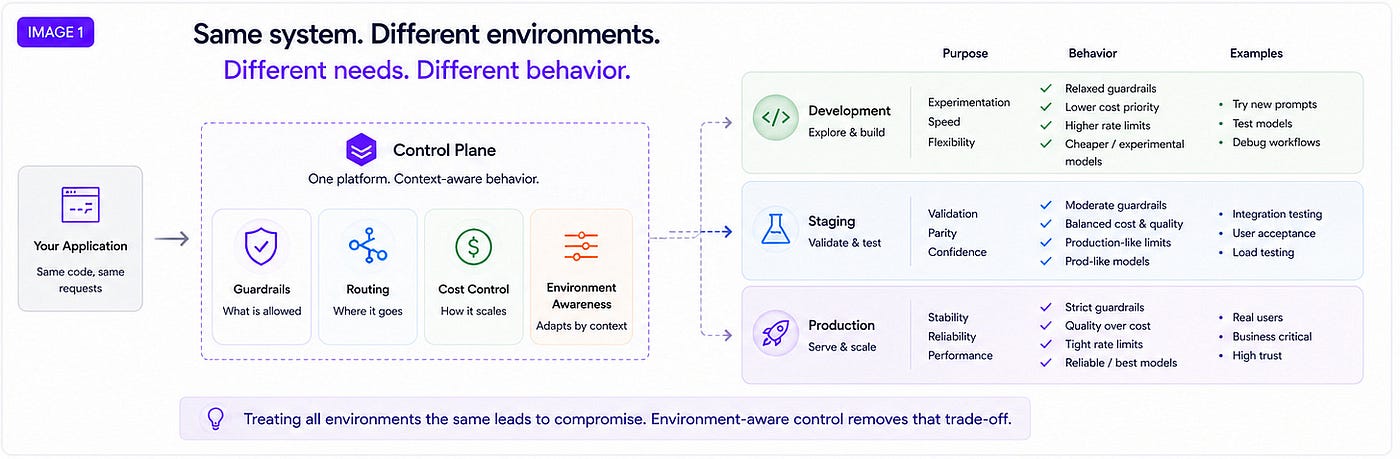
The solution is not to create entirely separate systems. It is to create a single system that can adapt its behaviour based on context.
Configs for Environments
Environment-aware control is about introducing that adaptability.
It allows the same underlying system to operate differently depending on where a request originates. Policies can be stricter in production, more relaxed in development, and selectively applied in staging. Routing decisions can favour lower-cost models during experimentation and higher-quality models in production. Rate limits, budgets, and guardrails can all be tuned to match the needs of each environment.
This approach preserves consistency while enabling flexibility.
In practice, this requires more than just configuration flags. It requires a structured way to define how behaviour changes across environments.
Policies need to be aware of context.
A request that is acceptable in development may not be acceptable in production. A model that is suitable for experimentation may not meet the reliability requirements of a live system. Cost thresholds that are reasonable during testing may be too high at scale.
These distinctions need to be encoded explicitly.

As systems grow, environment-aware control also becomes essential for collaboration.
Different teams often operate at different stages of the lifecycle. One team may be experimenting with new features, while another is maintaining a production system. Without clear boundaries, changes in one environment can unintentionally affect another.
By isolating behaviour through environment-specific policies, teams can move independently without introducing instability.
Progressive Delivery
There is also an important operational benefit.
Environment-aware systems make it easier to promote changes safely.
A feature can be tested in development, validated in staging, and then promoted to production with confidence that it will behave as expected. The transition is a controlled progression, with policies and constraints evolving along the way.
This reduces the need for manual intervention and lowers the risk of unexpected outcomes.
Conclusion
At this point, the system begins to feel cohesive.
Guardrails ensure that requests are safe. Routing ensures that they are handled correctly. Cost control ensures that they remain sustainable. Environment-aware control ensures that all of this behaves appropriately across contexts.
These layers reinforce each other.
A guardrail policy may vary by environment. Routing decisions may depend on cost constraints. Cost limits may be defined differently for staging and production.
The system becomes a set of interconnected controls rather than independent features.
This is where the idea of a control plane becomes concrete. As a unified layer that governs behaviour across the entire lifecycle of an AI system. Without this layer, teams rely on discipline and coordination.
With it, they rely on structure. And structure is what allows systems to scale.
Next …
There is one final piece that completes this picture. Even with all these controls in place, teams still need to understand what is happening inside the system.
At a high level, as well at the level of individual requests.
They need to see how decisions are made, how policies are applied, and how behaviour evolves over time. In the next article, we will explore observability and auditability — and why visibility is the foundation for trust in production AI systems.
메타데이터
- post_id
- dc5f01133c08
- slug
- from-prototype-to-production-environment-aware-control-part-5-dc5f01133c08
- url
- https://itnext.io/from-prototype-to-production-environment-aware-control-part-5-dc5f01133c08
- canonical_url
- https://itnext.io/from-prototype-to-production-environment-aware-control-part-5-dc5f01133c08
- author_url
- https://medium.com/@santoshpai
- status
- ok
- fetched_at
- 2026-06-09 15:37:30