Europe’s Primary Care Crisis Will Not Be Solved by More Doctors Alone
How AI and digital infrastructure are turning family medicine from a sequence of appointments into a continuous operating system for…
Europe’s Primary Care Crisis Will Not Be Solved by More Doctors Alone
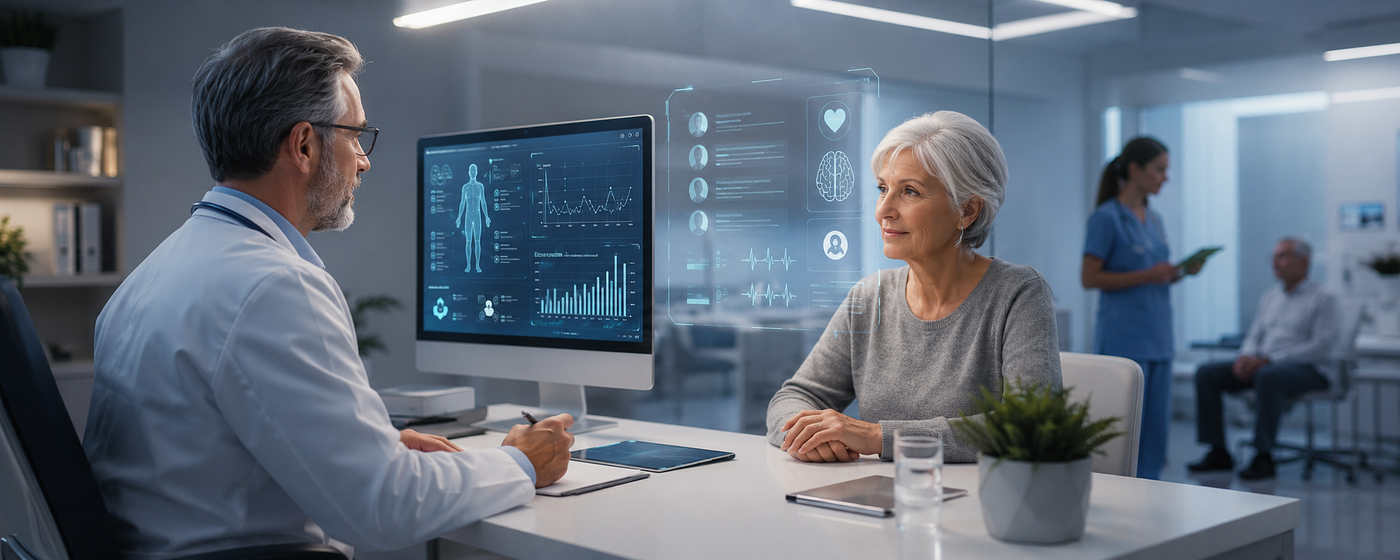
Ai in family medicine
How AI and digital infrastructure are turning family medicine from a sequence of appointments into a continuous operating system for population health
Europe’s primary care problem is usually described as a shortage of doctors.
That is true, but incomplete.
The deeper problem is that highly trained clinicians are working inside operating models designed for another era. They spend time searching for information, documenting visits, answering repetitive requests, coordinating referrals and following administrative rules that could increasingly be handled by software.
Meanwhile, patients experience healthcare as a collection of disconnected episodes: a family doctor consultation, a laboratory result, a specialist visit, a prescription and perhaps a hospital discharge. Each episode may work reasonably well on its own. The system connecting them often does not.
According to the OECD, general practitioners represent only around 20% of doctors across the European Union, while most countries report shortages and an uneven distribution of primary care professionals. WHO Europe estimates that the region could face a shortage of nearly one million health and care workers by 2030. These pressures will not be solved quickly through medical education alone. Training a doctor takes years, while demand is already increasing because of ageing populations and chronic disease.
Europe therefore needs more than additional doctors. It needs a different primary care operating model.
Artificial intelligence will be part of that model. But probably not in the way most people expect.
The first major impact of AI will not be replacing clinical judgement
The public conversation about medical AI remains overly focused on whether a model can diagnose a condition as accurately as a doctor.
That is an important research question. It is not yet the most valuable operational question.
The immediate opportunity lies in removing work that does not require a physician’s full clinical expertise:
- collecting and structuring information before the consultation;
- preparing a concise longitudinal patient summary;
- documenting the clinical conversation;
- processing routine patient requests;
- identifying overdue screening and follow-up;
- monitoring patients with chronic conditions;
- routing patients to the appropriate service;
- connecting family medicine with specialists, laboratories and imaging.
Evidence is beginning to support some of these uses. A 2025 ambulatory care study associated ambient AI scribes with 20.4% less time spent working on notes per appointment and 30% less after-hours documentation. Other studies have reported reduced administrative burden and burnout, although results vary and clinicians still need to review AI-generated records.
By contrast, the evidence for autonomous clinical decision-making remains less mature. A large 2026 cluster-randomised primary care trial found that a generative AI decision-support system did not significantly improve the primary clinical outcome, even though it could be deployed without an obvious deterioration in safety. This is a useful warning: plausible recommendations from an AI system do not automatically translate into better patient outcomes.
The winning model is therefore unlikely to be “AI doctor versus human doctor”.
It will be a clinical team in which AI collects, organises, checks and follows up, while trained professionals remain responsible for examination, uncertainty, judgement and accountability.
Primary care has four structural problems that technology can address
1. Access is poorly organised
Patients often do not know whether they need a family doctor, a specialist, a laboratory test or urgent care. The result is unnecessary telephone traffic, inappropriate appointments, delayed treatment and overcrowded emergency services.
A digital front door can collect the reason for contact, identify predefined warning signs, clarify eligibility and documents, and direct the patient to the right channel.
This does not require fully autonomous clinical triage. Many access problems are administrative and informational rather than diagnostic.
2. Doctors are surrounded by administrative work
Primary care consultations are short, but the work surrounding them is not.
A doctor may need to reconstruct the patient’s history, review several systems, document the visit, issue documents, check previous investigations and answer follow-up questions. Reducing this burden does not necessarily mean increasing the number of appointments indefinitely. It can mean giving the physician more attention for each patient and reducing work completed after clinic hours.
3. Care is fragmented
The family doctor may not receive the specialist’s report. The specialist may not see the complete medication list. An abnormal result may return without a clear owner. A hospital discharge can remain disconnected from community care.
Digitalisation creates value when it closes these loops, not merely when it replaces paper with a screen.
4. Primary care remains too reactive
Most practices are organised around the question:
Who has booked an appointment today?
A modern primary care system should also ask:
Which patients in our population need an intervention today, even if they have not requested one?
AI can analyse the registered population and identify people with overdue screening, uncontrolled chronic disease, abnormal results, medication risks or interrupted follow-up.
This is the transition from appointment management to population health management.
Four European models worth watching
Europe does not yet have one dominant model for AI-enabled primary care. Different operators are solving different parts of the problem.
Together, they show the direction of travel.
Germany: Avi Medical is building a digital operating system for the GP practice
Germany is one of the closest European markets to a scalable, privately operated but publicly reimbursed family medicine model.
Avi Medical combines physical GP practices with digital booking, electronic communication, video consultations, automated reminders and AI-assisted documentation.
What makes Avi strategically important is not any individual feature. It is the attempt to control the entire workflow around the consultation.
The company describes AI use across booking, documentation and follow-up. Its virtual assistant documents consultations in real time, while a significant share of patient requests — such as appointment changes, prescription requests or questions about results — is handled or routed automatically.
Avi reports more than 25 locations, over 100 doctors and hundreds of thousands of annual appointments. It also claims that its practices can manage more patients with less administrative effort than a conventional German GP practice. These are company-reported figures and require independent validation, but the operating model is still highly relevant.
The main lesson from Avi is simple:
Digitalisation should not be an additional layer placed on top of a traditional practice. It should redesign how the practice works.
A clinic using five disconnected digital tools may still be operationally analogue. A clinic with one integrated workflow can become genuinely digital.
France: ipso santé is connecting payment reform, teamwork and prevention
Ipso santé offers a different lesson.
Its urban family medicine practices combine extended opening hours, multidisciplinary teams, shared clinical records and a stronger focus on prevention. Some ipso practices participate in the Médecin Traitant Renforcé programme, developed with the French public health insurance system.
The programme moves part of physician remuneration away from individual consultations and toward fixed payments for the continuous management of registered patients.
That distinction matters.
If providers are paid only when a consultation takes place, technology may simply generate more consultations. If they are paid to keep a population healthier, technology can support prevention, monitoring and early intervention.
Ipso reports higher screening rates for major cancers, regular follow-up and lower average prescription-related costs within the programme. These are figures published by the organisation, but the model demonstrates something more fundamental: AI and digital tools become much more valuable when the financing system rewards continuity and outcomes.
The lesson from ipso is that primary care transformation requires three elements at the same time:
- technology;
- team-based delivery;
- payment incentives aligned with longitudinal care.
Software alone cannot create population health management if every professional remains organised and paid around isolated encounters.
Italy: Santagostino shows how to connect local care, specialists and diagnostics
Italy has fewer private networks built directly around publicly funded family doctors. For that reason, Santagostino is not a perfect primary care comparison.
It is nevertheless highly relevant.
Santagostino has built an accessible urban outpatient network combining specialist consultations, diagnostics, radiology, physiotherapy, mental health, dentistry and digital services.
Its use of AI is targeted rather than universal. Examples include AI-supported retinal image analysis and a digital dermatology tool that allows patients to monitor skin lesions. The company has also worked on sharing specialist reports with family doctors, addressing one of the most persistent failures of European outpatient care: the separation between primary care and specialist medicine.
Santagostino illustrates that digital primary care cannot stop at the family doctor’s door.
A family physician may identify the problem, but the patient still needs a functioning pathway through laboratory testing, imaging, specialist care, rehabilitation and follow-up.
The strategic asset is not simply the consultation. It is the ability to coordinate the complete outpatient journey.
Spain: Sanitas is demonstrating the integrated digital health ecosystem
Sanitas and its Blua digital health platform represent the most developed integrated model in this group.
Sanitas combines health insurance, medical centres, hospitals, digital consultations, prevention programmes, remote monitoring and AI-supported services.
Its digital ecosystem includes symptom orientation, video consultations, digital physiotherapy with AI-supported movement analysis, preventive programmes and tools that connect patients to physical or virtual care.
This is not directly comparable with publicly funded family medicine. Sanitas has an important structural advantage: as both payer and provider, it can capture some of the financial benefit generated by better prevention and coordination.
Nevertheless, it offers a glimpse of where primary care is heading.
The patient will not experience digital care and physical care as separate products. The same platform will collect information, recommend a channel, schedule the interaction, support the consultation and manage the next step.
Sanitas demonstrates the value of controlling the interface through which the patient enters and navigates the healthcare system.
Romania: Prevencia and the opportunity to build from a different starting point
Central and Eastern Europe should not simply copy Western European models.
The region has different reimbursement systems, lower digital maturity in parts of the public infrastructure, major differences between urban and rural access, and a highly fragmented relationship between family medicine and specialist care.
But it also has an opportunity.
Legacy systems are less deeply embedded in some areas, operating costs are lower and integrated outpatient networks can still be built around family medicine as the entry point.
At Prevencia, in Bucharest, we are working from this starting point.
The model combines family medicine with publicly reimbursed and private specialist services. The current role of iMona, Prevencia’s AI assistant, is deliberately limited: it helps patients understand available services, reimbursement rules, required documents and the appropriate next step. It does not diagnose or replace a doctor.
But the larger opportunity goes beyond a patient-facing chatbot.
The next stage is to connect the AI layer with:
- the longitudinal family medicine record;
- preventive care protocols;
- chronic disease registers;
- specialist referrals;
- laboratory and diagnostic results;
- appointment capacity;
- public reimbursement rules;
- multilingual patient communication;
- follow-up and unresolved clinical tasks.
This is especially relevant for patients who find the healthcare system difficult to navigate, including older people, patients with several chronic diseases and foreign workers unfamiliar with local administrative rules.
Prevencia is not yet the finished version of this model. It is an example of how an emerging regional operator can build primary care, outpatient services and AI infrastructure together rather than adding digital features after the network has already scaled.
Europe’s data infrastructure may finally make this possible
AI is only as useful as the information it can access.
A model cannot coordinate care if laboratory results, prescriptions, specialist letters and hospital discharges remain trapped in incompatible systems.
The European Health Data Space could therefore become more important than any individual AI product.
Under the current implementation timetable, EU countries should support cross-border exchange of patient summaries and electronic prescriptions by 2029. Laboratory results, medical images and hospital discharge reports should follow by 2031.
For primary care, this can create the foundation for a genuinely longitudinal record.
The family doctor would no longer depend entirely on what the patient remembers or carries on paper. AI could summarise changes, identify missing follow-up and detect contradictions across multiple sources.
The technology already has momentum. WHO Europe reported in April 2026 that 74% of EU countries were using AI-assisted diagnostics and 63% were using chatbots for patient engagement. But the same report warned that workforce training, governance and public trust are not developing at the same speed.
What AI cannot solve by itself
There is a risk that healthcare organisations will automate dysfunctional processes instead of redesigning them.
That would produce faster bureaucracy, not better care.
AI cannot by itself solve:
- inadequate reimbursement for prevention;
- poor allocation of responsibilities;
- insufficient nursing capacity;
- incompatible information systems;
- weak clinical governance;
- lack of trust between organisations;
- unequal access to digital tools;
- incorrect or incomplete source data.
It can also create new problems.
Over-sensitive systems can generate unnecessary referrals and investigations. Automated notes can introduce convincing errors into the medical record. Patients without digital skills can be excluded. Clinicians can become overly reliant on recommendations that appear more certain than the underlying evidence.
Every serious implementation therefore needs:
- defined clinical responsibility;
- human approval for material decisions;
- clear patient consent;
- version control and audit logs;
- ongoing safety evaluation;
- monitoring across languages and patient groups;
- a non-digital alternative for patients who need one.
The objective is not maximum automation. It is the appropriate allocation of work between patients, software, administrative teams, nurses and doctors.
The new primary care operating model
Across Avi Medical, ipso santé, Santagostino, Sanitas and emerging networks such as Prevencia, the same architecture is beginning to appear.
A digital front door
One place where the patient can explain the problem, understand the options and access the appropriate service.
A clinical operating system
A workflow connecting scheduling, preparation, documentation, prescriptions, results and follow-up.
A population health engine
A system that identifies patients requiring prevention, monitoring or intervention before they request an appointment.
A referral and diagnostics orchestrator
A mechanism ensuring that specialist care, laboratory results and imaging return to the clinician responsible for the patient.
A governance layer
Clear rules defining what AI may do automatically, what requires confirmation and what remains exclusively a human clinical decision.
The providers that build these layers into one system will have a major advantage over those that simply purchase a chatbot or an AI documentation tool.
Primary care is becoming the control tower of healthcare
The future of European medicine will not be entirely virtual.
Patients will still need physical examination, continuity, trust and a clinician capable of managing uncertainty. Technology cannot replace these functions. It can protect them by removing the work that distracts from them.
The strongest primary care networks will combine physical proximity with digital continuity.
They will know not only who is attending today, but which patients are at risk, which results remain unresolved and which preventive interventions are overdue.
They will not treat digital care as a separate channel. They will use it as the coordination layer across the entire patient journey.
Europe’s primary care crisis is real. AI will not manufacture doctors, repair payment systems or create trust on its own.
But used correctly, it can increase the effective capacity of existing teams, improve continuity and transform family medicine from a reactive appointment service into the operating system of a healthier population.
That is the real opportunity — and a far more important one than building an artificial doctor.
메타데이터
- post_id
- dc61c76c1330
- slug
- europes-primary-care-crisis-will-not-be-solved-by-more-doctors-alone-dc61c76c1330
- url
- https://medium.com/@cristian.sas/europes-primary-care-crisis-will-not-be-solved-by-more-doctors-alone-dc61c76c1330
- canonical_url
- https://medium.com/@cristian.sas/europes-primary-care-crisis-will-not-be-solved-by-more-doctors-alone-dc61c76c1330
- author_url
- https://medium.com/@cristian.sas
- status
- ok
- fetched_at
- 2026-07-13 06:23:13






