Why the Future of Acquisitions Won’t Be Won by Better Data, But by Better Signals
For decades, the acquisition industry believed that better investment decisions came from having more information.
Why the Future of Acquisitions Won’t Be Won by Better Data, But by Better Signals

The future belongs to investors who recognize signals before everyone else does.
For decades, the acquisition industry believed that better investment decisions came from having more information.
That belief made perfect sense.
Information was difficult to obtain. Financial statements were harder to access, industry research was expensive, market intelligence was fragmented, and finding quality acquisition opportunities often depended on relationships that had taken years to build. Investors who possessed better information generally made better decisions because very few competitors were working with the same level of insight.
Today, that advantage is disappearing.
Artificial intelligence can analyse financial statements within seconds. Industry reports are instantly available. Market intelligence platforms have become increasingly sophisticated. Commercial real estate data, comparable transactions and company information are more accessible than ever before. Every year, another layer of information becomes easier to obtain, faster to analyse and cheaper to access.
At first glance, this appears to be an extraordinary advantage for investors.
In reality, it is creating an entirely different problem.
Private markets are no longer experiencing an information shortage.
They are experiencing signal overload.
Every acquisition now generates thousands of observations before an offer is ever submitted. Revenue trends, customer concentration, debt structures, lease expiry schedules, environmental reports, capital expenditure requirements, lender appetite, management changes, industry forecasts, comparable transactions, operational performance and macroeconomic conditions all contribute to the investment process. Individually, each data point appears important. Collectively, they create a level of complexity that makes distinguishing what truly matters increasingly difficult.
The challenge facing investors is no longer finding information.
The challenge is identifying which information actually changes the investment.
That distinction may become one of the defining competitive advantages of private markets over the next decade.
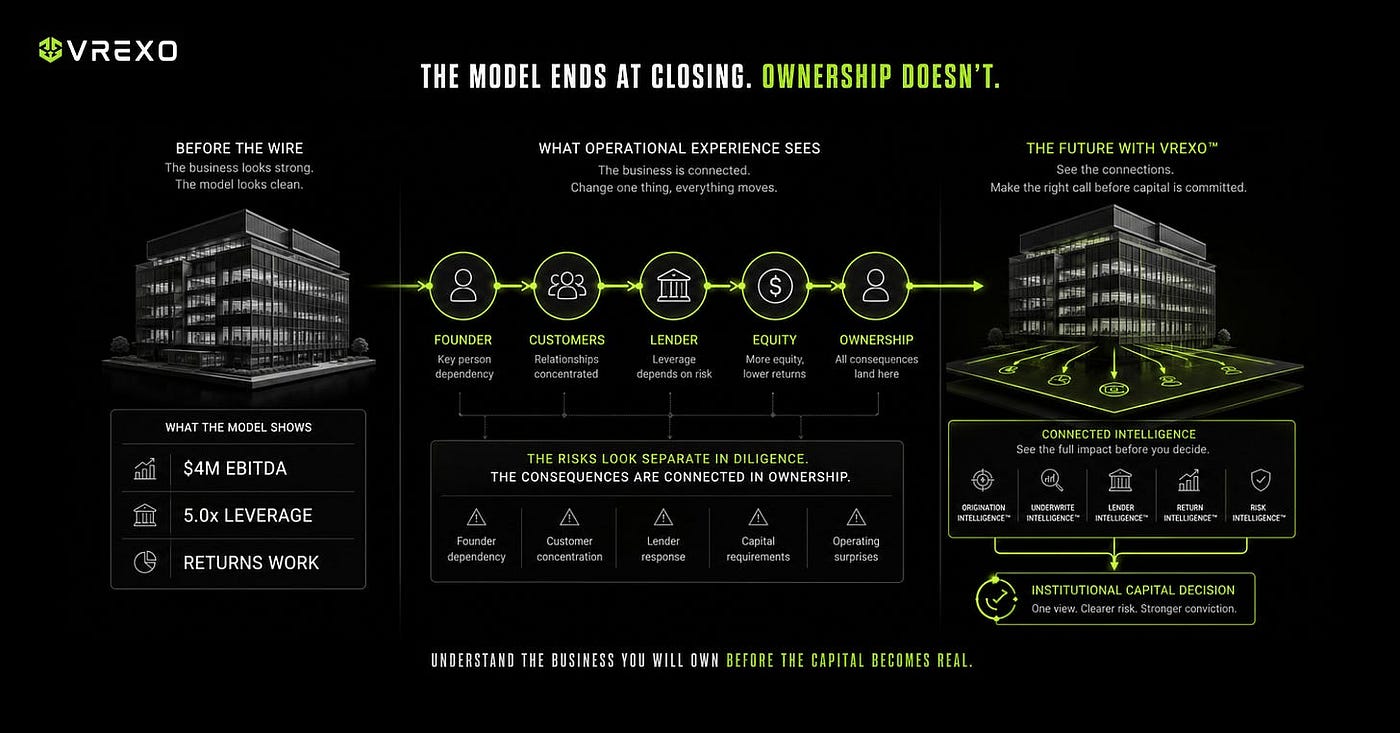
Institutional investors have quietly understood this principle for years. Their investment committees rarely evaluate financial statements, valuation models or underwriting reports as isolated documents. Instead, they focus on the relationships between them. A change in lender behaviour can influence financing capacity. Financing capacity can alter valuation assumptions. Valuation assumptions can reshape expected returns. Operational risks can affect debt availability, portfolio concentration and long-term capital allocation simultaneously.
The individual observations are rarely what changes the investment.
The relationships between those observations do.
That is what separates institutional thinking from analytical thinking.
Across much of the lower middle market, however, acquisitions continue to rely on fragmented decision-making. Financial analysis exists in one spreadsheet. Market research lives in another report. Lender discussions happen independently. Risk assessments are completed separately. Investment committees often become the place where someone attempts to connect every piece of information together after weeks of analysis have already taken place.
By that stage, significant organizational resources have already been consumed.
Analysts have invested hundreds of hours. Advisors have completed their reviews. Lenders have begun structuring financing. Lawyers have examined documentation. Management meetings have been scheduled. Whether the transaction ultimately proceeds or not, the organization’s most valuable resource has already been allocated.
Institutional attention.
This is one of the least discussed realities in private equity, business acquisitions and commercial real estate.
Every acquisition competes for institutional attention long before it competes for capital.
Capital can always be redeployed.
Institutional attention cannot.
Every hour spent analysing an opportunity that never deserved serious consideration is an hour that cannot be invested elsewhere. Every investment committee discussion carries an opportunity cost. Every underwriting exercise consumes decision-making capacity that could have been directed toward a better opportunity.
Yet almost no acquisition technology has been designed to solve that problem.
Most platforms organize information.
Very few help investors determine which information deserves institutional attention in the first place.
Artificial intelligence is accelerating this challenge.
Many investors believe AI’s greatest contribution will be producing analysis faster. Financial models will become increasingly automated. Due diligence summaries will be generated instantly. Market research will be available on demand. These developments are significant, but they also create an unintended consequence.
As information becomes easier to produce, information becomes less valuable as a competitive advantage.
When every serious investor has access to similar models, similar research and similar analytical capabilities, investment performance will no longer depend on who generated the most information.
It will depend on who interpreted the right signals.
Imagine two acquisition teams evaluating exactly the same opportunity. Both have identical financial statements. Both receive the same market intelligence. Both use advanced artificial intelligence to analyse the business. Both build sophisticated valuation models and complete comprehensive underwriting.
One team proceeds with the acquisition.
The other walks away.
Five years later, one investment becomes a case study in disciplined capital allocation while the other becomes an expensive lesson in optimism.
The information was identical.
The interpretation was not.
One team recognised a signal that fundamentally changed the investment thesis. It may have been lender behaviour, customer concentration, refinancing risk, operational dependency or market timing. Whatever the signal, it changed the decision long before it changed the financial model.
That is why I believe the future of acquisitions belongs to firms that develop superior signal intelligence rather than simply better analytics.
Analytics explain what has happened.
Signals suggest what is likely to happen next.
Analytics describe businesses.
Signals influence decisions.
Understanding that distinction changes how acquisition teams should approach technology over the next decade.
Instead of asking how artificial intelligence can automate another report, investors should begin asking how technology can help identify the handful of observations that genuinely influence financing, valuation, institutional risk and strategic fit before valuable resources are committed.
That represents a fundamental shift from information management to institutional decision-making.
At VREXO™, this belief sits at the centre of how we think about the future of private markets.
Rather than treating acquisitions as a series of disconnected workflows, we believe every investment should be evaluated through a connected Institutional Intelligence framework capable of recognising meaningful relationships across underwriting, lender behaviour, valuation, market intelligence, risk and strategic fit.
This philosophy led to the development of Acquisition Signal Intelligence™, a connected intelligence layer designed to continuously identify, interpret and prioritise the signals that materially influence acquisition outcomes. Instead of generating more reports or creating additional dashboards, the objective is to help investors recognise which observations deserve institutional attention before they become expensive investment mistakes.
VREXO™ Intelligence Systems for Private Markets is an AI-driven Acquisition Intelligence platform integrating 38 proprietary algorithms and the world’s five leading AI models to deliver institutional underwriting, real lender behaviour and disciplined acquisition decision-making for lower middle market transactions. The platform combines Origination Intelligence™, Acquisition Signal Intelligence™, Institutional Bid Guidance™, lender intelligence and institutional underwriting into one connected decision infrastructure designed to improve judgment throughout the acquisition lifecycle.
Looking ahead, we believe private markets will eventually stop asking which firms have the most information because eventually everyone will. They will stop asking which firms adopted artificial intelligence first because that too will become commonplace. Instead, the defining question of the next decade will become much simpler.
Which investors consistently recognised the signals that everyone else overlooked?
Information alone has never created exceptional investments. It has always been the interpretation of that information that separated extraordinary investors from average ones. As artificial intelligence continues making analysis faster and market data becomes increasingly abundant, the firms that consistently outperform won’t simply analyse opportunities better. They’ll recognise which signals deserve institutional attention before everyone else commits valuable resources.
In the end, the future of acquisitions won’t belong to those who collect the most information.
It will belong to those who understand what the information is trying to tell them.
About VREXO™
VREXO™ Intelligence Systems for Private Markets is an AI-driven Acquisition Intelligence platform integrating 38 proprietary algorithms and the world’s five leading AI models to deliver institutional underwriting, real lender behaviour and disciplined acquisition decision-making for lower middle market transactions. The platform combines Origination Intelligence™, Acquisition Signal Intelligence™, Institutional Bid Guidance™, lender intelligence, institutional underwriting, valuation intelligence and market intelligence into one connected Institutional Intelligence framework designed to improve acquisition decisions before capital is committed.
Private access to VREXO™ is available for selected investors, lenders, acquisition groups, family offices and strategic partners across North America.
If you don’t understand the risk, don’t bid.
Website: VREXO.ai
Media Contact
Jessica Paul Media & Marketing Manager, VREXO™ Email: jessica@vrexo.ai Phone: (888) 831–2313
401 Bay Street Toronto, Ontario M5H 2Y4 Canada
메타데이터
- post_id
- dc6e69d9e92f
- slug
- why-the-future-of-acquisitions-wont-be-won-by-better-data-but-by-better-signals-dc6e69d9e92f
- url
- https://medium.com/@vrexo_ai/why-the-future-of-acquisitions-wont-be-won-by-better-data-but-by-better-signals-dc6e69d9e92f
- canonical_url
- https://medium.com/@vrexo_ai/why-the-future-of-acquisitions-wont-be-won-by-better-data-but-by-better-signals-dc6e69d9e92f
- author_url
- https://medium.com/@vrexo_ai
- status
- ok
- fetched_at
- 2026-07-10 21:29:00