There’s a Currency in Your Wallet Rotting Right Now (And No, It’s Not Crypto)
A few got the version that lasts forever. You got the strawberries.
There’s a Currency in Your Wallet Rotting Right Now (And I’m Not Talking About Crypto)
A few got the version that lasts forever. You got the strawberries.
There’s a Currency in Your Wallet Rotting Right Now (And No, It’s Not Crypto)
There’s a gift card in a drawer in your house right now. You know the one. Someone gave it to you, forty dollars to a store you go to twice a decade, and it’s been sitting in that drawer turning into a coaster. Maybe the balance still works. Maybe a “monthly service fee” has been eating it since 2022.
Either way, that card is doing the one thing we all swear money can’t do: it’s expiring.
And you’ve got company: nearly half of US adults are sitting on one, a pile that adds up to about $23 billion in money that’s already been paid for and may never get spent.

Source: 43% of US citizens have at least one unused gift card
Now, hand a seven-year-old a lemonade stand and watch how fast they reinvent capitalism from scratch. Prices, IOUs, a two-for-one deal to clear inventory before bedtime, a loan from a little brother at a frankly predatory rate. Kids do this constantly, and the reason it’s funny is that they treat the rules of money as something you make up on the spot, which is the one thing adults have completely forgotten about money — and children have exactly right.
Because we did make it up.
Money is a story so old and so agreed-upon that it feels like a law of physics, but every piece of it was somebody’s weird idea once. Around 600 BCE a kingdom in what’s now Turkey stamped a lion onto lumps of gold and invented the coin. In 995, a merchant in Chengdu got tired of hauling iron and handed out paper notes instead, and paper money was born in a shop. Then Kublai Khan did the fully unhinged thing and printed money backed by nothing at all. It was money because he said it was money, and everyone went along with it. We still do. The bills in your wallet are worth something for exactly one reason: all of us have agreed, without ever saying so, not to be the person who stops believing first.
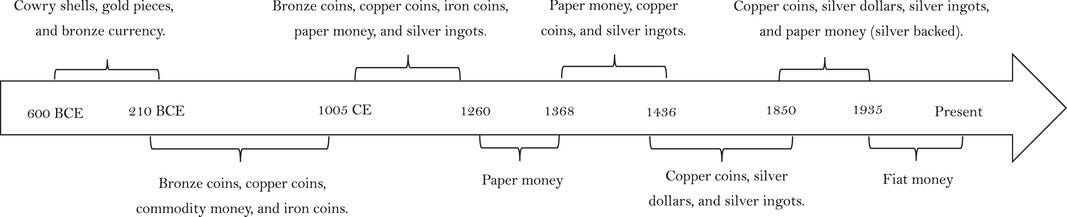
The evolution of currency formats from 600 BCE to the present (Source: The rise and fall of paper money in Yuan China, 1260–1368)
Once you see that money is a made-up thing, the obvious question is the one nobody with a suit or a start-up or a rocket launcher wants you asking. If we invented all of it, who decided the rules should work the way they do now? Who decided that money should be the one thing you own that (most of the time) gets better the longer you refuse to use it?
Because that’s the strange property. A newspaper is worthless by Tuesday. A loaf of bread, a fish, a bag of spinach, every real thing decays if you sit on it, which is nature’s gentle way of telling you to use the thing or pass it along. Money is the one exception. Money you can pile up and sit on, and it doesn’t rot. A dollar is a dollar is a dollar. That’s the whole appeal that separates money from a basket of strawberries, which starts plotting its own decay the second you carry it out of the store.
Except the gift card in the drawer knows better. And so, it turns out, did a wild-eyed, vegetarian, free-love-preaching German businessman who died broke and mostly forgotten in 1930, and was right about something almost everyone still gets backwards. His name was Silvio Gesell, and his big idea sounds, on first contact, completely deranged: money should rot, on purpose, by design — just like the strawberries in your fridge.
The man who wanted money to rot
Why is it good that money lasts forever? Go ahead.
The obvious answer is: because it lets you save. A currency that melted in your hands would be a nightmare to live on. Fair. Fair. But notice what you did just now. You defended the durability of money by imagining yourself as a saver, someone with a pile to protect.
Now imagine yourself as ‘the other guy’: you’re the one selling something that can’t wait. You grow those strawberries. You haul them to market on a week when everyone’s broke and prices are sliding, and a shopper looks at your price and says, out loud, “I’ll come back next week when it’s cheaper.” For them, waiting is smart. For you, it’s brutal. Strawberries don’t get a next week. By then, they are already rooting in the basket.
Silvio Gesell watched an economy die of hoarding, up close, and it happened here, more or less in my backyard. In the 1890s, he was running an import business in Buenos Aires when Argentina defaulted on £48 million of sovereign debt and the economy fell off a cliff. He watched prices drop and watched people respond by sitting on their cash and waiting for prices to drop even more. There was plenty of money in Argentina. It just wouldn’t move. The second people got scared, they clamped down on every peso, and money withdrew exactly when the country needed it out in the open. There was plenty of money in Argentina. It just wouldn’t move.
And it’s the guy with the strawberries who eats the loss every time. Because the money can wait and the strawberries can’t, the person holding money has a kind of power the person holding goods never has: the power to do nothing. To hold out. To let the other guy sweat until he eventually has to drop the price.
Gesell’s diagnosis, in one line, was that money’s greatest feature (its ability to sit in a drawer and not rot) is also a weapon pointed at everyone whose stuff does rot. Which is most of us, because our labor is the most perishable thing there is. You cannot save Tuesday. If nobody buys your Tuesday, it’s gone.
*The French anarchist Pierre-Joseph Proudhon had already put it best: *Money isn’t the key that opens the market. It’s the bolt that bars the door.
So Gesell proposed the fix that got him laughed out of respectable economics for a century: make the money rot too. His version was a bill called Freigeld, “free money,” with fifty-two little boxes on the back. Every week, to keep your hundred-dollar bill worth a hundred dollars, you had to buy a ten-cent stamp and stick it in a box. Miss your stamps and your money shrank. Over a year the bill lost about five percent of its value, and that five percent went to the state instead of the taxman. Suddenly, cash was a hot potato, and nobody wanted to be holding it when the music stopped, so everybody spent, or lent, or invested — fast.
Where interest pays you to keep money still, Gesell’s stamp charged you for it.
The ski town that pulled it off
When the US government mailed out pandemic relief checks to get money moving, researchers tracked who did what with the money. The lowest-income households, the ones with an average bank balance of about $141, spent nearly a third within 10 days, mostly on food and basics. They didn’t need a stamp on the back of the bill to make them spend it fast. They needed it, and it was gone.
Meanwhile, the households with a cushion mostly saved it or paid down debt, which is why the checks did less to jump-start the economy than anyone hoped — because what’s smart for each careful saver (holding on and waiting) becomes a disaster when everyone does it at once, and the spending just stops.

Each panel in the figure reports the distribution for the share of stimulus payment used for saving, paying off debts, and consumer spending (Source: How Did U.S. Consumers Use Their Stimulus Payments?)
A former vice president of the St. Louis Fed looked at that and floated something that would’ve gotten a heretic burned a century ago: what if the relief checks came with an expiration date, so you had to spend them before they evaporated? He called them hot money credits, but it was Gesell’s stamps.
You already know, somewhere, that this can work, because you’ve watched a small closed economy run on hot-potato money and didn’t even flinch. Ever bought chips at a casino? The house hands you a currency that feels absurd to hold onto, a currency whose entire design is to keep moving. Ever been to a festival with those wristband credits that die when you go home? We invent expiring money constantly, whenever we really want people to spend. We just never let ourselves imagine it could run a town.
Except it did. Once. Beautifully.
In 1932, the Austrian town of Wörgl was dying the way everywhere was dying from the Depression: a third of the workforce idle, the mill shut, the money all hiding under mattresses. So the mayor, a railway man with a socialist streak who’d read Gesell and nothing left to lose, printed his own currency: “work certificates” that lost 1% of their value every month unless you stuck a stamp on the back. He paid townspeople in it to fix the roads, lay pipe, and pour a bridge.
The money took off like it was on fire.
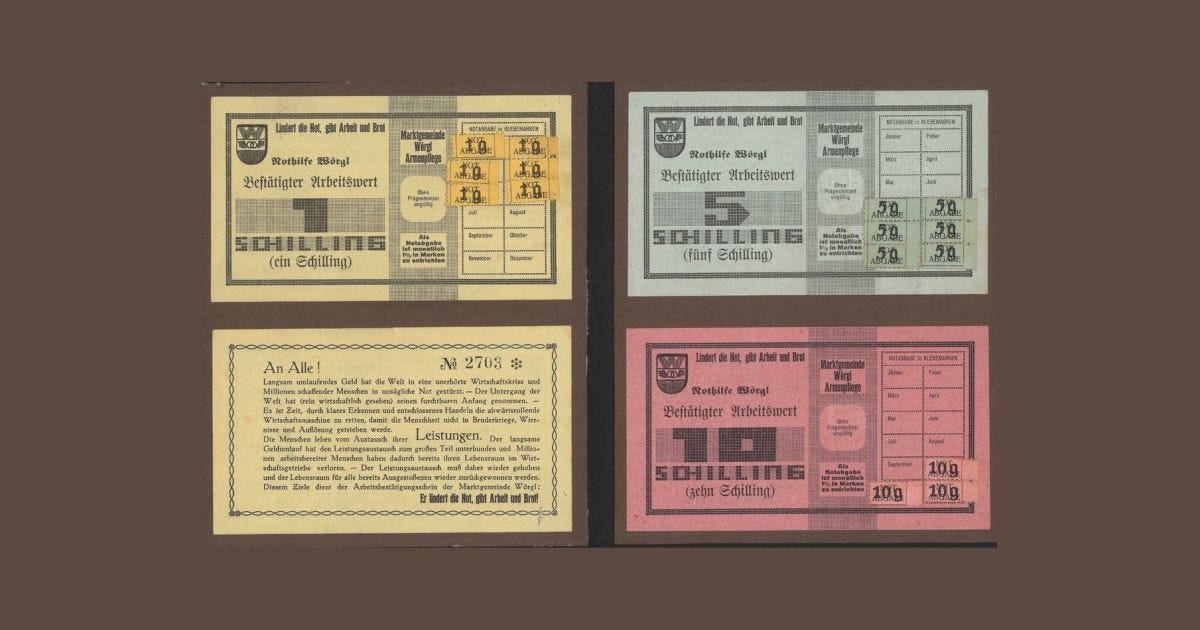
The Wörgl work value confirmations worth 1, 5 and 10 shillings — the Wörgl free money (Source: The Free Economy Experiment of Wörgl)
Nobody wanted to be caught holding a bill when the stamp came due, so everyone spent fast, and the merchant who took your certificate spent it that same afternoon. People paid their taxes early, in advance, just to get the stuff out of their hands. In one year, the Wörgl scrip changed hands roughly fourteen times faster than the ordinary Austrian schilling. While unemployment climbed everywhere else in the country, Wörgl’s fell. The town that had been dying was, briefly, humming.
Word spread. Other towns wanted in. Two hundred Austrian mayors lined up to copy it, France took interest, newspapers called it the Miracle of Wörgl. That popularity is exactly what killed it. A little town printing money that outperformed the national currency was an unbearable embarrassment to the central bank, which saw its monopoly slipping, panicked, and got the whole thing banned in 1933. The stamps came off and unemployment returned.
I promised I wouldn’t sell you a miracle, so let me poke the hole myself
Plenty of economists look at Wörgl and argue that the stamp was never the hero. The mayor didn’t just print funny money; he also spent it into a completely dead local economy. A bucket of fresh spending will juice a depressed town whether the money expires or not. So how much of the miracle was the magic expiring money, and how much was just a broke town finally spending again? Nobody fully knows.
Wörgl is a single data point from a town of four thousand people ninety years ago, and if I told you it settles the question, you should walk away. It doesn’t. It only proves the thing can run, not that the stamp was the engine.
[embed]
Money already expires — or it doesn’t at all
So your gut reaction to a five percent annual bleed on your cash is probably outrage. Now, a quick question: when’s the last time you had exactly zero dollars? Not “felt broke.” Zero. Nothing in checking, nothing in savings, payday four days out, an empty fridge and a tank of gas that has to make it. If you can’t remember, you’re on the winning side of what I’m about to describe, and it’s hard to see from up there (and I’m up there with you now, but I’ve been down, too).
But try with me: think about the person working two jobs and yet arriving at the last week of each month with exactly zero dollars left. Their money expires constantly.
It expires as rent, which is a stamp you pay every single month just for the right to keep existing indoors. It expires as the overdraft fee, the payday loan at 400%, the “convenience” surcharge, the deposit you’ll never see again. It expires as inflation, which eats hardest at the people who can’t stockpile, because you cannot buy eleven months of rent in advance to beat the price, but a hedge fund can absolutely buy the building.
Being broke is a set of penalties for failing to move money you never got to hold in the first place. And it is exactly as living under Gesell’s stamp. We even hand out expiring money on purpose: food benefits that vanish at month’s end, gift cards that decay, the airline miles that evaporate if you don’t fly.
When was the last time a rich person’s actual wealth came with a use-it-or-lose-it clock?
A billionaire’s money is the potato that never rots. It sits in an index fund and grows in its sleep, or in real estate, or in a painting in a climate-controlled vault in a free port, compounding in the dark while its owner does nothing but exist. In 2025, the world’s billionaires got 81 percent richer than they were in 2020, their combined stack hitting $18.3 trillion (!). That’s our money system’s true miracle: the twelve richest people now hold more than the poorest four billion humans combined and holding still is the single most profitable thing they can do — precisely what Gesell hated. The people at the top designed money that never expires at all.
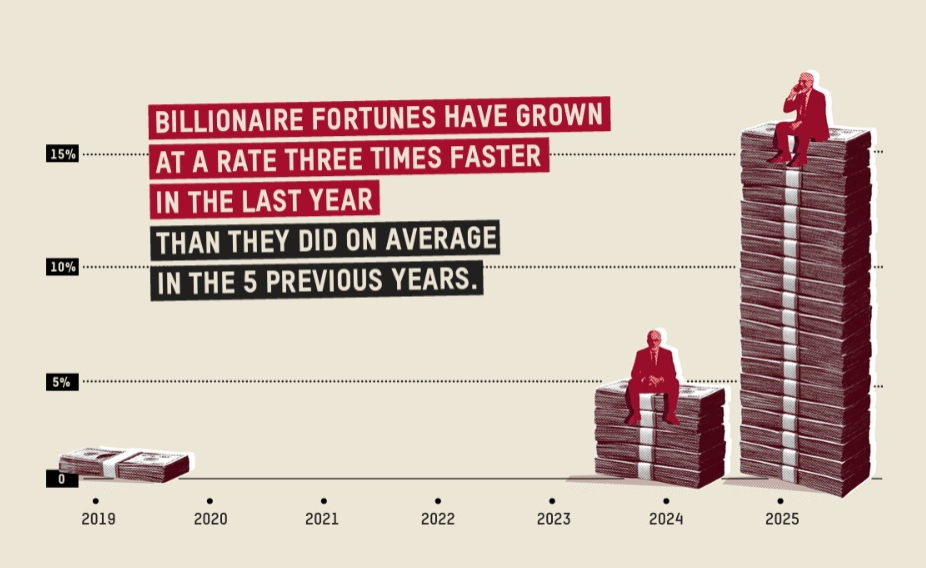
(Source: Oxfam)
So, yes: you’re already paying interest on your money.
You have been your whole life. It’s called inflation, and in most years it chews through your money at a rate that would make Gesell’s stamp look gentle. The dollar you had in 2020 buys you about seventy-nine cents of stuff today. Nobody handed you a bill for that missing twenty-one cents. It evaporated, the way the gift card evaporated.
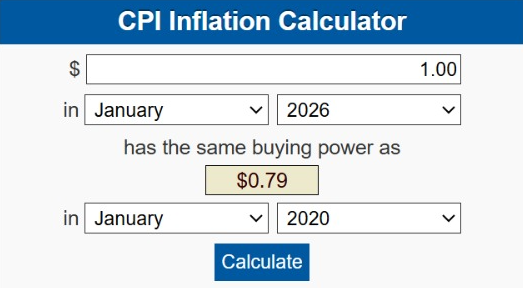
A dollar you had in 2020 buys you about seventy-nine cents of stuff today (Source)
Every kind of money charges you a fee for holding it. Gold gets stolen or costs a fortune to guard. Cash gets inflated away. Even the money in your savings account, “earning interest,” is usually losing the footrace with prices. There is no such thing as money that just sits there, safe and still and free. You are always paying rent on it.
The only question any money system ever answers, the only one, is who gets charged for the privilege of holding money, and who gets to hold it for free.
The costume of a law
I don’t think Gesell’s real gift to us was the stamp.
Expiring money, aimed straight, still bites the wrong people first. Force a family with a lot of savings that their money will evaporate unless they spend it, and they shrug and spend it on gold, buy boats, buy another apartment they’ll never sleep in, park the value somewhere the stamp can’t reach, no harm done. Tell a family with nothing that their money now comes with a fee for holding it, and you’ve just taxed the one buffer standing between them and famine. Make dollars rot and the people with real money just stop using dollars. The potato-proofing is a luxury good.
But the stamp was almost a distraction, sticky enough to get his foot in the door of your attention, which is exactly what it just did.
Gesell looked at money, the most fixed and sacred and untouchable thing in modern life, the thing that feels like gravity, and left us the question: Why is money like this and not some other way?
None of this is physics. All of it is a decision wearing the costume of a law of nature.
Why do we treat the money we happened to be born into as though it fell from the sky fully formed, obviously and permanently correct, when it is in fact the most made-up thing we own?
When your paycheck loses its footrace with the rent, when the twenty in your wallet buys less every single year, who’s collecting the fee you didn’t know you were paying?
And if money that sits still and grows forever is the good kind, the kind worth defending, the kind we built the whole system to protect, then why is it always the people who need it least who get to hold the good kind, and the people who need it most who are stuck holding a basket of rotten strawberries?
I help curious minds who need a relatable pen put their sharpest ideas into words: stories, perspectives, and insights that actually get read. Reach out!
***If you want to support my work, here is the place to do so.* If not, thanks for reading anyway!
메타데이터
- post_id
- dc766d75c872
- slug
- theres-a-currency-in-your-wallet-rotting-right-now-and-no-it-s-not-crypto-dc766d75c872
- url
- https://medium.com/southern-winds/theres-a-currency-in-your-wallet-rotting-right-now-and-no-it-s-not-crypto-dc766d75c872
- canonical_url
- https://medium.com/southern-winds/theres-a-currency-in-your-wallet-rotting-right-now-and-no-it-s-not-crypto-dc766d75c872
- author_url
- https://medium.com/@rickylanusse
- status
- ok
- fetched_at
- 2026-07-09 00:50:33