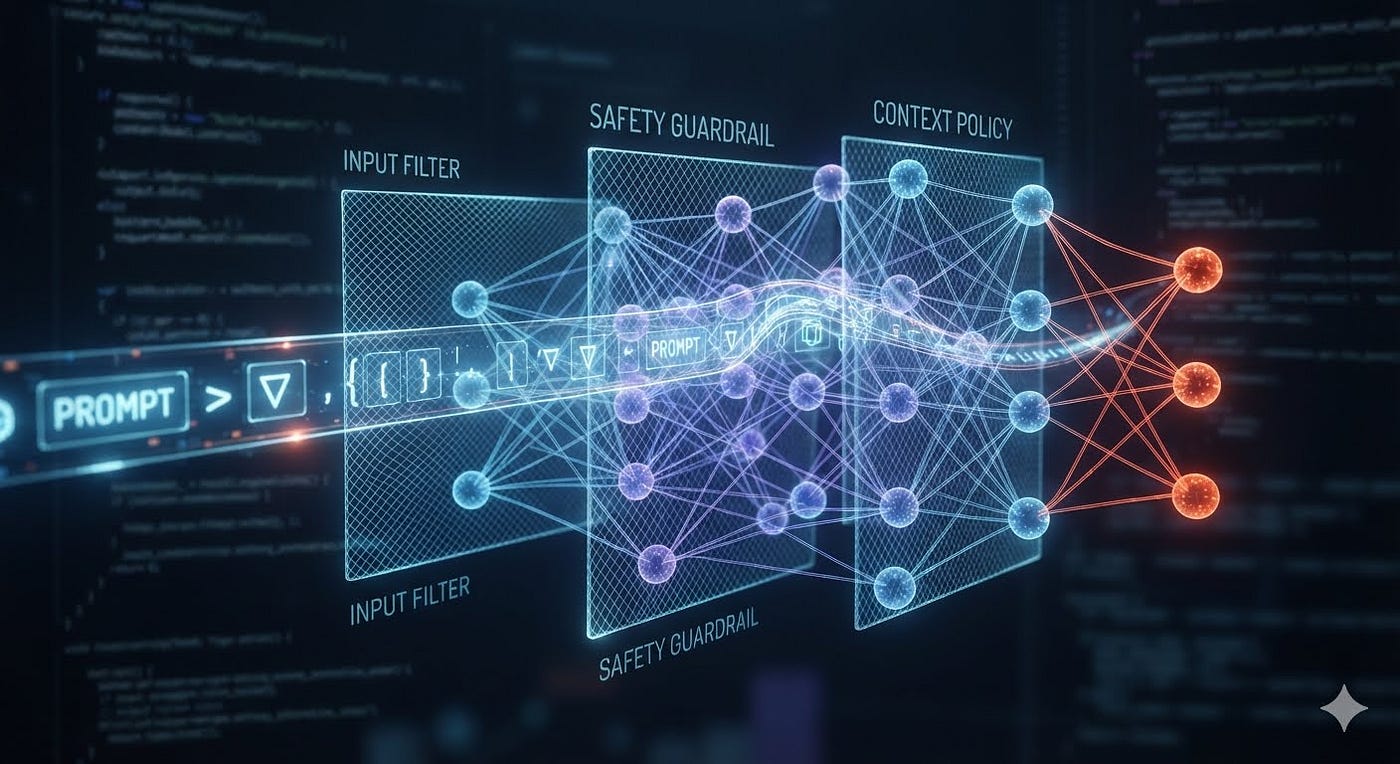
Can We Actually Interpret What a Language Model Is “Thinking”? A Tour of NLP Interpretability
We can measure what a model outputs. We still can’t reliably explain why. That gap might be the most consequential unsolved problem in AI…
Can We Actually Interpret What a Language Model Is “Thinking”? A Tour of NLP Interpretability
We can measure what a model outputs. We still can’t reliably explain why. That gap might be the most consequential unsolved problem in AI safety.
Ask a large language model why it refused a request, or why it gave a specific answer, and it will happily generate an explanation. But that explanation is not a window into its actual math. It is just more generated text. The model is not reporting on its own inner workings. It is guessing what a plausible answer should sound like.
This is the core problem: we cannot verify what actually happens inside a model between input and output. We do not know what happens mechanically in the network weights.
This gap is among the most critical challenges in NLP safety, since methods like RLHF, constitutional AI, and guardrail classifiers only shape model behavior. They do not confirm why the behavior changed. You can train a model to stop saying something without knowing. But you do not know if you removed the capability or if the model just learned to hide it.
What “Interpretability” Actually Means Here
In NLP safety research, “interpretability” splits into two distinct traditions:
- Behavioral interpretability: This looks at input and output relationships. It tracks how outputs change when you alter the prompt. It tells you what the model does, not how.
- Mechanistic interpretability: This tries to reverse-engineer the actual math inside the network. It identifies specific circuits and patterns responsible for behaviors.
This article focuses on mechanistic interpretability. It claims we can open the black box.
Modern LLMs use the transformer architecture. This is a stack of layers operating on a residual stream. Think of the residual stream as a running notepad. Each layer reads from it and writes back to it. Mechanistic interpretability studies this notepad.
Three techniques dominate current practice:
- Attention visualization: inspecting attention weight patterns to see where a model “looks” when producing an output.
- Probing classifiers: training a small auxiliary classifier on a model’s internal activations to check if specific facts or concepts are hidden inside the model layers.
- Sparse autoencoders (SAEs): unsupervised models trained to decompose a layer’s dense activation vector into a much larger set of sparse, individually meaningful features, addressing a specific technical obstacle called superposition
Real-World Benchmarks and Case Studies
Interpretability research has moved from theory to real results over the past three years. A few concrete results anchor the field:
- Induction heads. Anthropic identified induction heads, a specific attention pattern responsible for in-context learning ability in transformers. This mechanism lets a model complete a repeated pattern (
A B ... A →predictB). - Scaling Monosemanticity (Anthropic, Claude 3 Sonnet). Researchers trained SAEs on a production-scale model’s activations, successfully extracting millions of interpretable features. These included highly specific concepts like a “Golden Gate Bridge” feature, a sycophancy tracker, and features associated with deception. Remarkably, turning up these features measurably changed the model’s behavior exactly as predicted.
- Gemma Scope: Google DeepMind released open-source toolkits across the Gemma model family. This allows independent global researchers to test interpretability claims without relying solely on corporate labs.
- The negative result: DeepMind’s interpretability team found that SAEs failed to improve performance on downstream safety tasks, leading them to deprioritize the technique. This indicates that the technique does not yet meet the required scale for real-world production.
Underlying Mechanisms: Why This Is Hard
Interpretability is hard because of how neural networks handle data.
- Superposition: Neural networks compress more concepts than they have neurons by encoding ideas as overlapping directions in activation space. Consequently, a single neuron might fire for completely unrelated concepts such as academic citations and distinct visual patterns. This means you cannot reliably read intent from a single neuron’s activation
- Distributed, non-local computation: Transformer math is not like human code. Transformer behaviors do not sit in a single “module” or line of code. Instead, actions like refusing a harmful request emerge from the small, distributed contributions of dozens of attention heads and MLP layers across the residual stream. This makes interpreting AI fundamentally different from classical software debugging.
Correlation vs. Causation
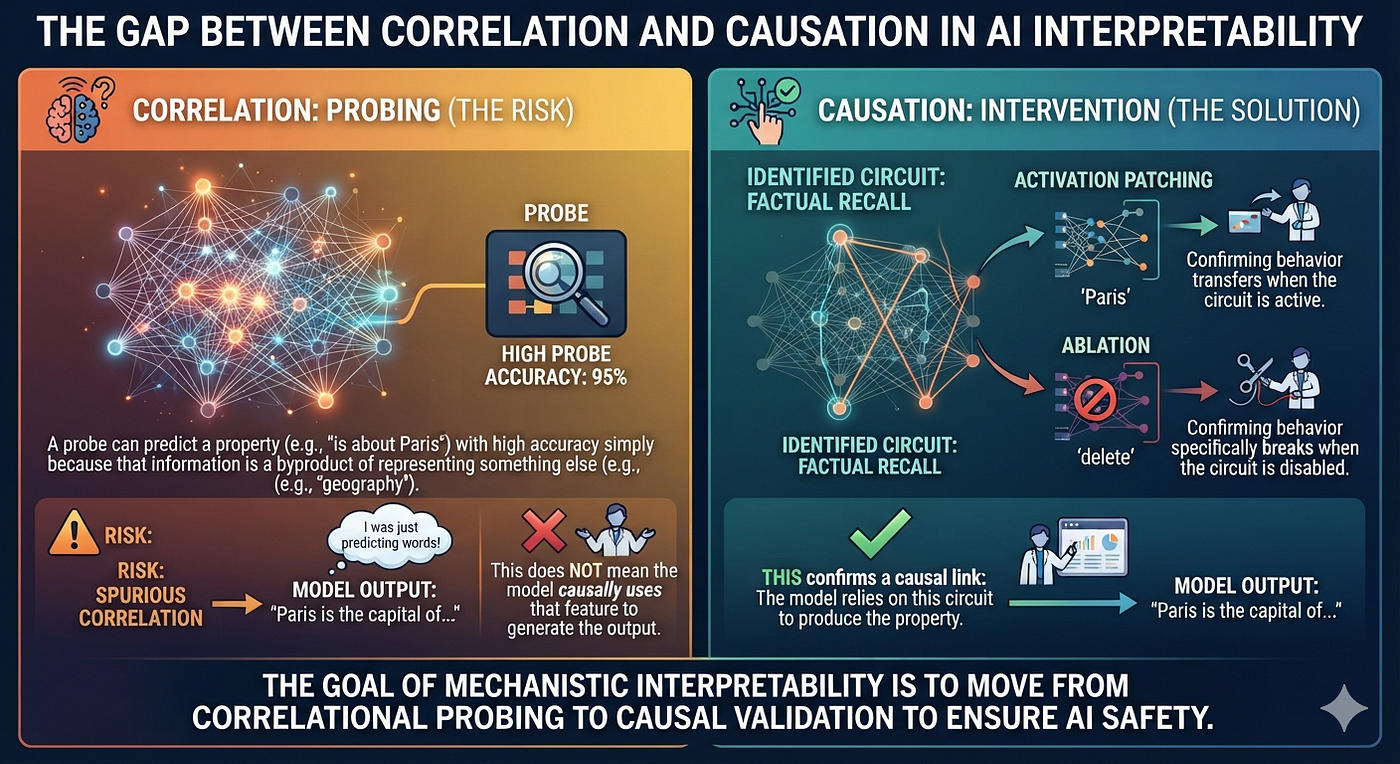
Probing classifiers are highly vulnerable to a subtle flaw: a probe can achieve near-perfect accuracy predicting a property from internal activations without the model actually using that property to make decisions. The data might just be a passive byproduct. Because high accuracy doesn’t prove usage, the field increasingly demands causal validation by using active interventions like activation patching or ablation to confirm behavior shifts exactly as predicted.
Mitigation Strategies: What’s Actually Being Done
Researchers are building active tools to test and fix these flaws:
- Circuit-level reverse engineering: Scientists identify the exact pathways (circuits) responsible for a behavior. They validate this by deleting a circuit to confirm the behavior breaks, or copying it into another run to see if the behavior transfers.
- Sparse autoencoders for feature discovery: Advanced variants like Matryoshka SAEs and BatchTopK SAEs aim to fix known engineering flaws in earlier designs, specifically feature splitting and feature absorption. These flaws occur when a single true underlying concept fragments across multiple redundant features, undermining the clean, one-feature-one-concept goal.
- Feature Steering: Once a causally validated feature is identified, researchers can directly manipulate model behavior by amplifying or suppressing that feature’s activation at inference time. This is a much more surgical intervention than prompt engineering or full fine-tuning. It targets a specific internal representation directly rather than reshaping the entire output distribution from the outside.
- Reward Model Interpretability: Because RLHF and RLAIF shape AI behavior indirectly through learned reward models, recent work applies SAEs and probing directly to these reward models. This allows researchers to check whether the reward signal tracks the intended safety properties or is just a spurious correlate. Common examples of these bad shortcuts include rewarding excessive response length or superficial politeness markers.
- Chain-of-Thought Monitoring: Some safety systems monitor an AI’s visible reasoning trace for concerning content. However, this is a weak guarantee and not a substitute for mechanistic interpretability. Stated reasoning is generated text rather than a verified readout of internal computations, meaning the model’s actual logic and its output can easily diverge.
Current State: Where the Field Stands
The honest consensus is a split verdict:
- Narrow claims are on solid ground: Finding specific circuits and facts is real, reproducible science. We have open benchmarks and shared model suites like Gemma Scope and LlamaScope.
- General safety guarantees are unresolved: The field cannot yet reliably catch deceptive behavior in massive models before deployment. Explaining a flaw after it happens is much easier than stopping it in advance.
- The field is actively self-correcting: Researchers are openly admitting that early interpretability results were often overconfident.
The ultimate open question is whether interpretability can scale fast enough to keep pace with AI growth. Today’s safety techniques shape AI behavior without confirming the underlying mechanism. Closing that gap is the difference between knowing a model is truly safe and simply hoping it behaves during testing.
This article reflects the published research record as of mid-2026 and is intended for a technical but non-specialist audience.
This article reflects the published research record as of mid-2026 and is intended for a technical but non-specialist audience. Terms are defined inline rather than assumed.
메타데이터
- post_id
- dc9adce6cb45
- slug
- can-we-actually-interpret-what-a-language-model-is-thinking-a-tour-of-nlp-interpretability-dc9adce6cb45
- url
- https://medium.com/@maryam_azam/can-we-actually-interpret-what-a-language-model-is-thinking-a-tour-of-nlp-interpretability-dc9adce6cb45
- canonical_url
- https://medium.com/@maryam_azam/can-we-actually-interpret-what-a-language-model-is-thinking-a-tour-of-nlp-interpretability-dc9adce6cb45
- author_url
- https://medium.com/@maryam_azam
- status
- ok
- fetched_at
- 2026-07-10 11:40:45