🚀 From Hadoop to Spark 3.5: Why Azure Databricks Is the Modern Big Data Standard
Big data processing did not begin with distributed systems. In the early stages, organizations relied on a single powerful supercomputer…
🚀 From Hadoop to Spark 3.5: Why Azure Databricks Is the Modern Big Data Standard
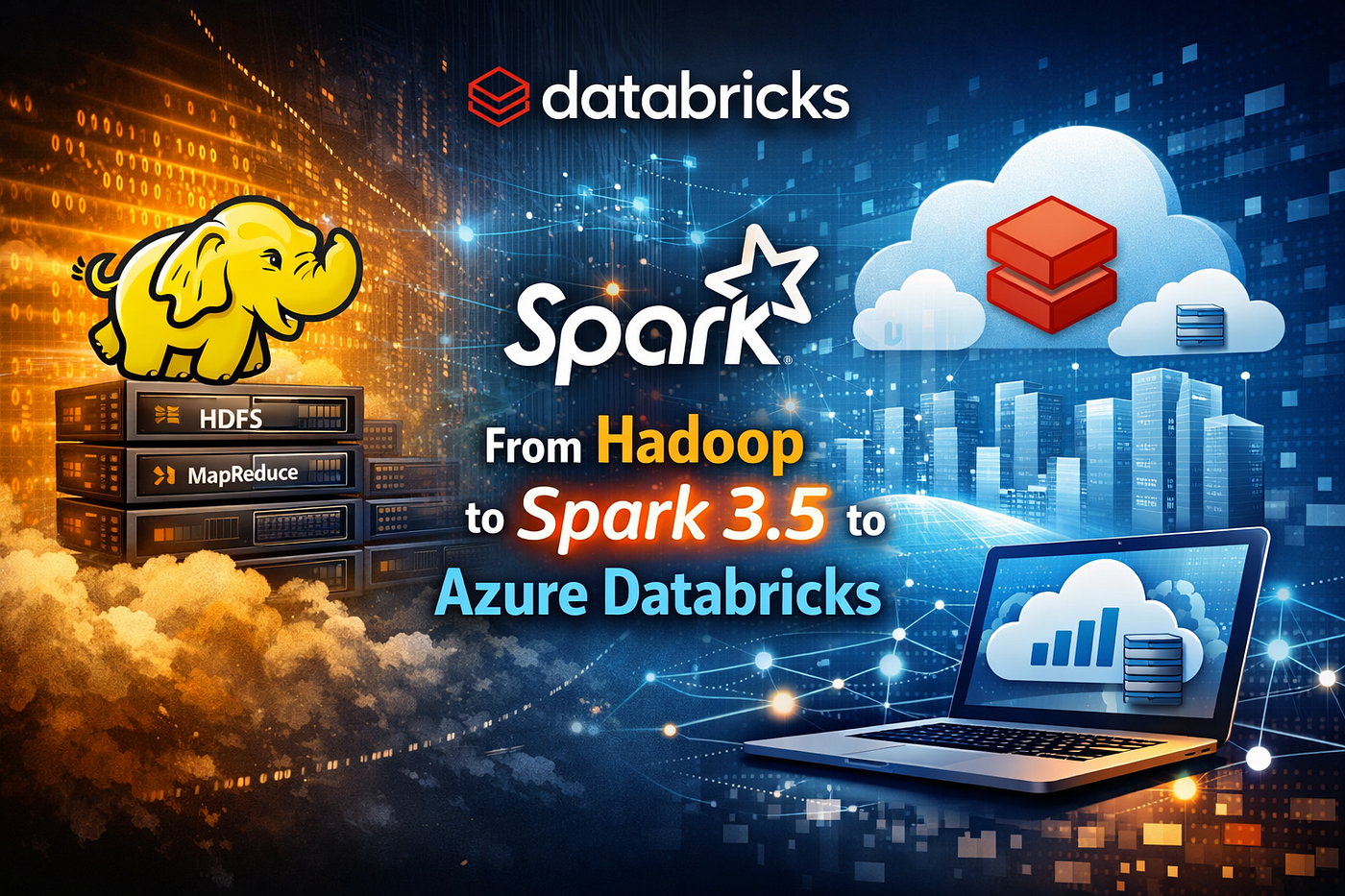
Big data processing did not begin with distributed systems. In the early stages, organizations relied on a single powerful supercomputer that handled both storage and compute. This model followed vertical scaling, where hardware resources were added to one machine as demand increased. However, vertical scaling had clear limitations. A single system cannot scale indefinitely, and tightly coupling storage with compute created performance bottlenecks.
To solve this problem, distributed computing was introduced. Instead of relying on one large system, multiple computers began working together in parallel. This approach uses horizontal scaling, where new machines are added to handle growing workloads. A group of machines working together is called a cluster, and the system responsible for coordinating them is known as a cluster manager. This shift formed the foundation of modern big data architecture.
Hadoop: The First Distributed Breakthrough
Apache Hadoop was one of the first major distributed platforms. It introduced HDFS (Hadoop Distributed File System) for storage and MapReduce for distributed processing.
Hadoop significantly improved large-scale data handling compared to a single-machine setup. However, MapReduce had operational limitations. Every processing step required reading data from disk and writing it back to disk. This repeated disk input and output reduced overall performance. Developers also had to manually implement map and reduce functions, which increased complexity and required specialized skills.
These limitations created the need for a faster and more flexible processing framework.
Apache Spark 3.5: In-Memory Distributed Processing
Apache Spark introduced in-memory processing, which changed how large-scale data workloads are executed. Instead of repeatedly accessing disk storage, Spark processes data in RAM. This reduces disk I/O and significantly improves performance.
Spark separates storage from compute. It can read data from HDFS, cloud storage, or traditional databases, while processing happens in memory. Spark supports multiple programming languages, including Java, Python, SQL, and R. It scales horizontally by adding compute nodes when required.
Spark replaced MapReduce as the preferred distributed processing model, while still integrating with Hadoop-based storage systems. It remains a processing engine and does not provide storage.
The Spark Ecosystem
Spark includes multiple components that support different workloads:
- Spark Core manages scheduling, memory management, and fault tolerance.
- RDDs (Resilient Distributed Datasets) were the original distributed abstraction.
- DataFrames and Datasets provide higher-level APIs with better optimization.
- Spark SQL enables structured data processing.
- Spark Streaming supports real-time workloads.
- MLlib supports machine learning tasks.
- Graph processing enables graph-based analytics.
Spark works with cluster managers such as YARN, Mesos, Standalone, and Kubernetes. It remains strictly a distributed data processing framework.
Azure Databricks: Managed Spark at Scale
Databricks was created by the founders of Spark to deliver a managed cloud platform built on Spark.
Azure Databricks integrates Spark directly into the Azure ecosystem. It simplifies cluster management, runtime optimization, and collaborative development.
In an Azure architecture, Spark handles distributed processing, while Azure Data Lake Gen2 provides storage. This separation of storage and compute aligns with modern data platform design and enables scalable analytics solutions.
Important Notes
- Big data evolved from vertical scaling to horizontal scaling.
- Distributed computing separates storage from compute.
- Hadoop introduced HDFS for storage and MapReduce for processing.
- MapReduce relied heavily on disk input and output.
- Spark introduced in-memory distributed processing.
- Spark supports Java, Python, SQL, and R.
- DataFrames and Datasets are preferred over RDDs.
- Spark is a processing engine, not a storage system.
- Azure Databricks provides managed Spark in the cloud.
- Azure Data Lake Gen2 provides scalable storage in Azure-based architectures.
Action Items
- Review vertical scaling versus horizontal scaling concepts.
- Understand why MapReduce caused performance bottlenecks.
- Study Spark 3.5 in-memory execution fundamentals.
- Practice transformations using DataFrame APIs.
- Deploy a cluster in Azure Databricks.
- Connect Azure Databricks to Azure Data Lake Gen2.
- Compare self-managed Spark clusters with managed Azure Databricks environments.
메타데이터
- post_id
- dca08bb9d046
- slug
- from-hadoop-to-spark-3-5-why-azure-databricks-is-the-modern-big-data-standard-dca08bb9d046
- url
- https://medium.com/@singhanuj2803/from-hadoop-to-spark-3-5-why-azure-databricks-is-the-modern-big-data-standard-dca08bb9d046
- canonical_url
- https://medium.com/@singhanuj2803/from-hadoop-to-spark-3-5-why-azure-databricks-is-the-modern-big-data-standard-dca08bb9d046
- author_url
- https://medium.com/@singhanuj2803
- status
- ok
- fetched_at
- 2026-07-08 14:06:06