Across the Seas: The Possible Egyptian Origins of Madayikavu Bhagavathi
Madayikavu Bhagavathi is the tutelary deity of the Chirakkal Kovilakam, the erstwhile royal house of North Malabar.¹ The goddess is…
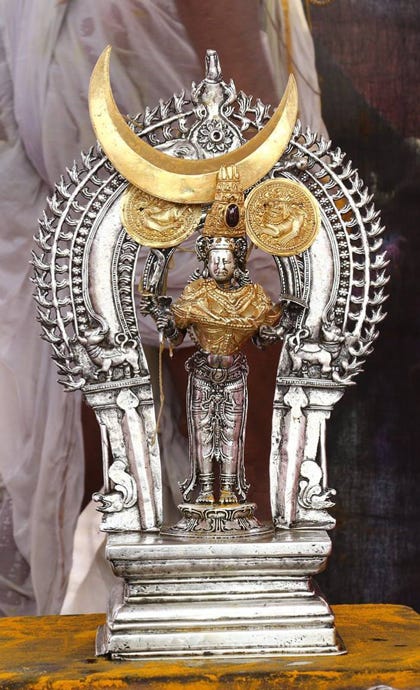
Madayikavu Bhagavathi, courtesy of Sree Madayi Thiruvarkadu Bhagavathi Temple
Across the Seas: The Possible Egyptian Origins of Madayikavu Bhagavathi
Madayikavu Bhagavathi is the tutelary deity of the Chirakkal Kovilakam, the erstwhile royal house of North Malabar.¹ The goddess is worshipped as a woman crowned with a tall headdress adorned by a prominent crescent moon. The temple itself comprises two principal shrines — one dedicated to Lord Siva, facing east, and the other to the goddess, facing west.
According to family lore, the Chirakkal lineage traces its origins to migration from across the seas into Kerala. While later brahmin-centric traditions situate this homeland in present-day Gujarat, such narratives often overlook India’s extensive ancient maritime networks and long-standing connections with regions beyond the subcontinent.

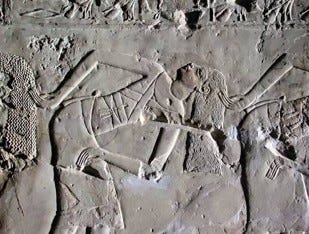
Wall relief of Isis in east upstairs, temple of Edfu, Egypt, By Edfu40.JPG: Rémihderivative work: JMCC1 (talk) — Edfu40.JPG, CC BY-SA 3.0, https://commons.wikimedia.org/w/index.php?curid=16144491. Note the crescent shaped cow horns encircling the solar disk crowning her head.
Madayikavu Bhagavathi is also known as Tiruvarkadu Achchi.² The term Achchi is the Malayalam correspondent of the Egyptian goddess Isis, who was widely venerated throughout ancient Egypt.³ In particular, at Edfu, Isis was worshipped as Hathor, consort of the falcon sky-god Horus.⁴ Through this syncretism, Isis came to be depicted with a tall crown featuring crescent-shaped horns encircling a solar disk. By the Ptolemaic period (ca. 300–30 BCE), this horned crown was increasingly stylized as a crescent moon.⁵

Temple of Edfu, By Patrick.reb — Own work, CC BY-SA 3.0, https://commons.wikimedia.org/w/index.php?curid=21788968
Around 237 BCE, a grand temple dedicated to Horus was constructed at Edfu, replacing an earlier New Kingdom structure (ca. 1550–1069 BCE), which itself likely stood upon an even older sanctuary dating back to the Third Dynasty of the Old Kingdom (ca. 2686–2613 BCE).⁶ Notably, while the later temple is aligned along a north–south axis, the earlier structure followed an east–west orientation.⁷

Inside the sanctuary at the Temple of Edfu, By timsdad, CC BY-SA 3.0, https://commons.wikimedia.org/w/index.php?curid=7252679
In antiquity, Edfu served as a regional capital in Upper Egypt and was a key trade center.⁸ Trade routes linking Edfu through the Eastern Desert to the Red Sea coast suggest its importance in maritime commerce. Among its ancient names was ḫꜥ.t-wr.t.⁹ The Malayalam correspondent of this ancient Egyptian word is varkad, preserved in the epithet Tiruvarkkad. Thus, Tiruvarkkad Achchi can be read, in this comparative framework, as “the revered Isis of Edfu.”

Front entrance of Madayikkavu Temple, By Ilango adikal chera, CC BY-SA 3.0, https://commons.wikimedia.org/w/index.php?curid=41500921
Taken together, these linguistic, iconographic, and historical parallels suggest the possibility that the Chirakkal family’s migration into Kerala may have originated in Egypt, bringing with them the sanctified cult image of their tutelary deity, Isis of Edfu. The present-day iconography of the goddess, particularly the crescent-adorned crown, indicates that her worship in Kerala may reflect influences from the Greco-Roman reinterpretations of Isis between approximately 300 BCE and 300 CE, a period overlapping with the Sangam Age in South India, during the heyday of Kerala’s maritime fame.
Notes
[1] https://en.wikipedia.org/wiki/Madayi_Kavu
[2] Sree Madayi Thiruvarkadu Bhagavathi Temple
[3] 𓄿𓊨𓏏𓁐 https://thesaurus-linguae-aegyptiae.de/lemma/271. Note that the pronunciation likely dates the name to a timeframe after the vulture hieroglyph, 𓄿, changed sounds from /r/ to /a/ (ca. 1600 BCE). The earlier version of the goddess’ name corresponds to the old Malayalam name അർച്ച archa.
[4] https://en.wikipedia.org/wiki/Isis
[5] https://en.wikipedia.org/wiki/Isis#CITEREFDelia1998
[6] https://isac.uchicago.edu/research/projects/tell-edfu/temple-horus
[7] https://en.wikipedia.org/wiki/Temple_of_Edfu
[8] https://arce.org/project/tell-edfu-project-tep/
[9] https://thesaurus-linguae-aegyptiae.de/lemma/858722. The name is derived from a composite of two words: 𓅨𓂋 wr “great” and 𓈍𓂝𓏏𓈅 ḫꜥ.t “primeval hill,” the latter word being the root of Malayalam കൊടുമുടി kodumudi “peak.”
메타데이터
- post_id
- dca19baa2cb3
- slug
- across-the-seas-the-possible-egyptian-origins-of-madayikavu-bhagavathi-dca19baa2cb3
- url
- https://medium.com/@variyam-2021/across-the-seas-the-possible-egyptian-origins-of-madayikavu-bhagavathi-dca19baa2cb3
- canonical_url
- https://medium.com/@variyam-2021/across-the-seas-the-possible-egyptian-origins-of-madayikavu-bhagavathi-dca19baa2cb3
- author_url
- https://medium.com/@variyam-2021
- status
- ok
- fetched_at
- 2026-06-09 15:37:30