Humanity on Trial
Film: The Voice of Hind Rajab (Arabic with English subtitles)
Humanity on Trial
Film: The Voice of Hind Rajab (Arabic with English subtitles)
Cast: Saja Kilani, Motaz Malhees
Directed by: Kaouther Ben Hania
Duration: 1 hr 29 mins
Rating:
Few films are as devastating as Kaouther Ben Hania’s Oscar-nominated and highly acclaimed The Voice of Hind Rajab — and that is partly because few stories are as tragic and gut-wrenching as this one. The film was held up by India’s censor board before finally releasing here, despite containing no onscreen violence — zero, zilch.
The film is based on facts and set entirely within one office, yet reconstructing what happened on that fateful day in January 2024 must have been harrowing in itself. The undisputed facts: a family was travelling in a car in Gaza when it was fired upon by the Israeli Defence Forces. Five-year-old Hind Rajab was left trapped inside, surrounded by the bodies of her uncle, aunt, and young cousins. She tried to hold on and call for help — but it was later discovered that soldiers had fired 355 bullets into the car, with a family and children inside. Let me put that in words: three hundred and fifty-five bullets. What kind of monstrosity is that? Humanity took several steps backward that day, and continues to do so in that region. And that is not all — an ambulance with paramedics was dispatched to rescue her. They too were ambushed and killed.
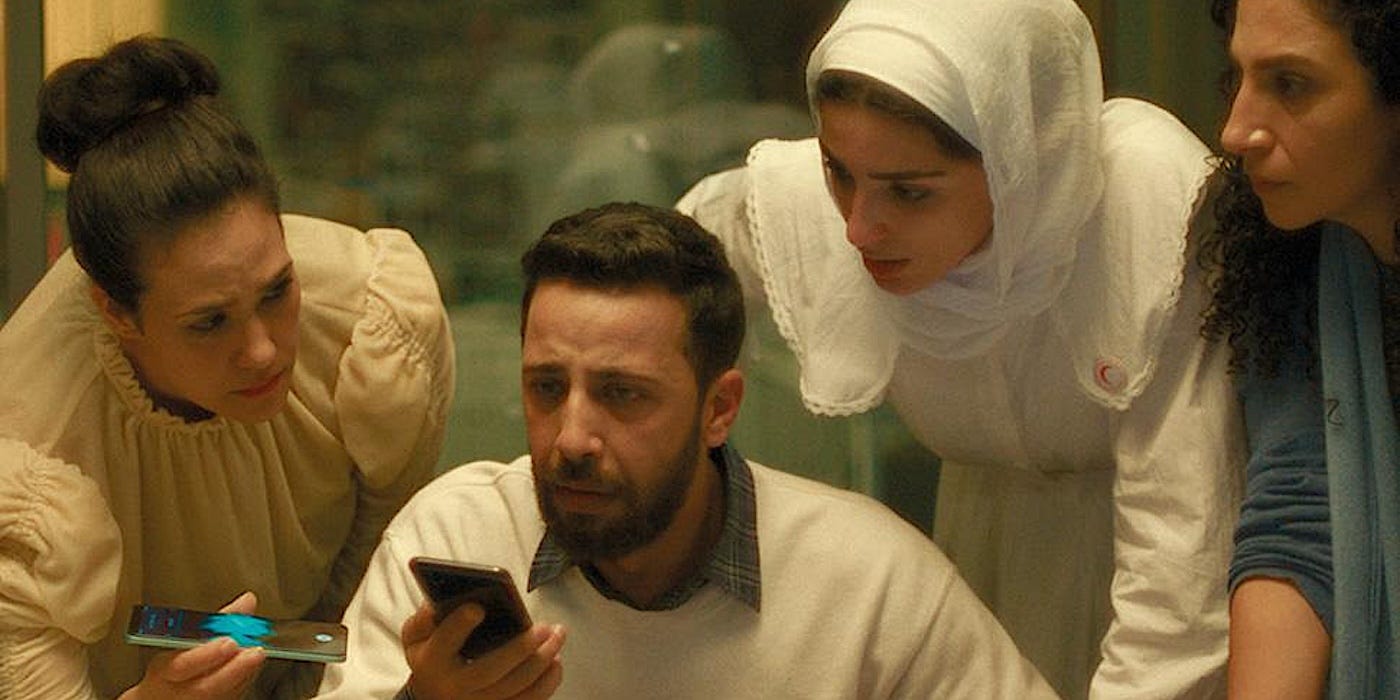
The film uses real recordings from that day. We hear Hind Rajab’s voice — “Please come and take me,” she pleads — along with those of the Palestine Red Crescent Society volunteers who spoke to her. A call comes in from Germany seeking assistance, which eventually leads to contact with Hind herself: a little girl who says she is trapped, that her cousins are bleeding but “sleeping,” and begs for help. The entire film unfolds from within the Society’s office. Omar (Motaz Malhees) and Rana (Saja Kilani) take turns speaking with her, cycling through every shade of emotion — anger, desperation, helplessness. An ambulance is just eight minutes away, but it cannot leave without clearance; without permission, it too risks being shot. When it finally sets out, it cannot get through — buildings have been bombed, the roads buried under rubble. None of this is shown on screen; it exists only in conversation.
The chief coordinator Mahdi (Amer Hlehel) is sympathetic, yet he knows that deviating from protocol could cost more lives. That protocol requires obtaining permission from the Israeli Ministry of Defence through the Red Cross and other channels. “How can you coordinate with the army that killed them?” Omar asks.
Hind Rajab’s voice, meanwhile, is frightened but eerily calm. It is getting dark. She is alone. “Please come, I am so scared,” she says, again and again — while her mother calls desperately from home on another line.
You know how this ends. Yet Ben Hania makes you seethe with anger and frustration at the way it unfolds. One might ask whether a story like this risks being exploitative — the filmmaking is emphatically not. Some stories, however uncomfortable, demand to be told. Credit is due to Brad Pitt, Joaquin Phoenix, Rooney Mara, Jonathan Glazer, and Alfonso Cuarón, who came on board as executive producers.
They say all is fair in love and war — no, all is not fair. Period. And to paraphrase Bob Dylan: how many deaths will it take till we know that too many people have died?
(The review was published in The Navhind Times on 27th June 2026)
메타데이터
- post_id
- dcd4913fe0bd
- slug
- humanity-on-trial-dcd4913fe0bd
- url
- https://medium.com/@sachinchatte/humanity-on-trial-dcd4913fe0bd
- canonical_url
- https://medium.com/@sachinchatte/humanity-on-trial-dcd4913fe0bd
- author_url
- https://medium.com/@sachinchatte
- status
- ok
- fetched_at
- 2026-07-24 11:33:09