AWS EC2, Auto Scaling, and Cloud Automation Explained
A detailed exploration of EC2 instance management, AMIs, elasticity, Auto Scaling, and Elastic Load Balancing. Learn how to design highly…
AWS EC2, Auto Scaling, and Cloud Automation Explained
A detailed exploration of EC2 instance management, AMIs, elasticity, Auto Scaling, and Elastic Load Balancing. Learn how to design highly available, scalable, and fault-tolerant cloud infrastructures with AWS services.
⭐ Understanding Provisioning and Compute Scalability in AWS
Provisioning in AWS is the process of creating and managing cloud resources such as EC2 instances, storage volumes, networking components, and application environments. Each action — launching, modifying, or terminating resources — is executed through AWS API calls.
Three primary interaction models exist for provisioning in AWS, each offering a different level of control and automation depending on the requirement:
🟩 1. AWS Management Console — Visual and Beginner–Friendly
The console is a web-based graphical interface for accessing AWS services using point-and-click workflows. It is intuitive, visually descriptive, and suitable for tasks such as service exploration, manual resource creation, system monitoring, billing review, and day-to-day administrative actions. While simple to use, it is not ideal for production-grade automation and introduces manual variability.
🟦 2. AWS Command Line Interface (CLI) — Scriptable, Fast, Repeatable
The CLI communicates directly with AWS APIs through terminal commands. It facilitates rapid provisioning, bulk resource actions, and repeatable automation. CLI usage inside local terminals or AWS CloudShell accelerates operational workflows and reduces manual configuration errors. Ideal for engineers handling recurring provisioning requirements or large-scale deployments.
Example command:
aws ec2 run-instances --image-id ami-12345 --instance-type t2.micro🟨 3. AWS SDK — Infrastructure Provisioned Programmatically
The SDK integrates AWS resource provisioning into application code. Languages like Python, Java, Go, and JavaScript can trigger automated provisioning as part of the application’s workflow. This approach enables infrastructure that scales dynamically and programmatically, supporting cloud-native automation, microservices, and backend orchestration.
Example (Python — Boto3):
import boto3
ec2 = boto3.resource('ec2')
ec2.create_instances(ImageId='ami-12345', InstanceType='t2.micro')
🔐 EC2 — Unmanaged Compute and Shared Responsibility
Amazon EC2 falls under the category of unmanaged compute. AWS supplies the infrastructure layer including physical servers, networking, virtualization, hypervisors and hardware security. The instance operating system, software stack, configurations, patching, monitoring, data protection, and access governance must be handled by the customer.
EC2 offers freedom and customization similar to owning a server, but that flexibility requires ongoing responsibility. Unlike fully managed services such as Lambda, Aurora, or S3, EC2 demands operational care once provisioned.
🔶 Amazon Machine Images (AMIs)
An AMI is a launch blueprint for EC2 instances. It includes system software, configuration state, boot settings, and metadata required to run an instance. Instances launched from the same AMI inherit identical configuration, improving consistency and deployment efficiency.
AMIs include:
• Operating system and pre-installed software • Block device and volume mapping • Virtualization and architecture settings • Launch permissions defining who can deploy it
Types of AMIs
🟩 AWS-Provided (Public) AMIs
Official base images supplied and maintained by AWS. Minimal software is installed, making them suitable for fresh environment creation, labs, and custom stack building.
🟦 Custom AMIs
Created manually by configuring an EC2 instance and converting it into an AMI. Ideal for scaling production clusters, multi-region deployment, and rapid provisioning of identical environments.
🟨 Marketplace or Vendor AMIs
Distributed by third-party providers with software and security configurations included, such as firewalls, CMS platforms, or analytics systems. Useful for quick application rollout when vendor optimisation is preferred.
Regional Consideration: AMIs are region-specific. If a customer plans to deploy EC2 instances across multiple AWS regions, the AMI must be copied to each target region before launching instances. This ensures consistency of configurations and software across all regions.
🔁 Why AMIs Improve Repeatability
• Every new instance behaves the same way as the source blueprint • Large-scale deployment becomes faster with fewer configuration steps • Eliminates drift caused by manual installation • Suitable for staging, development, production, or disaster recovery environments
AMIs transform configuration into a reusable asset, enabling predictable and scalable infrastructure.
📈 Scaling on EC2 — Supporting Growth Over Time
Vertical Scaling (Scale-Up)
Capacity is increased by upgrading the instance type to higher CPU, memory or bandwidth classes. Example : t2.micro → t2.small → t2.medium → m5.large
Horizontal Scaling (Scale-Out)
Additional EC2 instances are launched and load distributed between them. Works best when paired with load balancing for traffic distribution across compute nodes.
🔄 EC2 Elasticity — Expand and Contract Automatically
Elasticity enables infrastructure to adjust according to real-time demand. When traffic increases, additional instances launch. When demand falls, excess instances terminate. This ensures resource efficiency and cost management without over-provisioning.
Elasticity is achieved through:
• Auto Scaling Groups • CloudWatch metrics and alarms • Scaling policies based on load
⚙ Amazon EC2 Auto Scaling
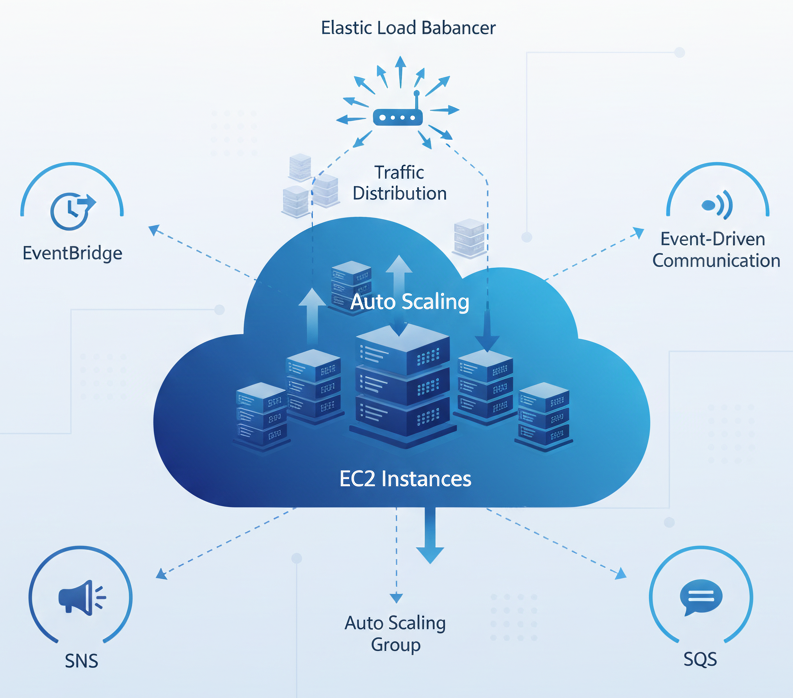
EC2 Auto Scaling maintains application capacity automatically. It responds to demand fluctuations by adding or removing instances based on monitored utilization. Auto Scaling groups define the limits within which scaling occurs.
Regional Deployment: Auto Scaling groups are also region-specific. To maintain consistent scaling behavior across multiple regions, customers must configure separate Auto Scaling groups in each region, ensuring that instances scale based on local demand and CloudWatch metrics.
Auto Scaling Parameters
Minimum capacity : Ensures a guaranteed instance count is always running.
Desired capacity : Represents ideal operational instance count for current load.
Maximum capacity : Defines the upper limit to prevent uncontrolled scale-out.
Scaling is cost-efficient because billing applies only to active instances.
🌐 Elastic Load Balancing (ELB)
ELB distributes incoming traffic across multiple compute resources. It improves application responsiveness, prevents overload, and enables smooth scaling as Auto Scaling adds or removes instances. ELB acts as the single entry point for traffic, routing requests only to healthy backend nodes.
Advantages of ELB
• Balanced request distribution under varying loads • Automatic scaling with incoming traffic patterns • Decoupled architecture reducing direct service dependency
Routing Strategies
• Round Robin — sequential distribution between nodes • Least Connections — prioritises servers with fewer active sessions • IP Hash — routes based on source IP for consistent session handling • Least Response Time — selects nodes responding fastest
🔁 Architecture Patterns — Tightly vs Loosely Coupled Systems
Tightly coupled systems interdepend on internal components. Failure in one part can cascade, reducing system stability and maintenance flexibility.
Loosely coupled designs separate components so they operate independently. Failure in one does not impact others, enabling incremental upgrades, fault isolation, and scalable growth. This model aligns strongly with resilient cloud application architecture.
📩 Event-Driven and Asynchronous Messaging in AWS
Modern applications benefit from asynchronous integration. Components communicate without requiring simultaneous availability. AWS supports this through EventBridge, Amazon SNS and Amazon SQS.
Amazon EventBridge
Routes events between microservices. Handles surge traffic and queues events if a destination service is temporarily unavailable, promoting failure isolation and operational continuity.
Amazon SQS
A durable message queue decoupling producers from consumers. Messages persist until processed, enabling throttling control, workload buffering and high-throughput application pipelines.
Amazon SNS
A publish–subscribe system distributing messages from one publisher to thousands of subscribers. Supports email alerts, SMS delivery, application triggers and fan-out automation. FIFO topics maintain strict order when required.
메타데이터
- post_id
- dcd607b8ae5c
- slug
- aws-ec2-auto-scaling-and-cloud-automation-explained-dcd607b8ae5c
- url
- https://medium.com/@dhivLakksh/aws-ec2-auto-scaling-and-cloud-automation-explained-dcd607b8ae5c
- canonical_url
- https://medium.com/@dhivLakksh/aws-ec2-auto-scaling-and-cloud-automation-explained-dcd607b8ae5c
- author_url
- https://medium.com/@dhivLakksh
- status
- ok
- fetched_at
- 2026-08-04 16:45:44