The Unbearable Weightlessness of Trust: A Descent into the Global Protocol State
The enduring structure of human civilization — a grand, complex tapestry of nation-states, markets, and social contracts — is underpinned…
The Unbearable Weightlessness of Trust: A Descent into the Global Protocol State
The enduring structure of human civilization — a grand, complex tapestry of nation-states, markets, and social contracts — is underpinned by a single, increasingly anachronistic foundation: institutional trust. This reliance on opaque, centralized human intermediaries to manage the core functions of society, from confirming identity to validating ownership, is a historical compromise. It is a system perpetually flirting with inefficiency, corruption, and the inherent frailty of human authority.
The contemporary world stands poised for an architectural revolution, pivoting from the historical dependence on bureaucratic friction to the cold, elegant certainty of mathematics. The envisioned Decentralized Civilizational Architecture is a philosophical coup, asserting that the most reliable guarantor of law, truth, and liberty in the future will be the incorruptible, transparent algorithm.
I. The Alchemic Transition: From Institutional Faith to Algorithmic Inevitability
The most significant intellectual hurdle in grasping this future is the required shift from institutional trust to algorithmic trust. The emergence of cryptographic consensus shatters the millennia-old arrangement where immense power was granted to centralized ledger-keepers. Why tolerate the bias and opacity of a human committee when a blockchain can provide immutable rule enforcement and transparent governance?
The law, traditionally a text open to endless semantic interpretation, begins its evolution into executable code — Smart Contracts. A contract becomes a self-enforcing mechanism, its terms guaranteed not by moral obligation or expensive legal review, but by technological necessity. The system cannot be bribed, intimidated, or conveniently lose a file. It operates with the unfeeling, deterministic precision of a protocol.
This transformation yields a crucial, counter-intuitive nugget: True social transparency is achieved not when institutions promise to show their workings, but when the mechanism prevents them from having any secrets to begin with. Corruption is minimized not through better surveillance, but through the elimination of the human gatekeeper who serves as the singular point of failure.
II. The Dissolution of Digital Hegemony: Humanity’s Co-owned Cognition
As the architecture of trust decentralizes, so too must the architecture of knowledge and infrastructure. The prevailing digital realm is one of towering, proprietary silos, where the Intelligence Layer (AI models, foundational algorithms) is owned by a handful of corporate entities. The essential tools and knowledge of modern civilization remain private property.
Decentralization posits the radical idea that intelligence and infrastructure belong to everyone. This is the End of Ownership in the digital sphere, where:
- AI models become open and protocol-owned commons.
- Algorithms transform into non-rivalrous public goods, auditable and accessible by all.
- Compute and Storage move to the edge, distributed across a planet-wide, permissionless mesh of devices.
This shift is enabled by Hardware Commoditization, which places powerful computation capabilities directly onto individual edge devices. This results in default privacy (data never leaves the device) and near-zero latency, but its true political significance lies in the decentralization of power.
The resulting brain puzzle is this: The world is made safer from tyranny not when the tools of power are destroyed, but when they become so cheap and universally distributed that no single entity can hoard them. If every citizen’s device is an autonomous, intelligent node in a network, the monopoly on actionable intelligence dissolves. Humanity co-owns its cognition.
III. The Global Prototypes: DPIs and the Architectural Scaffolding
The truly fascinating aspect of this vision is its real-world proto-existence in global Digital Public Infrastructure (DPI) initiatives, which establish the principle of rule-based, automated governance. These systems, while currently centralized, provide the essential proof-of-concept for the future Protocol State.
Digital Identity (ID) Systems:
- India’s Aadhaar: The world’s largest biometric ID system, demonstrating a population-scale digital identity layer (a core component of the Trust Layer).
- The European Digital Identity Wallet (EUDI Wallet): An initiative aimed at creating a self-sovereign, interoperable digital identity across the EU, emphasizing citizen control over data sharing (the self-sovereign identity model).
Digital Payments and Exchange Systems:
- India’s UPI (Unified Payments Interface): A massively successful real-time payment rail, showing how open protocols can disintermediate traditional financial institutions (a functional proto-DPI layer).
- Brazil’s PIX: An instant payment platform that is fast, universal, and free for consumers, highlighting the rapid, national adoption of open-protocol finance.
- Estonia’s X-Road: A foundational data exchange layer that ensures interoperability between all government databases, acting as a secure, distributed spine for e-governance (a foundational Compute and Data Layer).
Enterprise Architecture Models:
- India Enterprise Architecture (IndEA) and InDEA 2.0: A federated architectural framework designed to integrate various government IT systems across silos using open standards, promoting reusability and a ‘Whole-of-Government’ approach.
- Singapore’s Digital Utilities: A set of common, reusable digital components (like Singpass for secure login) that developers — both public and private — build upon, mirroring the concept of shared public digital rails (a precursor to Open Digital Ecosystems — ODE).
- European Cloud Federation and GAIA-X: Initiatives focused on creating a secure, sovereign European data infrastructure using a federated, open-standards approach, countering the centralized control of current hyperscale cloud providers.
These examples — from the Digital Public Goods (DPG) fostered by the DPGA (an alliance founded by countries like Norway and Sierra Leone) to the layered designs of global Enterprise Architectures — demonstrate the fundamental principles of rule-based automation, interoperability, and citizen-centric data control.
IV. The Protocol State: From Bureaucracy to Autonomous Execution
The next evolution involves replacing the partial centralization of these DPI models with full, cryptographic decentralization via Blockchain and DAOs. The nation-state evolves into the Protocol State — a political organism governed by transparent, self-executing code.
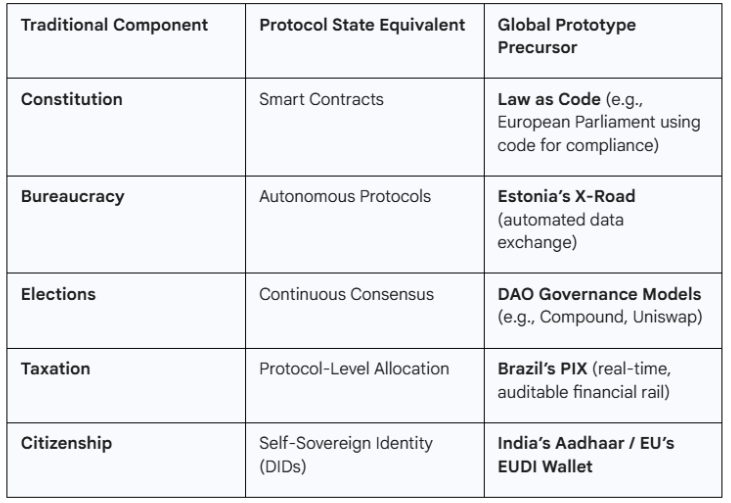
The government becomes math-governed, its operations borderless, and its execution incorruptible because the rules are enforced by the network itself, not by fallible administrators. The core counter-intuitive nugget holds: the highest form of political liberty — the guarantee of immutable rights — is achieved through absolute computational constraint, encoded in a Digital Constitution.
V. Dual Reality: The Metaverse and its Physical Twin
This new governance structure co-exists across a Dual Reality — the Physical Layer and the Digital Layer (Web3 Metaverse).
- Physical Layer: Robots perform labor, local fabrication handles production, and physical logistics run on decentralized protocols (Protocol Cities).
- Digital Layer: Identity is persistent and self-sovereign; assets are cryptographically owned; economies are tokenized and programmable.
The critical linkage is the Synchronized State: a digital twin of a city or a person holds legal rights, property, and reputation that mirror the physical reality. The boundary dissolves, creating a single, integrated realm where a reputation earned in a governance DAO in the digital space directly translates into real-world civic influence.
The final architecture resolves into the four-layer stack: Trust, Intelligence, Compute, and Experience. This stack demands the convergence of global efforts: the functional transparency of DPIs, the decentralization of Web3, and the computational power of the Edge.
The world is transitioning from nation-states built on centralized power to interoperable protocol polities built on mathematics and transparency. The ultimate irony of this decentralized civilization is that the path to a completely open, borderless, and anti-authoritarian system is paved by the highly structured, non-negotiable logic of code. It is an end to human friction, replacing it with the predictable, if unfeeling, inevitability of the algorithm.
메타데이터
- post_id
- dce1bca9a5de
- slug
- the-unbearable-weightlessness-of-trust-a-descent-into-the-global-protocol-state-dce1bca9a5de
- url
- https://medium.com/@Landbox/the-unbearable-weightlessness-of-trust-a-descent-into-the-global-protocol-state-dce1bca9a5de
- canonical_url
- https://medium.com/@Landbox/the-unbearable-weightlessness-of-trust-a-descent-into-the-global-protocol-state-dce1bca9a5de
- author_url
- https://medium.com/@Landbox
- status
- ok
- fetched_at
- 2026-06-22 05:41:33